9 Best Miter Saws for Trim Work (November 2026)
The best miter saws for trim work include the DEWALT 20V MAX 7-1/4-Inch Miter Saw for portable trim work, the DEWALT 12-Inch Miter Saw for tall base molding, and the SKIL 10" Dual Bevel Sliding Compound Miter for repeat compound angles.
On this page (6 sections)
The best miter saw for trim work for most buyers is the DEWALT 20V MAX 7-1/4-Inch Miter Saw, thanks to its adjustment-free cut line indication, compact 30 lb design and stated capacity for common base and crown molding.
Choose the DEWALT 12-Inch when taller trim matters, or the SKIL when dual-bevel cuts and wider stock are higher priorities.
Trim work rewards repeatable angles more than raw motor speed.
A clean joint depends on the corner measurement, the miter setting, the bevel setting when needed, stable support and a blade that suits the material.
Small gaps often come from a corner that is not truly square rather than from a weak motor.
That is why a clear cut line guide and positive stops can matter more on molding than top speed on wide lumber.
If the terms are unclear, start with What Is the Difference Between a Bevel Cut and a Miter Cut?.
A miter changes the angle across the face of the trim.
A bevel changes the angle through its thickness.
Knowing that split helps you read product specs without mixing up the two adjustments.
It also helps you decide whether a single-bevel saw will force awkward repositioning on your project.
For most rooms, the saw only has to repeat a handful of angles cleanly.
The real test is whether it can hold the molding flat, show the cut line clearly and return to the same setting piece after piece.
Portability matters too, because trim is often cut close to the wall where it will be installed.
A lighter saw that can move from room to room may suit that workflow better than a heavy bench model.
Our picks at a glance
-
1

-
2

-
3
 Best for repeat compound angles
SKIL 10" Dual Bevel Sliding Compound Miter
9.5/10 our score
See it on Amazon
- 4
 Check it
Metabo HPT 10-Inch Compound Miter Saw
Best for lightweight angle setup - 5
 Check it
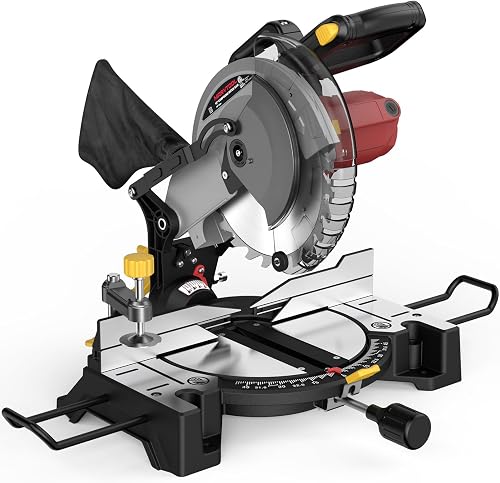
MarvTool 10-inch Compound Miter Saw
Best for compact multi-material work - 6
 Check it
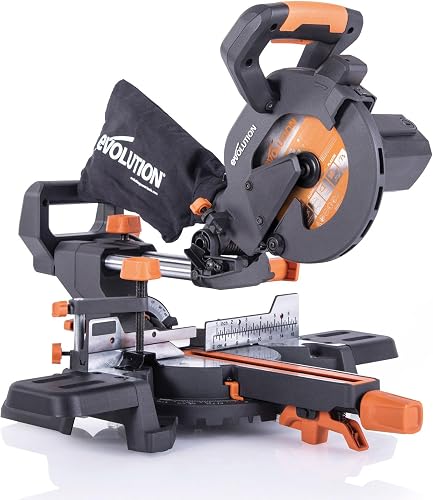
Evolution Power Tools R185SMS+ Sliding Miter Saw
Best for mixed-material projects - 7
 Check it
DOVAMAN 10-Inch Sliding Miter Saw
Best for wide trim stock - 8
 Check it
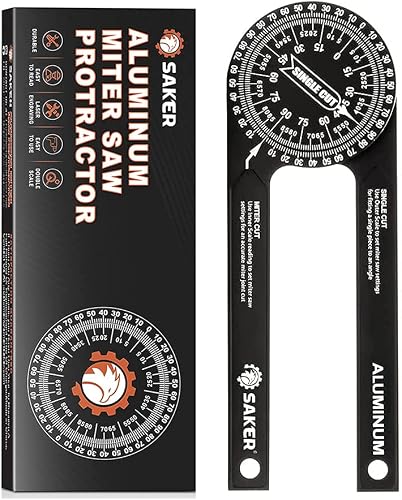
Saker Miter Saw Protractor 7-Inch Aluminum Protractor
Best for measuring corner angles - 9
 Check it
Stanley 1-20-600 Saw Storage Miter Box
Best for simple hand-cut trim
The best miter saws for trim work
The DEWALT 20V MAX is the strongest portable choice, while the DEWALT 12-Inch and SKIL cover larger or more complex trim layouts. The remaining picks trade capacity, weight, material range or measuring support.
Our score weighs specs, features and buyer feedback against what you're shopping for. We checked the stated capacities, angle controls, cut-line aids, portability and included accessories, then ranked the products from highest score to lowest.
| Product | Best for | Blade | Power | Trim capacity | Our score |
|---|---|---|---|---|---|
| DEWALT 20V MAX 7-1/4-Inch Miter Saw | portable trim work | 7-1/4 in | 20V MAX battery powered | 3 5/8 in crown, 3 1/2 in base vertically | 9.7 |
| DEWALT 12-Inch Miter Saw | tall base molding | 12 in | 15 A corded electric | 9.6 | |
| SKIL 10" Dual Bevel Sliding Compound Miter | repeat compound angles | 10 in | 15 A corded electric | 9.5 | |
| Metabo HPT 10-Inch Compound Miter Saw | lightweight angle setup | 10 in | 15 A corded electric | 9.3 | |
| MarvTool 10-inch Compound Miter Saw | compact multi-material work | 10 in, 36 teeth | 120V corded electric | 9.0 | |
| Evolution Power Tools R185SMS+ Sliding Miter Saw | mixed-material projects | 7-1/4 in | 10 A corded electric | 8.9 | |
| DOVAMAN 10-Inch Sliding Miter Saw | wide trim stock | 10 in | 15 A corded electric | 8.8 | |
| Saker Miter Saw Protractor 7-Inch Aluminum Protractor | measuring corner angles | 8.5 | |||
| Stanley 1-20-600 Saw Storage Miter Box | simple hand-cut trim | 8.0 |
DEWALT 20V MAX 7-1/4-Inch Miter Saw: Best for portable trim work
- Integrated cut line cross-cut positioning system
- 3 5/8 in nested crown capacity
- 3 1/2 in vertical base capacity
- 30 lb compact design
The compact cordless design and cut line system suit trim work that moves between rooms or job sites. Its stated crown and base capacities cover many smaller molding jobs.
Pros
- Adjustment-free cut line indication
- Compact 30 lb design
- 11 positive miter stops
Cons
- Tool only
- Smaller blade than the 10- and 12-inch picks
The DEWALT 20V MAX 7-1/4-Inch Miter Saw fits trim work that moves around the house or between job sites. Its 30 lb compact design is easier to carry than the larger corded saws, and its battery-powered format avoids a cord at the cutting station.
The integrated cut line cross-cut positioning system gives you an adjustment-free indication of the cut line. That is useful when a small error can leave a visible gap at a molding joint.
The saw has 11 positive miter stops, a cam lock miter handle and an oversized bevel scale. It also supports 3 1/2 in base vertically and 3 5/8 in nested crown, according to the stated capacity.
This is the best miter saw for trim work when portability and repeatable setup matter more than maximum blade size. It is a tool-only cordless model, so check that your 20V MAX battery and charger setup matches your work plan.
DEWALT 12-Inch Miter Saw: Best for tall base molding
- 15-Amp corded motor
- 14 positive miter stops
- 5 1/2 in vertical base support
- Single bevel compound design
The 12-inch blade and tall sliding fence give this DEWALT a strong fit for larger base and crown molding. Its single-bevel layout may require more material repositioning than a dual-bevel saw.
Pros
- Tall 5 1/2 in base support
- 14 positive stops
- Includes clamp, dust bag and carbide blade
Cons
- Single bevel
- Larger 42.8 lb design
The DEWALT 12-Inch Miter Saw suits larger base molding and buyers who want a tall sliding fence.
It supports 5 1/2 in base molding vertically and 5 1/2 in crown molding vertically nested.
Its 15-Amp corded motor and 12-inch blade give it a larger cutting format than the compact DEWALT.
The stainless-steel detent plate has 14 positive stops, which helps when you repeat common angles across several pieces.
The single-bevel design ranges from 0-48° left and 0-3° right.
For trim that needs a bevel in the opposite direction, you may need to turn or reposition the workpiece.
That extra handling takes time, and it can introduce small shifts if the piece is not seated the same way twice.
Choose this model when molding height is the deciding factor.
Its 42.8 lb weight and corded power make it better suited to a fixed workshop station than frequent room-to-room carrying.
On a bench, the cord is less of a concern and the larger format becomes the main benefit.
Measure your tallest molding first, then check whether the fence height truly covers it without awkward shims or flipping.
SKIL 10" Dual Bevel Sliding Compound Miter: Best for repeat compound angles
- 15-Amp motor
- 4,800 RPM
- Dual bevel
- LED shadow line
- 2x12 cross-cut capacity at 90°
The dual-bevel layout helps when trim requires bevels on both sides, while the LED shadow line shows the cut position. Sliding capacity also helps with wider boards.
Pros
- Dual-bevel operation
- LED shadow line
- 2x12 capacity at 90°
Cons
- 39.4 lb footprint
- Corded operation
The SKIL 10" Dual Bevel Sliding Compound Miter is a strong fit for trim layouts that call for bevel cuts on either side.
Its dual-bevel stops cover 48° and 45° left, 0° and 45° right.
The LED shadow line shows the cut position and is designed for high-precision cuts.
The saw also cuts up to 2x12 lumber at 90° and 2x8 lumber at 45°, giving it useful sliding capacity for wider boards.
Its 15-Amp motor runs at 4,800 RPM, and the miter range reaches 50° left and right with 11 positive stops.
A horizontal grip and center safety trigger suit left- or right-handed use.
Choose the SKIL when you want one saw to handle common miters, compound angles and wider trim stock.
At 39.4 lb, it is portable enough to move but still needs a stable, level work surface.
Dual bevel matters most when crown or chair rail work would otherwise require flipping the piece and rechecking the cut.
The sliding action also helps with wider stock, though long molding still needs support beyond the table.
Set the saw on a solid stand or bench, and let the slide pull straight back without twisting the workpiece.
Metabo HPT 10-Inch Compound Miter Saw: Best for lightweight angle setup
- 24 lb design
- 15-Amp motor
- 0–52° miter range left and right
- 0–45° bevel range left
- Large work table
This single-bevel saw is easy to move and offers a broad miter range for trim layouts. Its large table and vice clamping system help support and hold molding during a cut.
Pros
- 24 lb portable design
- 0–52° miter range
- 5-year tool body warranty
Cons
- Single bevel
- No sliding capacity stated
The Metabo HPT 10-Inch Compound Miter Saw is the lightest powered saw in this group at 24.2 lb.
Its 0-52° miter range left and right gives you room for unusual corner angles, while the single bevel reaches 0-45° left.
The large work table supports molding as you line up a cut, and the vice clamping system helps hold the workpiece.
Its 15-Amp motor reaches up to 5,000 RPM.
This saw suits a home workshop or installer who needs a portable corded tool with broad miter adjustment.
Since it is a single-bevel model and no sliding capacity is stated here, measure your molding before choosing it for wide pieces.
The wide miter range is handy for corners that do not fall on common detents.
That said, you will still need to confirm each unusual angle and lock it before cutting finished trim.
The 5-year tool body warranty is part of the supplied product information.
Treat warranty coverage as a separate buying factor from cut accuracy, and read the current terms before ordering.
For daily care, keep the table clear of offcuts and check that the clamp holds thin molding without bending it.
A test cut on scrap remains worthwhile, especially when you first dial in a nonstandard angle.
MarvTool 10-inch Compound Miter Saw: Best for compact multi-material work
- 15-Amp motor
- 5,000 RPM
- Extension tables
- Transparent blade guard
- Vise clamp and dust collection bag
The lightweight 20.5 lb body and extension tables fit smaller work areas. Its stated surface range includes wood, plastic and soft metal, though trim buyers should focus on the supplied blade and angle needs.
Pros
- 20.5 lb design
- Extension tables
- Dust collection bag
Cons
- No sliding capacity stated
- 45° angle range
The MarvTool 10-inch Compound Miter Saw focuses on a lightweight 20.5 lb body, extension tables and a 15-Amp motor.
Its 0-45° miter and bevel ranges cover many standard trim layouts.
The transparent blade guard keeps the cutting area visible, while the vise clamp helps secure material.
A dust collection bag is included, which can help contain some debris around the cutting station.
The title states that this saw is intended for metal, plastic, wood and laminates, but trim buyers should still match the blade and cutting setup to the molding material.
Its 36-tooth blade is included with the equipment described.
Choose MarvTool when a compact corded saw with side support is more useful than sliding capacity.
The 45° angle range is simpler than the wider miter ranges on several other picks.
That simpler range is fine for standard 45° miters, but it leaves less room for odd corners.
Extension tables help with longer pieces, provided they are set level with the main table.
If they sit low, the molding can tip or shift as the blade enters the cut.
For trim, steady support and a secure clamp matter as much as the listed speed.
Evolution Power Tools R185SMS+ Sliding Miter Saw: Best for mixed-material projects
- 7-1/4 in multi-material compound sliding design
- 45° bevel
- 50° miter
- 210 mm slide
- Blade and dust bag included
This sliding saw is a choice for buyers who cut more than wood and want a 45° bevel with a 50° miter range. For fine trim, confirm that the included blade and material setup match your molding.
Pros
- Sliding design
- 50° miter range
- Blade and dust bag included
Cons
- 10 A motor
- Trim capacity details are limited
The Evolution Power Tools R185SMS+ Sliding Miter Saw is aimed at projects that combine wood, plastic and metal.
Its 7-1/4 in sliding compound format includes a 45° bevel, a 50° miter and a 210 mm slide.
For trim, the main attraction is the sliding layout and broad miter range.
For mixed-material work, the title also identifies multi-material cutting, so it may suit a workshop where molding is only one of several jobs.
A blade and dust bag are included.
The stated motor rating is 10 A, and the saw runs at 3,700 RPM.
Choose Evolution when material variety matters more than the largest trim capacity.
Before cutting visible molding, confirm that the included blade and the planned material match the finish you need.
Blade choice is the key detail here, because a blade suited to metal may not leave the same edge on painted trim.
Make a test cut on an offcut and inspect the face and back edge before committing.
The slide can help with wider pieces, but keep the pull smooth and square.
Rushing the slide is a common way to wander off the marked line.
DOVAMAN 10-Inch Sliding Miter Saw: Best for wide trim stock
- 13 in sliding rail
- Up to 4 x 13 in cutting range
- Dual-speed settings
- Laser guide
- Three TCT blades
The long slide and extendable tables make this DOVAMAN useful for wider boards. Its dual-speed settings and included blades also support material changes, but careful setup still matters for visible trim.
Pros
- 13 in sliding rail
- Three TCT blades
- Ambidextrous design
Cons
- 17 kg weight
- Laser alignment still needs a test cut
The DOVAMAN 10-Inch Sliding Miter Saw suits wider trim stock because its 13 in sliding rail and extendable side tables support a stated cutting range up to 4 x 13 in. The ambidextrous layout also works for left- or right-handed operators.
Its dual-speed settings are 5,000 RPM and 3,200 RPM, and the included equipment has three TCT blades. A laser guide helps indicate the cut line, but you should still make a test cut on scrap before committing to finished molding.
The saw supports wood, plastic and soft metal, with a 0–45° bevel cut stated in the product highlights. Its 17 kg weight makes it less convenient to carry than the Metabo HPT or MarvTool.
Choose DOVAMAN when sliding reach and included multi-material blades matter. Set up the side tables level with the main table so long trim does not sag or shift during the cut.
Saker Miter Saw Protractor 7-Inch Aluminum Protractor: Best for measuring corner angles
- Laser-engraved scales
- CNC-machined aluminum alloy
- Inside and outside corner reading
- 5.9 x 1.2 x 3.9 in size
This angle finder helps you measure a real corner before transferring the result to a miter saw. Its small aluminum body is easy to carry with trim tools.
Pros
- Direct angle reading
- Inside and outside corner use
- Lightweight 6.3 oz body
Cons
- Hand tool, not a saw
- One-piece design
The Saker Miter Saw Protractor 7-Inch Aluminum Protractor helps with the part of trim work that happens before the saw starts.
Its laser-engraved scales are designed for direct angle reading, including inside and outside corners.
The CNC-machined aluminum alloy body weighs 6.3 oz and measures 5.9 x 1.2 x 3.9 in.
That makes it small enough to carry with a tape measure, pencil and trim offcuts.
Use it when a room corner does not match a simple assumed 90° angle.
For more setup ideas, see these notes on the best miter saw jig for angles.
This is a measuring accessory, not a powered saw.
It earns a place in the roundup because accurate corner measurement can prevent wasted molding, even when your saw has a good detent plate.
Take the reading at the actual corner, mark it clearly, and check it against the saw scale before you cut.
If the corner is uneven along its height, a single reading may not tell the whole story.
In that case, test pieces and small adjustments may still be needed.
Even so, a direct reading is a better starting point than guessing.
Stanley 1-20-600 Saw Storage Miter Box: Best for simple hand-cut trim
- 90°, 45° and 22.5° slots
- 11.81 in length
- Saw storage system
- Aluminum construction
The Stanley box is a low-complexity option for small trim pieces where a powered saw is unnecessary. Its fixed slots limit angle choice compared with the powered miter saws.
Pros
- No powered saw setup
- Three fixed angle slots
- Stores the saw
Cons
- Fixed angle choices
- Not suited to wide molding
The Stanley 1-20-600 Saw Storage Miter Box is a simple option for small trim pieces and light hand-cut work.
Its fixed slots cover 90°, 45° and 22.5° cuts, and the aluminum box includes a saw storage system.
At 11.81 in long and 2.3 lb, it takes less room than a powered miter saw.
The fixed slots also make setup straightforward when your project uses one of the three available angles.
The trade-off is limited flexibility.
You cannot dial in a measured corner angle the way you can with a powered miter saw, and the box is not intended for wide molding.
Choose Stanley for small repairs, short trim pieces or a workspace where powered tools are not practical.
For larger baseboards, compare the capacity of the powered saws above first.
Hand cutting also rewards patience, because a slow, steady stroke usually tracks the slot better than force.
Keep the molding flat and firm against the box, and check the pencil line before each pass.
For a small repair, that simple setup can be enough.
For a full room, the lack of angle adjustment quickly becomes the limiting factor.
What should you look for in a miter saw for trim?
The best miter saw for trim work needs enough vertical and sliding capacity for your molding, plus angle controls that match the joints you plan to make.
A clear cut-line guide and stable material support can matter as much as motor speed.
Start with the molding dimensions.
The DEWALT 12-Inch supports 5 1/2 in base molding vertically, while the compact DEWALT supports 3 1/2 in base vertically and 3 5/8 in nested crown.
Those numbers tell you more than blade size alone, because tall molding must sit square against the fence.
Next, decide if you need sliding capacity.
A sliding rail lets the blade travel through wider stock, while a non-sliding saw can be smaller and easier to store.
The SKIL handles 2x12 lumber at 90°, and the DOVAMAN states a 13 in rail with up to 4 x 13 in cutting range.
Capacity is only useful if the piece stays stable through the whole cut.
Long trim needs support at the same height as the table, or it can sag as the blade exits.
Bevel choice also affects the workflow.
A single-bevel saw tilts in one direction, while a dual-bevel saw can tilt both ways.
Dual bevel saves flipping and repositioning, which helps keep the orientation consistent on matching pieces.
Read What Is a Compound Miter Saw? before choosing between a basic miter saw and a compound design.
Then match the saw to your molding height, corner angles and workspace, in that order.
How do you set up a miter saw for clean trim cuts?
A clean trim cut starts with a stable saw, accurate corner measurement and a test cut in scrap. Place the saw on a level support surface, keep the workpiece against the fence, and support long molding at the same height as the saw table.
Measure the actual corner instead of assuming every wall meets at 90°. The Saker protractor can help read inside and outside corners before you set the miter angle.
Mark the waste side clearly, then align the blade or shadow line with the cut mark. Keep your hands away from the blade path and use the supplied or compatible clamp when the molding needs extra restraint.
Make a test cut from a scrap of the same trim. Bring the two pieces together before cutting the finished pieces, because a small adjustment may be needed when the corner is not square.
If you are working on baseboards, follow this guide to cutting baseboards with a miter saw. It covers the order of measuring, marking and cutting so the finished joints are easier to plan.
Is a miter saw better than a table saw for trim?
A miter saw is usually better for crosscuts, miters and compound angles in trim, while a table saw is better for long rip cuts.
The right tool depends on whether you need to cut across the molding or change its width.
A miter saw keeps the blade and fence relationship fixed while you bring the trim to the cut.
That makes repeated crosscuts and angle cuts practical, especially when the saw has positive detents.
For trim, repetition is the point, because a room may need many matching pieces at the same angle.
A table saw can cut long boards lengthwise, but it is not a direct replacement for the angle controls and compact crosscut workflow of a miter saw.
See How Does a Miter Saw Differ from a Table Saw? for the task-by-task difference.
In practice, some shops use both tools on the same project.
The table saw handles ripping or sizing, and the miter saw handles the final crosscuts and joints.
That split can save time when molding needs both kinds of work.
For larger trim projects, also compare the best miter saw for baseboard cuts and the best miter saws for woodworking if your work extends beyond molding.
Match the tool to the cut you are making most often, rather than to the one task you rarely do.
More guides on this topic
This guide suits crown molding where a saw cut alone may not close every joint.
It is a useful next read after you have sorted miter capacity and bevel needs.
How do you choose between these trim saws?
Choose the DEWALT 20V MAX when you want the most portable option with a clear cut-line system and enough capacity for many common trim jobs. Choose the DEWALT 12-Inch when tall base or crown molding is the main concern.
Pick the SKIL for dual-bevel work and wider stock. The Metabo HPT is the lighter corded choice with a broad miter range, while MarvTool favors a compact body with extension tables and a dust bag.
DOVAMAN is the better fit when you want a long sliding rail, multiple blades and two speed settings. Evolution makes more sense when wood, plastic and metal are all part of the workshop.
For angle measurement, add the Saker. For a basic hand-cut solution, choose the Stanley box when fixed 90°, 45° or 22.5° slots cover the job.
The best miter saw for trim work is the one that matches your molding height, corner angles and available workspace. Pick DEWALT 20V MAX for portable accuracy, DEWALT 12-Inch for tall molding, SKIL for dual bevels, or Metabo HPT for a lighter corded setup.
Our top 3 picks at a glance
-
1
-
2
-
3
Best for repeat compound angles
SKIL 10" Dual Bevel Sliding Compound Miter
9.5/10 our score
See it on Amazon
Frequently asked questions
What is the best miter saw for trim work?
The DEWALT 20V MAX 7-1/4-Inch Miter Saw is the best miter saw for trim work for most buyers because it combines a cut line positioning system, 11 positive miter stops, a 30 lb body and stated capacity for 3 1/2 in base and 3 5/8 in nested crown. Choose a larger saw when your molding needs more capacity.
Is a 10-inch or 12-inch miter saw better for trim?
A 10-inch miter saw is easier to move and can handle many trim tasks, while a 12-inch saw offers more blade reach for taller molding. The DEWALT 12-Inch Miter Saw supports 5 1/2 in base molding vertically, while the SKIL 10-inch model offers sliding 2x12 cross-cut capacity at 90°.
Do you need a dual-bevel miter saw for trim?
You don't need a dual-bevel miter saw for every trim job. It can reduce the need to flip or reposition molding when bevels are required on both sides.
The SKIL 10-inch model has dual-bevel stops at 48° and 45° left, 0° and 45° right, while single-bevel saws can still make many common trim cuts.


