Miter Saw vs Radial Arm Saw: Which Should You Choose? (November 2026)
Choose a miter saw for repeatable angled cuts and a compact setup; choose a radial arm saw when its broader cutting tasks justify the extra space and setup. A miter saw is a type of radial saw, but the names usually refer to different workshop tools.
On this page (8 sections)
Choose a miter saw for repeatable angled cuts and a compact setup; choose a radial arm saw when its broader cutting tasks justify the extra space and setup. A miter saw is a type of radial saw, but the phrase “radial saw” often means a radial arm saw.
The key difference is how you guide the blade. A miter saw pivots down through the work, while a radial arm saw travels along an overhead arm.
That affects crosscut capacity, how much room you need and which cuts feel convenient. Your typical stock and workshop layout should decide the choice.

Is a miter saw a radial saw?
Yes, a miter saw is a radial saw in the broad sense because its blade moves on a pivoting arm. In common workshop usage, “radial saw” usually refers to a radial arm saw.
A miter saw’s head drops through material that rests against a fence. Many models let you set a miter angle, and compound models also tilt the blade for bevel cuts.
A radial arm saw has an arm above its table, and the blade moves along that arm. This layout can support different operations, depending on the machine and its attachments.
So the names overlap, but they aren't interchangeable when you're comparing machines. If someone recommends a “radial saw,” ask whether they mean a miter saw or a radial arm saw.
How do their crosscut capacities compare?
Compare the published crosscut capacity of each exact model, because neither saw type has one standard cutting width. A sliding miter saw generally reaches farther across a board than a non-sliding one.
A radial arm saw's capacity depends on its arm travel and setup. Don't assume it can cut any width just because the blade moves along an arm.
The DEWALT 12-inch miter saw is specified for a 2 x 8 in crosscut at 90° and a 2 x 6 in crosscut at 45°. Those figures describe that model, not every 12-inch miter saw.
A sliding design can add width by moving the head across the stock. Read how a sliding miter saw changes cutting capacity before deciding whether that extra travel solves your usual cuts.
For wide panels, neither stationary saw may be the easiest option. A circular saw with a straightedge can be more practical when the panel is too wide or awkward to bring to the saw.
Which saw suits repeated angle cuts?
A miter saw is usually the simpler pick for frequent, repeatable miter and bevel cuts. Its fence and angle settings make it easy to return to common trim angles.
The DEWALT 12-inch model has 14 positive miter stops and bevels left up to 48°. Its stated crosscut capacity makes it a fit for common dimensional lumber cuts, subject to the size limits above.
The DEWALT cordless sliding model has 11 positive stops, a cut line positioning system and a 30 lb weight. It may suit trim work where carrying the saw and setting repeated angles matter.
Radial arm saws can perform crosscuts and, depending on the model, other operations. Their flexibility can help in a shop that uses those features often, but it also means more setup and adjustment to learn.
For a closer look at miter saw layouts, see miter saw types. If you're deciding between two common styles for crosscuts, compare a miter saw vs chop saw.
How much workshop space do they need?
A miter saw takes less machine space, while either saw needs clear room for the stock and safe movement. Plan around the complete work area, not just the tool's footprint.
A miter saw sits on a bench or stand, with the board extending to either side. Long trim may need roller stands or other support, and the saw needs clear space for the head to pivot.
A radial arm saw needs room for its arm and for stock to move across the table. Its larger working zone can be worthwhile if you use its range of operations, but it may be hard to fit into a small shop.
Mark the proposed saw and stock paths on the floor with tape. Include room to stand, adjust the saw, move long boards and keep nearby doors or walkways clear.
A compact cordless miter saw may be easier to store between jobs. For example, the DEWALT 20V MAX sliding miter saw weighs 30 lb and is described as compact and lightweight.
What setup and adjustments should you expect?
A miter saw has a more straightforward setup for its main job: secure it, set the angle, support the stock and cut. A radial arm saw usually asks more of you before it is ready for accurate work.
Both saws need a stable mounting surface and a fence or table that supports the work. Follow the manual for securing the saw, blade changes and adjustments.
A radial arm saw's alignment and blade travel affect whether cuts track square and true. The exact setup varies, so use the manufacturer's instructions and check the saw's alignment before relying on it for precise work.
Miter saws also need regular checks. Confirm the fence and angle settings, and make a test cut on scrap when accuracy matters.
The miter saw buying guide covers capacity, features and setup details to weigh before choosing a model. If you're considering a cordless option, best DeWalt miter saws can help you compare that brand's formats.
Which saw is better for trim and framing?
A miter saw is a convenient choice for trim; choose based on the stock size and cut angles you repeat. For framing or long stock, support and portability may matter more than the saw's label.
A 12-inch miter saw can handle the stated crosscuts of the DEWALT DWS715, while a smaller sliding model may offer enough width for trim without the bulk of a larger saw. Measure your common workpieces before settling on either.
For long boards, add support at both sides of the cut so the material stays level. A miter saw does not feed or support a long board by itself.
A radial arm saw can make sense when your shop already has the room and you know you'll use its range of operations. If you mainly need accurate crosscuts and miters, its extra setup may not earn its floor space.
When is a circular saw a better fit?
A circular saw is often the better choice for portable cuts or large sheet goods that are awkward to move onto a stationary saw. It trades the miter saw's fixed fence and stops for a hand-guided cut.
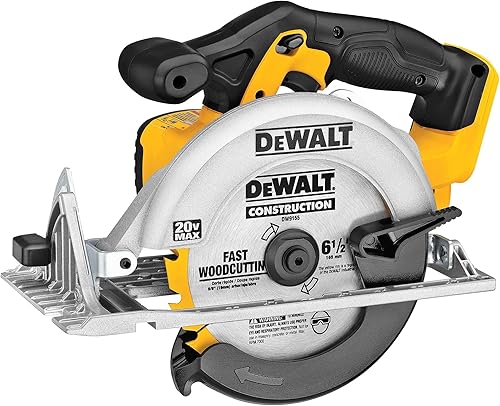
The DEWALT 20V MAX Circular Saw is cordless and has a 0–50° bevel capacity. Its battery and charger are sold separately.
The SKIL 15 Amp Circular Saw has a single beam laser guide, a dust blower and a 51° bevel capacity. A marked line and straightedge can help guide a long cut, but check the cut path and support the sheet before starting.
For trim involving metal, check that the saw and blade are suited to the material. Our guide to the best miter saw for metal covers the specific tool choice.
If your projects call for only occasional miter cuts, a hand saw and box can take up less room than either powered saw. See best hand saw with miter box for that option, or compare miter saws with laser guides if you want help seeing the cut line.
Which saw should you choose?
Pick a miter saw for repeatable crosscuts and angles in a compact workshop; pick a radial arm saw when you have room and need its broader range of operations. For large panels or work away from the bench, consider a circular saw.
Before you buy, measure your widest and thickest regular stock, then check the exact model's crosscut capacity. Choose the simplest saw that handles those tasks and fits the space you can give it.
If the miter saw fits your work, decide between sliding travel, blade size and portability based on your cuts. If you're still comparing a miter saw vs radial saw, begin with the model's capacity and the room it needs to operate.
Frequently asked questions
Is a miter saw a radial saw?
Yes. A miter saw is a radial saw because its blade moves down through the work on a pivoting arm.
In everyday shop talk, “radial saw” often means a radial arm saw, a different machine with a blade that travels along an arm.
Which saw takes up less space?
A miter saw usually takes less space as a machine, especially a compact model, but it still needs room for long stock and supports. A radial arm saw needs room for its arm, table and stock movement, so measure the whole working area before choosing.
Can a miter saw cut as wide as a radial arm saw?
It depends on the exact saw and blade travel. A sliding miter saw can crosscut wider stock than a basic non-sliding model, while radial arm saw capacity also varies by model.
Check the published crosscut width and material thickness for the saw you plan to use.
Which saw is better for trim?
A miter saw is usually the simpler choice for trim because its fence and angle settings support repeatable crosscuts and miters. A sliding model can add crosscut width.
Choose by the trim size, cut angles and available support space.
Can a circular saw replace either saw?
A circular saw can make crosscuts and bevel cuts, but it is hand guided, so repeat cuts need a careful layout or guide. It can be easier to carry to large sheet goods or a jobsite.
For frequent precise angle cuts, a miter saw is usually more direct.


