9 Best Dual Bevel Miter Saws (November 2026)
The best dual bevel miter saws include the DEWALT 12-inch Double Bevel Miter Saw for frequent two-way bevel cuts, the DEWALT 12-Inch Miter Saw for a 12-inch single-bevel option, and the SKIL 10" Dual Bevel Sliding Compound Miter for common bevel stops.
On this page (8 sections)
- How we compared dual bevel miter saws
- Compare these dual bevel miter saws
- The best dual bevel miter saws for different cuts
- How do you choose between a 10-inch and 12-inch dual bevel saw?
- When does sliding action help on a dual bevel miter saw?
- Is a dual bevel saw worth it for trim work?
- What should you plan for when setting up a miter saw?
- Which dual bevel miter saw should you choose?
The best dual bevel miter saw for many woodworking setups is the DEWALT 12-inch Double Bevel Miter Saw, with beveling left and right, a sliding design and an XPS shadow line. SKIL is a strong 10-inch option with a stated 2x12 crosscut capacity at 90 degrees, while DOVAMAN pairs a 12-inch blade with a dual-bevel slide.
A dual bevel saw tilts in both directions, which can reduce the need to flip trim or reset the bevel when making matching cuts. The right choice also depends on blade size, sliding capacity, shop space and whether you cut wood alone or other materials.
For a broader view of the saw style, compare our guide to the best sliding miter saw. To understand how beveling fits with compound cuts, see what a compound miter saw does and the difference between a bevel cut and a miter cut.
Our picks at a glance
-
1
 Best for frequent two-way bevel cuts
DEWALT 12-inch Double Bevel Miter Saw
9.7/10 our score
See it on Amazon -
2

-
3
 Best for common bevel stops
SKIL 10" Dual Bevel Sliding Compound Miter
9.5/10 our score
See it on Amazon
- 4
 Check it
Makita LS1019L 10" Dual-Bevel Sliding Compound Miter
Best for compact sliding layout - 5
 Check it
Metabo HPT 10-Inch Compound Miter Saw
Best for a light single-bevel saw - 6
 Check it
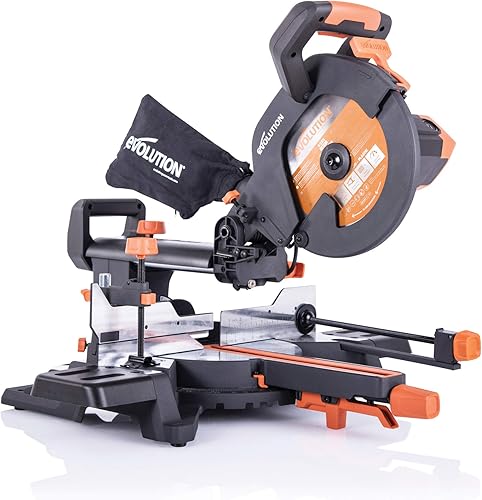
Evolution Power Tools R255SMS+ PLUS 10-Inch Sliding
Best for mixed-material cutting - 7
 Check it
DOVAMAN 12-Inch Dual-Bevel Sliding Compound Miter Saw
Best for a 12-inch dual-bevel slide - 8
 Check it
MarvTool 10-inch Compound Miter Saw
Best for low weight and extensions - 9
 Check it
Evolution Power Tools R255SMS-DB+ 10-Inch Dual Bevel
Best for dual bevel and mixed materials
How we compared dual bevel miter saws
The best dual bevel miter saws make it easier to repeat left and right bevel cuts while matching the saw to your material and workspace. We compared the listed blade sizes, bevel ranges, sliding designs, cut capacities and setup features.
Our score weighs specs and features against what you're shopping for. We gave more weight to models that clearly combine dual bevel action with useful capacity or alignment features, and included single-bevel options lower in the order as comparison points for buyers considering a simpler saw.
Dual bevel is the key distinction in this roundup. The DEWALT DWS715 and Metabo HPT C10FCG2 bevel only to one side, while the Evolution R255SMS+ has a listed 0 to 45 degree bevel range without dual bevel wording.
They are here to help clarify the tradeoff, not as substitutes for a saw that tilts both ways.
Compare these dual bevel miter saws
Blade size, bevel direction and sliding action are the quickest ways to narrow down dual bevel miter saws. Check the stated cut capacity for your material and angle before choosing a model.
| Product | Best for | Blade | Bevel | Alignment | Our score |
|---|---|---|---|---|---|
| DEWALT 12-inch Double Bevel Miter Saw | frequent two-way bevel cuts | 12 in | 0 to 49 degrees left and right | XPS LED shadow line | 9.7 |
| DEWALT 12-Inch Miter Saw | a 12-inch single-bevel option | 12 in | Single bevel | 9.6 | |
| SKIL 10" Dual Bevel Sliding Compound Miter | common bevel stops | 10 in | 9.5 | ||
| Makita LS1019L 10" Dual-Bevel Sliding Compound Miter | compact sliding layout | 10 in | 9.4 | ||
| Metabo HPT 10-Inch Compound Miter Saw | a light single-bevel saw | 10 in | 0 to 45 degrees left | 9.3 | |
| Evolution Power Tools R255SMS+ PLUS 10-Inch Sliding | mixed-material cutting | 10 in | 0 to 45 degrees | 9.1 | |
| DOVAMAN 12-Inch Dual-Bevel Sliding Compound Miter Saw | a 12-inch dual-bevel slide | 12 in | 0 to 45 degrees | 9.1 | |
| MarvTool 10-inch Compound Miter Saw | low weight and extensions | 10 in | 0 to 45 degrees | 9.0 | |
| Evolution Power Tools R255SMS-DB+ 10-Inch Dual Bevel | dual bevel and mixed materials | 10 in | 45 degrees left and right | 8.3 |
The best dual bevel miter saws for different cuts
The DEWALT DWS780 is the leading pick for frequent two-way bevel work, while the other models suit different blade sizes, materials and shop setups. Each saw below is described by the features relevant to its intended use.
DEWALT 12-inch Double Bevel Miter Saw: Best for frequent two-way bevel cuts
- 12-inch sliding compound saw
- Bevels 0 to 49 degrees left and right
- XPS LED shadow line
- Dust collection captures over 75% of generated dust
A 12-inch sliding saw with a dual bevel range and projected shadow line. It suits buyers who want to set bevels in either direction without turning the workpiece.
Pros
- Bevels left and right
- XPS shadow line
- Dust collection captures over 75% of generated dust
Cons
- Larger 12-inch format may take more bench space
- Its broad feature set may be more than occasional trim work needs
The DEWALT DWS780 combines a 12-inch blade with a sliding compound design and bevel range from 0 to 49 degrees in both directions. That broad range can help when you need repeated left and right bevel cuts without turning each board around.
Its XPS LED system casts a shadow at the blade position, giving you a visual cut line on the work surface. DEWALT says the dust collection system captures over 75% of the dust generated, a useful feature when the saw runs in a shared workshop.
The saw also has positive bevel stops at 0, 22.5, 33.9, 45 and 49 degrees in both directions. Those stops cover several common trim angles, and the high visibility scale helps you see the setting.
Choose it for regular trim, frame or woodworking jobs that use both bevel directions. Its 12-inch sliding format is substantial, so account for the full footprint and room needed for stock support.
DEWALT 12-Inch Miter Saw: Best for a 12-inch single-bevel option
- 12-inch blade
- Single bevel
- 14 positive miter stops
- Tall sliding fence
This 12-inch saw is a single-bevel model, so it does not meet the dual bevel requirement. It can still suit buyers comparing larger blade capacity who are comfortable flipping stock for opposite bevels.
Pros
- 12-inch blade
- 14 positive miter stops
- Fence supports tall molding vertically
Cons
- Single bevel requires resetting or turning stock for the opposite angle
- Not a true dual bevel saw
The DEWALT DWS715 is a single-bevel saw, so it belongs in this roundup as a comparison point rather than a dual bevel recommendation. Its 12-inch blade and 14 positive miter stops may suit buyers who want a larger blade and can turn stock or reset the bevel for opposite cuts.
A tall sliding fence supports base molding up to 5-1/2 inches vertically, according to the product details. The saw also includes a carbide tipped blade, wrench, dust bag and vertical clamp.
The stated bevel range is 0 to 48 degrees left and 0 to 3 degrees right. That limited rightward adjustment does not make it a two-way bevel saw, so think about how often you cut opposite bevels before choosing it.
Choose it if your work mostly uses one bevel direction and the 12-inch blade appeals to you. If you need repeated matching bevels, compare the best 12-inch dual bevel sliding compound miter saw options.
SKIL 10" Dual Bevel Sliding Compound Miter: Best for common bevel stops
- 10-inch sliding saw
- 15 amp motor, 4,800 RPM
- Dual bevel stops at 48 and 45 degrees left, 0, and 45 degrees right
- 2x12 crosscut capacity at 90 degrees
SKIL pairs a 10-inch sliding format with four dual bevel stop positions and an LED shadow line. The stated 2x12 crosscut capacity at 90 degrees is useful for wider stock.
Pros
- Dual bevel stops on both sides
- LED shadow line
- 2x12 crosscut capacity at 90 degrees
Cons
- 10-inch blade may not suit every large-stock task
- Check the fence and support setup for your workpieces
The SKIL MS6305-00 is a 10-inch dual bevel sliding saw with four positive bevel stop positions: 48 and 45 degrees left, 0, and 45 degrees right. Its 15 amp motor is rated at 4,800 RPM, and the LED shadow line shows where the blade meets the work.
SKIL states a crosscut capacity of up to 2x12 lumber at 90 degrees and 2x8 at 45 degrees. Those figures help separate capacity by angle, since a board that fits at a square cut may be too wide at an angled setting.
The saw can miter up to 50 degrees left and right, with 11 positive stops at common angles. Extension rods, a dust bag, hex key and clamp are included.
Choose it for a 10-inch sliding format with clear bevel stops and a stated wide crosscut capacity. If you prefer a 12-inch blade, compare the best 12-inch sliding miter saw choices and verify their bevel direction.
Makita LS1019L 10" Dual-Bevel Sliding Compound Miter: Best for compact sliding layout
- 10-inch dual-bevel sliding saw
- Single slide-glide operation
- 6-5/8-inch nested crown capacity
- Laser
Makita's single slide-glide rail design is intended to reduce the saw's footprint and allow operation flush against a wall. Its stated nested crown capacity is 6-5/8 inches.
Pros
- Dual bevel
- Single slide-glide operation
- Large stated nested crown capacity for a 10-inch saw
Cons
- Confirm the actual bench footprint and clearance before setup
- A 10-inch blade may not fit every cutting need
The Makita LS1019L pairs a 10-inch blade with dual beveling and a single slide-glide rail operation. Makita says this design reduces the saw's footprint and allows it to sit flush against a wall, which may matter where bench depth is limited.
The saw has a stated nested crown molding capacity of 6-5/8 inches, a figure often useful for trim work. A laser is included, and the linear ball bearing system is designed for accurate cuts.
Makita gives the saw a 57.9 lb weight in its feature details. That makes the compact rail layout different from a light portable saw: plan for a stable base and enough room to handle longer stock.
Choose it when wall clearance and crown molding capacity matter in a dual bevel 10-inch saw. See our best 10-inch dual bevel miter saw comparison for more options in this blade size.
Metabo HPT 10-Inch Compound Miter Saw: Best for a light single-bevel saw
- 10-inch single-bevel saw
- 24 lb stated weight
- 15 amp motor up to 5,000 RPM
- Miter range 0 to 52 degrees left and right
This portable 10-inch saw is a single-bevel model, not a dual bevel saw. Its low stated weight and two-way miter range may appeal to buyers who prioritize portability over beveling both ways.
Pros
- Light stated weight
- Miter range extends 52 degrees left and right
- 5-year tool body warranty
Cons
- Single bevel only
- No sliding action is specified in the product details
The Metabo HPT C10FCG2 is a single-bevel saw, despite its place among these comparisons. It tilts from 0 to 45 degrees left, so buyers who need opposite bevels should consider a true dual bevel model instead.
Portability is its clearest distinction: the stated weight is 24 lb. It also has a 10-inch blade, a 15 amp motor rated up to 5,000 RPM, and a miter range of 0 to 52 degrees left and right.
The large table and vice clamping system support workpiece setup. Metabo HPT provides a 5-year tool body warranty, according to its stated warranty details.
Choose it if a light saw and broad miter range matter more than dual bevel action. For frequent left and right bevel cuts, a dual bevel saw can reduce repositioning.
Evolution Power Tools R255SMS+ PLUS 10-Inch Sliding: Best for mixed-material cutting
- 10-inch sliding saw
- Cuts wood, embedded-nail wood, composite decking, mild steel and plastic
- 0 to 45 degree bevel
- Dual quick release clamps
Evolution describes this as a multi-material saw for wood, embedded-nail wood, composite decking, mild steel and plastic. Its bevel range is single-sided, so it does not provide dual bevel operation.
Pros
- Listed for multiple material types
- Sliding design
- Includes dual quick release clamps
Cons
- Not a dual bevel saw
- Verify blade and material guidance for each job
The Evolution R255SMS+ PLUS is a 10-inch sliding saw built around multi-material cutting, not dual bevel operation. Evolution lists wood, wood with embedded nails, composite decking, mild steel and plastic among the materials it can cut with one blade.
Its bevel range is 0 to 45 degrees, and its miter range is 50 degrees left and right. The PLUS version includes dual quick release clamps, taller fences, a dust bag, slide rail protector and a 3 m cable.
Evolution says cuts in mild steel produce virtually no sparks and leave the material cool to the touch. Follow the maker's blade and material guidance for the work in front of you.
Choose it for mixed-material jobs where its listed cutting range fits your materials. If beveling both ways is the deciding factor, compare the dual-bevel Evolution R255SMS-DB+ instead.
DOVAMAN 12-Inch Dual-Bevel Sliding Compound Miter Saw: Best for a 12-inch dual-bevel slide
- 12-inch dual-bevel sliding saw
- 15 amp motor up to 3,800 RPM
- Laser guide
- Maximum stated capacity of 4.2 x 13 in
DOVAMAN combines a 12-inch blade, sliding rail and dual bevel function. Its nine common angle presets and laser guide provide clear setup features for home woodworking.
Pros
- 12-inch dual-bevel sliding design
- Laser guide
- Stated 4.2 x 13 in maximum capacity
Cons
- DOVAMAN advises checking and adjusting angles after shipment
- Confirm the capacity that applies to your cut angle
The DOVAMAN DMS03G has a 12-inch blade, sliding rail system and dual bevel operation from 0 to 45 degrees. Its stated maximum cutting capacity is 4.2 x 13 inches, although capacity can vary with the cut angle.
A laser guide supports alignment, and the base has nine common angle presets, including 0, 15, 22.5, 30 and 45 degrees on both sides. The 15 amp motor is rated up to 3,800 RPM.
DOVAMAN advises checking the miter cutting angle and making adjustments if needed after shipment. That makes a setup check sensible before you rely on preset angles for repeat cuts.
Choose it for a 12-inch dual bevel slide with a stated wide capacity and laser guide. Measure your stock and confirm the relevant capacity at the bevel and miter angles you use.
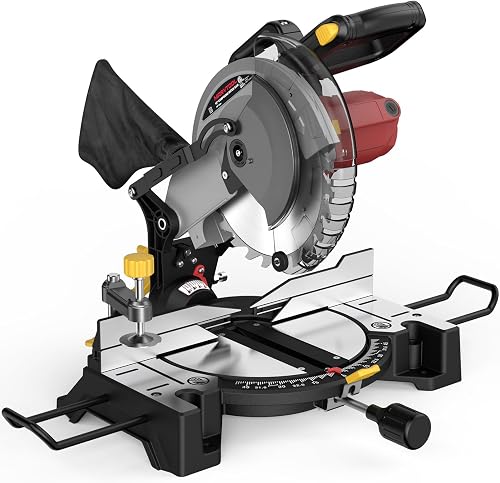
MarvTool 10-inch Compound Miter Saw: Best for low weight and extensions
- 10-inch single-bevel saw
- 20.5 lb stated weight
- Two extension tables
- 15 amp motor up to 5,000 RPM
MarvTool describes a lightweight single-bevel saw with extension tables. It is an alternative for buyers who value portability, but it does not bevel both ways.
Pros
- 20.5 lb stated weight
- Two extension tables included
- 15 amp motor
Cons
- Single bevel only
- No sliding action specified
The MarvTool 10-inch saw is a single-bevel model, not a dual bevel saw. Its stated weight is 20.5 lb, and the package includes two extension tables, which can be useful when moving the saw between work areas.
The 15 amp motor is rated up to 5,000 RPM. The saw's bevel range is 0 to 45 degrees, and its miter range is described as 0 to 45 degrees left.
The product details also describe cutting wood, plastic and soft metal. Verify blade suitability for the material and use the vise clamp to secure stock during setup.
Choose it for a lightweight 10-inch saw with extension tables if single bevel meets your work. For regular compound bevel cuts in both directions, select one of the dual bevel models above.
Evolution Power Tools R255SMS-DB+ 10-Inch Dual Bevel: Best for dual bevel and mixed materials
- 10-inch dual-bevel sliding saw
- 45 degree bevel left and right
- Cuts wood, embedded-nail wood, composite decking, mild steel and plastic
- 50 degree miter range left and right
This Evolution model combines dual bevel action with multi-material cutting capability. It fits buyers who need to cut more than wood, while its stated bevel range reaches 45 degrees on each side.
Pros
- Dual bevel
- Listed for multiple material types
- 50 degree miter range left and right
Cons
- Check blade guidance for each material
- Confirm support needs for long stock
The Evolution R255SMS-DB+ is a 10-inch sliding saw with beveling to 45 degrees left and right. Its miter range reaches 50 degrees in both directions, making it a direct option for buyers who want two-way bevel cuts and a wide miter range.
Evolution lists wood, wood with embedded nails, composite decking, mild steel and plastic as suitable materials for its multi-material cutting design. The included blade is described as a multi-material blade.
This model has a clear dual bevel specification, but its score is lower here because its stated bevel range stops at 45 degrees and the product details offer fewer capacity figures than some alternatives. Confirm the stock size you need against the saw's manual before buying.
Choose it for dual bevel action paired with Evolution's multi-material approach. Read our best dual bevel sliding miter saw guide if sliding range is central to your decision.
How do you choose between a 10-inch and 12-inch dual bevel saw?
Choose blade size by your usual stock, cut capacity and available workspace, then verify the model's stated limits at your cutting angle. A larger blade alone doesn't tell you exactly how wide or tall a workpiece the saw can cut.
A 10-inch model can make sense for a smaller shop or for trim and woodworking tasks that fit its capacity. The Makita's nested crown figure and SKIL's 2x12 square crosscut figure show how much the details can vary among saws with the same blade size.
A 12-inch saw may suit wider work, but compare its footprint, weight and support needs too. If you expect the saw to travel or share a compact bench, the saw's weight and rail layout may matter as much as blade diameter.
When does sliding action help on a dual bevel miter saw?
Sliding action helps when you need a wider crosscut than a fixed-head design allows. The saw head travels along rails, so the cutting width depends on the model, stock height and angle.
Look for separate capacity figures at 90 and 45 degrees when available. SKIL, for example, states different crosscut sizes at those two angles, while DOVAMAN gives a maximum capacity that you should check against your intended cut.
Sliding rails also affect setup space. Measure the bench depth and the clearance behind or around the saw, then compare the saw's design with your work area.
Is a dual bevel saw worth it for trim work?
A dual bevel saw is useful for trim when you often make matching bevels in opposite directions. You can keep the face of the workpiece oriented consistently while tilting the blade either way.
This can help with repeated cuts for corners, frames and molding runs. If you make only occasional bevel cuts in one direction, a single-bevel model may be enough, provided you are comfortable turning stock or resetting the saw for the other side.
Support the piece at the same height as the saw table and verify the angle with a test cut on scrap. A repeatable setup can matter more than extra angle range for everyday trim.
What should you plan for when setting up a miter saw?
Plan for a stable base, clear movement around the saw and support for long boards. A saw that fits on a bench may still need extra room for its sliding head and for stock extending to either side.
The saw's weight also affects portability. The Metabo HPT and MarvTool models have lower stated weights than the 12-inch DEWALT and Makita, but weight is only one part of setup; consider the stand, clamp use and material support.
If you need a dedicated base, compare the best miter saw stand for 10-inch and 12-inch saws. Match the stand's support and mounting system to your saw and the length of your stock.
Which dual bevel miter saw should you choose?
Choose the DEWALT DWS780 if you want a 12-inch sliding saw with a broad left and right bevel range and an XPS shadow line. Choose the SKIL for a 10-inch saw with stated crosscut capacities, or the Makita when its single slide-glide layout and crown capacity suit your shop.
For a 12-inch dual bevel slide with a laser, consider DOVAMAN and check its angle setup before repeat work. For mixed-material cuts, compare the Evolution dual bevel model with the materials and blade guidance for your jobs.
A single-bevel saw can save money or weight when opposite bevel cuts are rare, but frequent trim work is simpler with a true dual bevel design. Match the blade size, cut capacity, footprint and bevel range to the stock you actually use.
Our top 3 picks at a glance
-
1
Best for frequent two-way bevel cuts
DEWALT 12-inch Double Bevel Miter Saw
9.7/10 our score
See it on Amazon -
2
-
3
Best for common bevel stops
SKIL 10" Dual Bevel Sliding Compound Miter
9.5/10 our score
See it on Amazon
Frequently asked questions
What does dual bevel mean on a miter saw?
A dual bevel miter saw tilts its blade to the left and right, so you can make opposite bevel cuts without turning the workpiece over. The miter function rotates the saw head across the table for angled crosscuts.
This can save setup steps on repeated trim or frame cuts.
Is a sliding saw better than a non-sliding dual bevel saw?
A sliding saw moves the blade head forward and back, which can increase crosscut width. A non-sliding saw has a simpler front-to-back setup, but its cut width depends on the saw's design.
Check the maker's stated capacity at the angle and material you plan to cut.
Do I need a 10-inch or 12-inch dual bevel miter saw?
Choose by the cuts you make most and the room available for the saw. A 10-inch model can be easier to fit into a smaller work area, while 12-inch models may offer greater capacity, depending on the design.
Compare stated cut capacities and check the stand's support and clearance.
Can a single-bevel saw make the same cuts as a dual-bevel saw?
A single-bevel saw can make bevel cuts in one direction. To cut an opposite bevel, you usually reset the angle or turn the workpiece, which can add steps and create more chances to misplace a mark.
A dual bevel saw tilts both left and right.
What should I check before buying a dual bevel miter saw?
Check blade size, bevel range, sliding action, cut capacity, fence height, dust collection and whether the saw has stops at your common angles. Make sure its size fits your bench or stand and that long stock will have support.
For repeated work, consider how easily you can set and confirm angles.


