9 Best Miter Saw Blades for Aluminum (November 2026)
The best miter saw blades for aluminum include the TOMAX 12-Inch 100 Tooth TCG Aluminum for 12-inch aluminum crosscuts, the Revvstark 10 Inch 80T Table Saw Blades for mixed wood and plastic work, and the DEWALT Miter Saw Blade for fine finish work.
On this page (5 sections)
The best miter saw blade for aluminum is the TOMAX 12-Inch 100 Tooth TCG Aluminum, because it combines a 100-tooth Triple Chip Grind design with a 1-inch arbor.
It is stated for aluminum, plastic and non-ferrous metals, so it suits regular crosscuts on a matching 12-inch saw.
For a 10-inch saw, the TOMAX 10-Inch 80 Tooth TCG Aluminum is the more direct fit.
Tooth geometry, diameter, arbor size, kerf and maximum speed all affect fit. A blade can fit the spindle and still be wrong if it was designed for wood alone.
Think about the stock you cut most often before you shop. Thin sheet, extrusion, bar and plate can each ask for a different balance of finish, speed and durability.
A correct fit, a steady feed and a clean plate also matter as much as the headline tooth count.
If you are comparing general-purpose miter blades, see our guide to the best miter saw blades.
For a 12-inch saw, our guide to the best 12 inch miter saw blade covers broader choices.
Check diameter first, arbor second, then tooth geometry and material range. Only after those basics should finish, speed and features decide between models.
Our picks at a glance
-
1
 Best for 12-inch aluminum crosscuts
TOMAX 12-Inch 100 Tooth TCG Aluminum
9.7/10 our score
See it on Amazon -
2
 Best for mixed wood and plastic work
Revvstark 10 Inch 80T Table Saw Blades
9.7/10 our score
See it on Amazon -
3
- 4
 Check it
Revvstark Circular Saw Blade 12 Inch 100T
Best for 12-inch mixed-material capacity - 5
 Check it
TOMAX 10-Inch 80 Tooth TCG Aluminum
Best for 10-inch dedicated TCG cutting - 6
 Check it
MASTEC 10-Inch 100T Carbide Tooth TCG
Best for clean 10-inch aluminum cuts - 7
 Check it
TOYAKI 10-Inch Miter Saw Blade
Best for ultra-fine aluminum finishes - 8
 Check it
Diablo Saw Blade for Thick Aluminum
Best for thick aluminum and portable saws - 9
 Check it
IVY Classic 35056 Swift Cut 10"
Best for light-gauge aluminum
The best miter saw blades for aluminum
The TOMAX 12-inch blade is the strongest overall match for a 12-inch saw, while the TOMAX 10-inch and MASTEC options fit common 5/8-inch arbor saws. The remaining picks cover fine finish work, mixed materials, thick aluminum and light-gauge stock.
TOMAX 12-Inch 100 Tooth TCG Aluminum: Best for 12-inch aluminum crosscuts
- 12-inch diameter
- 100 carbide teeth
- Triple Chip Grind
- 1-inch arbor
- For aluminum, plastic and non-ferrous metals
The 12-inch TOMAX combines a high tooth count with TCG geometry for aluminum, plastic and non-ferrous metals. Its 1-inch arbor makes it the clearest fit for saws that accept that arbor size.
Pros
- 100-tooth TCG design
- Construction-grade carbide teeth
- Electrophoretic coating
Cons
- Requires a 1-inch arbor
- 12-inch size is not for smaller saws
The TOMAX 12-Inch 100 Tooth TCG Aluminum is the clearest overall pick when your saw accepts a 1-inch arbor. Its 100 carbide teeth and Triple Chip Grind geometry are aimed at smooth, durable cuts in aluminum, plastic and non-ferrous metals.
The 12-inch diameter suits larger saws and gives more cutting capacity than the 10-inch options. Confirm the approved diameter and arbor before mounting it, since a 12-inch blade is not a universal replacement.
Construction-grade carbide teeth are built for resistance, while the electrophoretic coating helps reduce rusting and corrosion. TOMAX also gives this blade a limited lifetime warranty.
That mix suits regular crosscuts where the cut edge will be seen. It also suits wider aluminum pieces without constant blade swaps.
Check the saw manual, guard clearance and arbor before you plan the job. Measure the workpiece as well, because diameter alone does not promise the depth you need.
For care, store the blade flat and dry and inspect the teeth before use. Keep chips clear of the plate so buildup does not add heat.
Choose it when aluminum is regular work and your saw takes a 1-inch arbor. It is less useful if your saw is limited to 10-inch blades or a 5/8-inch arbor.
Revvstark 10 Inch 80T Table Saw Blades: Best for mixed wood and plastic work
- 10-inch diameter
- 80 carbide teeth
- 5/8-inch arbor
- 7000 RPM maximum
- For wood, plastic and composite materials
This 10-inch Revvstark is a strong choice for wood, plastic and composite work where a clean, fine cut matters. Its stated material range does not make it a dedicated aluminum blade.
Pros
- 80 carbide teeth
- 5/8-inch arbor
- Noise-reducing perforations
Cons
- Designed for wood, plastic and composites
- Not a dedicated aluminum blade
The Revvstark 10 Inch 80T Table Saw Blades earns a high place for buyers who cut wood, plastic and composite materials as well as occasional non-metal stock. It has 80 tungsten carbide teeth, a 5/8-inch arbor and a stated maximum speed of 7000 RPM.
Its thin laser-cut kerf is designed for fast, clean cuts, while noise-reducing perforations and thermal expansion grooves address noise and heat. Those features suit general saw work, but its stated application is not dedicated aluminum cutting.
The blade is compatible with miter saws, table saws and 10-inch circular saws from brands including DEWALT, Craftsman, Ryobi and Milwaukee. Confirm your exact saw requirements before installation.
For daily use, the 80-tooth layout gives a balance for mixed shop work. It can move from panels and boards to plastics without swapping blades for every material change.
The trade-off is focus. A general blade can cover many jobs, yet it may not give the same edge control as a dedicated TCG blade in aluminum.
Set up by matching the 5/8-inch arbor and keeping speed within the stated limit. Support the work well, since a mixed material blade still needs a steady feed to cut cleanly.
Choose this when wood and plastic are the main jobs. Pick a dedicated TCG aluminum blade instead when aluminum crosscuts are the main reason for the purchase.
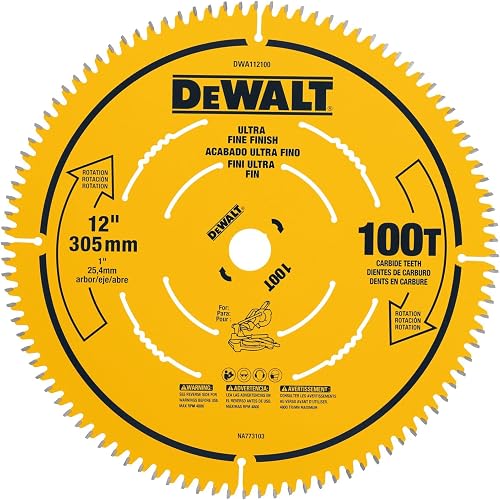
DEWALT Miter Saw Blade: Best for fine finish work
- 12-inch diameter
- 100 ultra-sharp carbide teeth
- Optimized tooth geometry
- Low-vibration body slots
- Precision tensioning
DEWALT's 12-inch blade is built around fine finish cutting, low vibration and accuracy. It lists metal among its compatible materials, but it is not presented as a dedicated aluminum TCG blade.
Pros
- 100-tooth fine-finish layout
- Ultra-sharp carbide
- Patented body slot design
Cons
- No arbor size stated here
- Fine-finish design may not suit every aluminum job
The DEWALT Miter Saw Blade is the fine-finish choice for buyers who want a 12-inch, 100-tooth blade with an accuracy-focused design. Its ultra-sharp carbide, optimized tooth geometry and precision tensioning are built around clean cutting and blade stiffness.
Patented body slots are designed to reduce vibration. That can help keep the cut steadier when the saw, workpiece and blade are correctly supported.
DEWALT lists metal and wood as compatible materials, so this blade may suit mixed workshop work. It is not described here as a dedicated aluminum TCG blade, and the arbor size is not stated in the available product details.
That distinction matters for aluminum buyers. A fine finish design can be useful, but it does not replace a blade that names aluminum and non-ferrous metals in its range.
If you use this blade, check the arbor and diameter against your saw before you order. Also check the speed limit in the product details and the saw manual, then plan for a controlled feed.
For care, keep the plate clean and listen for changes in sound or vibration. A blade that is stiff and steady will usually track better through the cut.
Choose it when fine finish work and the DEWALT design matter more than a dedicated aluminum label. For repeated aluminum cutting, compare it with the TOMAX and MASTEC TCG choices.
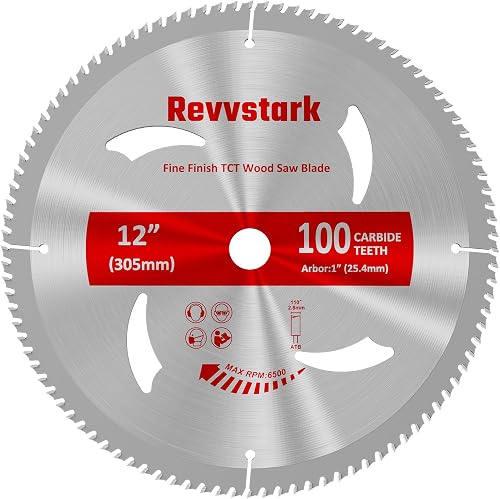
Revvstark Circular Saw Blade 12 Inch 100T: Best for 12-inch mixed-material capacity
- 12-inch diameter
- 100 tungsten carbide teeth
- 1-inch arbor
- 6500 RPM maximum
- For plastic, aluminum and non-ferrous metals
The 12-inch Revvstark pairs 100 teeth with a 1-inch arbor and states compatibility with aluminum and non-ferrous metals. Its thin kerf, thermal expansion grooves and noise-reducing perforations support repeated cutting.
Pros
- 100-tooth design
- 1-inch arbor
- Thermal expansion grooves
Cons
- Product title focuses on wood cutting
- Confirm saw and material fit before use
The Revvstark Circular Saw Blade 12 Inch 100T suits a 12-inch saw with a 1-inch arbor and a maximum speed of 6500 RPM. Its 100 tungsten carbide teeth and stated compatibility with plastic, aluminum and non-ferrous metals make it a flexible mixed-material option.
The blade also has a thin laser-cut kerf, noise-reducing perforations and thermal expansion grooves. Those details point to a design intended to manage cutting heat, noise and deflection during repeated work.
The product title focuses on cutting various wood, while the feature data includes aluminum and non-ferrous metals. Treat that difference as a reason to confirm the exact application before using it for a large aluminum project.
For set up, confirm that your saw accepts a 12-inch blade with a 1-inch arbor. The 6500 RPM limit should be treated as a ceiling, not as a speed you need to reach.
The 100-tooth layout can suit buyers who want a finer edge than a low tooth count blade. It can also suit mixed benches where wood, plastic and metal jobs follow one after another.
That flexibility has a trade-off in focus. A dedicated aluminum blade may be a more direct choice when aluminum is the main material.
Choose it when you need a 12-inch, 1-inch arbor blade that covers more than one material. The TOMAX remains the more direct aluminum-specific choice.
TOMAX 10-Inch 80 Tooth TCG Aluminum: Best for 10-inch dedicated TCG cutting
- 10-inch diameter
- 80 carbide teeth
- Triple Chip Grind
- 5/8-inch arbor
- For aluminum, plastic and non-ferrous metals
This TOMAX gives 10-inch saw owners a dedicated aluminum and non-ferrous metal option. Its 80-tooth TCG design balances a smooth cut with a smaller diameter and common 5/8-inch arbor.
Pros
- Dedicated aluminum TCG design
- 5/8-inch arbor
- Electrophoretic coating
Cons
- Less tooth count than the 100- and 120-tooth options
- 10-inch diameter limits cutting depth
The TOMAX 10-Inch 80 Tooth TCG Aluminum is the most direct choice for a 10-inch miter, circular or table saw with a 5/8-inch arbor. Its 80 carbide teeth and TCG grind are designed for aluminum, plastic and non-ferrous metals.
The lower tooth count than some options here can make sense when you want a balance between clean cutting and reasonable feed speed. The 10-inch diameter also suits saws that cannot accept a 12-inch blade.
TOMAX uses construction-grade carbide teeth and an electrophoretic coating to help resist wear, rusting and corrosion. The company also provides a limited lifetime warranty.
For daily use, that balance can be easier to manage on smaller parts and short runs. It gives a clean cut without making every pass feel slow or delicate.
The 10-inch size limits depth compared with a 12-inch blade, so check the guard and the workpiece before you commit. If the stock is wide or thick, a larger saw may be the better tool.
Set up by confirming the 5/8-inch arbor and the saw's approved diameter. Keep the blade clean and check for damage before each session, especially after a job with hard stock.
Choose it for regular aluminum work on a common 5/8-inch arbor saw. If your priority is the finest possible finish on thin stock, compare the 100-, 120- and 200-tooth options.
MASTEC 10-Inch 100T Carbide Tooth TCG: Best for clean 10-inch aluminum cuts
- 10-inch diameter
- 100 TCG carbide teeth
- 5/8-inch arbor
- For aluminum, Plexiglass, plastic and non-ferrous metals
- 5000 RPM maximum
The MASTEC suits a 10-inch miter, circular or table saw that accepts a 5/8-inch arbor. Its 100-tooth TCG layout favors smooth, clean cuts in aluminum and other non-ferrous materials.
Pros
- 100-tooth TCG layout
- Works with miter, circular and table saws
- Thin kerf design
Cons
- 5000 RPM maximum
- 10-inch diameter has less capacity than a 12-inch blade
The MASTEC 10-Inch 100T Carbide Tooth TCG is built for smooth, clean cuts in aluminum, Plexiglass, plastic and non-ferrous metals. It has 100 TCG carbide teeth, a 5/8-inch arbor and a stated maximum operating speed of 5000 RPM.
Its thin kerf design is intended for fast, smooth cutting. MASTEC also states that the blade works with miter saws, circular saws and table saws, giving it wider machine use than a miter-only product.
The 100-tooth layout favors finish quality over aggressive material removal. Match the 5000 RPM limit to your saw and do not assume a higher-rated saw should run at the blade's maximum.
That speed limit is one of the main things to plan around. If your saw runs faster, use the correct setting for the blade and the material rather than forcing the cut.
For bench use, the wider machine use can help a small shop that moves one blade between tools. Still, each saw needs its own check for diameter, arbor and guard fit.
Keep the plate free of buildup and support the work so it cannot shift during the pass. A steady, unforced feed usually protects both the edge and the finish.
Choose it when you want a dedicated 10-inch aluminum blade with more teeth than the TOMAX 80-tooth option. It is a practical middle ground between a general-purpose blade and an ultra-fine 120- or 200-tooth choice.
TOYAKI 10-Inch Miter Saw Blade: Best for ultra-fine aluminum finishes
- 10-inch diameter
- 120 teeth
- TCG design
- 5/8-inch arbor
- 2.8 mm thickness
TOYAKI has the highest tooth count in this roundup, with 120 teeth for ultra-fine finish work. It is made for aluminum, plastic and non-ferrous metals and fits common 5/8-inch arbor saws.
Pros
- Highest tooth count here
- TCG design
- 2.8 mm thickness
Cons
- 10-inch diameter
- Higher tooth count can favor finish over speed
The TOYAKI 10-Inch Miter Saw Blade is the ultra-fine finish pick, with 120 teeth, TCG geometry and a 5/8-inch arbor. It is designed for aluminum, plastic and non-ferrous metals and has a 2.8 mm thickness.
A higher tooth count can help when the visible cut edge matters more than fast stock removal. It can also make the blade a better fit for careful finishing work on smaller aluminum parts.
TOYAKI describes the blade as compatible with most common saw models, but the arbor still needs to match your saw. The product includes one saw blade, and its stated material is high-grade carbide.
For set up, treat the 5/8-inch arbor and 10-inch diameter as hard requirements. Check the saw manual and guard before you mount the blade, then test the fit with the saw unplugged.
The 120-tooth layout suits patient work where the edge will be handled or seen up close. It may feel less suited to fast removal of large stock, where a lower tooth count can move more material.
Care is simple but important. Keep the blade clean, store it flat and inspect the teeth before a finishing run.
Choose it for clean finish work on a compatible 10-inch saw. Choose the MASTEC or TOMAX 80-tooth option when you want a less finish-focused balance.
Diablo Saw Blade for Thick Aluminum: Best for thick aluminum and portable saws
- 7-1/4-inch diameter
- 56 TCG teeth
- 5/8-inch arbor
- .106-inch kerf
- 8000 RPM maximum
Diablo's 7-1/4-inch blade is aimed at thick aluminum and portable or low-powered saws. Its 56-tooth TCG layout gives up some fine finish potential for a more practical balance of speed, durability and capacity.
Pros
- Designed for thick aluminum
- Thin .106-inch kerf
- Laser-cut stabilizer vents
Cons
- Only 56 teeth
- 7-1/4-inch size is not a standard 10- or 12-inch miter blade
The Diablo Saw Blade for Thick Aluminum is the specialist choice for buyers working with thicker aluminum or a portable, low-powered saw. Its 7-1/4-inch diameter, 56 TCG teeth, 5/8-inch arbor and .106-inch kerf suit a different job than the high-tooth-count 10- and 12-inch blades.
The 56-tooth TCG geometry balances cutting speed, durability and clean edges. Diablo also uses laser-cut stabilizer vents to reduce vibration and heat, plus a Perma-SHIELD coating to resist heat, gumming and corrosion.
Its stated maximum speed is 8000 RPM. The blade is also described for aluminum, copper, plastics, brass and fiberglass, but the saw must accept a 7-1/4-inch blade.
Choose it when thick aluminum and portable-saw capacity matter more than the finest edge. For light finish work on a standard 10-inch miter saw, choose a smaller-tooth-gap option from this roundup.
IVY Classic 35056 Swift Cut 10": Best for light-gauge aluminum
- 10-inch diameter
- 200 teeth
- 5/8-inch arbor
- For aluminum, plastic and vinyl siding up to 1/8 in thick
- High carbon-alloy steel
IVY Classic is the specialist for light-gauge aluminum up to 1/8 in thick. Its 200 precision-ground teeth favor smooth, accurate cuts, but thicker aluminum needs a different blade.
Pros
- Highest tooth count here
- Clear 1/8-inch material limit
- Precision-ground teeth
Cons
- Only for light-gauge aluminum up to 1/8 in
- High carbon-alloy steel teeth are not carbide
The IVY Classic 35056 Swift Cut is made for light-gauge aluminum up to 1/8 in thick, along with plastic and vinyl siding. Its 200 precision-ground teeth and no-set design favor smooth, accurate cuts.
This is the highest tooth-count blade in the roundup, but it is also the most limited by material thickness. IVY Classic says thicker than 1/8 in requires its separate 10-inch 80-tooth non-ferrous and plastics blade.
The blade uses high carbon-alloy steel and a 5/8-inch arbor. Expansion slots help reduce heat buildup and warping, while the blade must rotate in the direction shown by its arrows.
That thickness limit should drive your choice more than the tooth count. A 200-tooth blade can be excellent on thin stock and a poor fit on thicker aluminum.
For set up, check the 5/8-inch arbor and the arrow direction before you make the first cut. Support thin sheet well so it does not chatter or flex during the pass.
The steel construction also sets expectations for care and use. Keep the blade clean and dry, and do not use it beyond the stated material range.
Choose it for thin aluminum sheet, plastic and vinyl siding. Do not choose it for thick aluminum simply because its tooth count is high.
How do you choose a miter saw blade to cut aluminum?
Choose a blade for aluminum by checking five things: tooth geometry, diameter, arbor, tooth count and stated material range. A blade that fits the saw physically may still be a poor match if its design is intended only for wood.
What tooth geometry should an aluminum blade use?
TCG, or Triple Chip Grind, is the most common geometry among the dedicated aluminum picks here. TOMAX, MASTEC, TOYAKI and Diablo all use TCG designs, which are intended to balance clean edges, durability and controlled cutting in non-ferrous materials.
The tooth shape still needs to match the job. A 56-tooth blade can favor speed and thicker material, while 100 or more teeth can favor a finer edge.
For a broader explanation of why tooth shape and count matter, see How Does Saw Blade Tooth Count Affect Cut Quality?.
Does blade diameter change aluminum cutting capacity?
Yes. A larger diameter generally gives a saw more potential cutting depth, but the saw guard and manual set the actual limit.
A 12-inch blade is not automatically safe or compatible on a 10-inch saw.
Check both the diameter and arbor. Our guide to What Is the Difference Between a Saw’s Blade Diameter and Depth of Cut? explains why those measurements should not be treated as the same thing.
How many teeth should an aluminum miter saw blade have?
Choose about 56 teeth when thicker aluminum and a faster cut are the priority, around 80 to 100 teeth for a balanced finish, and 120 or more teeth for fine work on suitable stock. The right count also depends on blade diameter and the material thickness.
The IVY Classic's 200 teeth are for light-gauge aluminum up to 1/8 in. The Diablo's 56 teeth are aimed at thick aluminum, showing why tooth count should follow the work rather than stand alone.
What arbor size should you check?
The arbor is the hole in the blade that fits over the saw's spindle. The dedicated 10-inch options here use a 5/8-inch arbor, while the 12-inch TOMAX and Revvstark options use a 1-inch arbor.
Never force a mismatch with an improvised setup. If you are also comparing blades for plywood or other sheet goods, our guide to the best circular saw blade for plywood covers how diameter, kerf and tooth count affect that work.
How do you set up a miter saw for aluminum?
Set up the saw by matching the blade to the saw, securing the aluminum and checking the blade direction and speed before cutting. Remove the old blade with the saw unplugged, follow the saw manual and confirm the guard moves freely after installation.
Support long aluminum pieces so they cannot shift or lever upward during the cut. Keep hands outside the saw's marked safe zone, and let the blade reach its operating speed before making the cut.
Use the blade's stated maximum speed as a limit, not a target to exceed. The MASTEC is listed at 5000 RPM, the Revvstark 12-inch blade at 6500 RPM, the Revvstark 10-inch blade at 7000 RPM and the Diablo at 8000 RPM.
Aluminum chips can be sharp and hot. Wear the protective equipment required by your saw manual, keep the work area clear and inspect the blade for damage before each use.
How do you keep an aluminum blade cutting cleanly?
Keep the blade clean, reduce vibration and replace it when the teeth or plate show damage.
Coatings, stabilizer vents and thermal expansion grooves can help manage heat and buildup, but they do not replace correct set up.
Clear chips from the work area after cutting and avoid forcing the saw through the material.
A feed rate that matches the blade and workpiece helps reduce rough edges and excess heat.
Wipe or brush the plate as the blade maker allows, and keep stored blades flat and dry.
That habit can reduce rust, gumming and the friction that makes a cut feel rough.
Check the teeth and plate before a new job, not only after a problem shows up.
A dull or damaged edge can leave burrs, wander or heat even when the saw settings are right.
Support the workpiece so it cannot lift, shift or lever during the cut.
Good support helps the blade track straight and keeps the finish consistent.
Let the blade reach its working speed before contact and keep hands clear of the cut path.
Follow the saw manual for guards, eye protection and chip control on every job.
If your workshop also uses band saws, the guide to how to choose custom band saw blades explains why blade width, tooth pattern and material choice must match the cut.
When the edge no longer cuts cleanly, stop and inspect the blade before you push harder.
Replacing a worn blade is often safer and cheaper than forcing a poor cut.
Which miter saw blade cuts aluminum best?
The TOMAX 12-Inch 100 Tooth TCG Aluminum is the best overall match for a 12-inch saw with a 1-inch arbor.
For a common 10-inch, 5/8-inch arbor saw, choose the TOMAX 10-Inch 80 Tooth TCG Aluminum for a balanced dedicated blade, or the MASTEC 100T for a finer cut.
Start with the saw you own, not with the blade you want.
Diameter and arbor must match the manual, and the guard must allow the blade to move freely.
Then match the blade to the stock in front of you.
Thin aluminum, thick aluminum, plastic and mixed work can each point to a different tooth count.
Choose TOYAKI or IVY Classic when finish quality on thinner stock matters most.
Choose Diablo when thick aluminum and a 7-1/4-inch portable-saw format matter more than maximum tooth count.
The Revvstark and DEWALT options can suit mixed wood, plastic, metal and fine finish work, but they are not the most direct dedicated aluminum TCG picks.
For metal projects beyond aluminum, compare the best miter saw blade for metal.
That guide can help when the job moves past non-ferrous stock into other metals.
The final choice should follow the saw approved diameter and arbor, the aluminum thickness and the finish you need.
If any of those three does not fit, change the plan before you cut.
Our top 3 picks at a glance
-
1
Best for 12-inch aluminum crosscuts
TOMAX 12-Inch 100 Tooth TCG Aluminum
9.7/10 our score
See it on Amazon -
2
Best for mixed wood and plastic work
Revvstark 10 Inch 80T Table Saw Blades
9.7/10 our score
See it on Amazon -
3
Frequently asked questions
What miter saw blade cuts aluminum?
A miter saw blade with Triple Chip Grind teeth and carbide construction is a strong choice for aluminum. Match the blade diameter and arbor to your saw, then check the blade's stated material range and maximum speed before cutting.
The TOMAX and MASTEC options here are dedicated aluminum TCG blades.
Can you use a wood blade to cut aluminum?
Don't assume a wood blade is suitable for aluminum. A wood blade may have a tooth shape, hook angle or speed rating that does not fit non-ferrous metal work.
Use a blade that names aluminum or non-ferrous metals as compatible, and follow the saw and blade safety instructions.
Are more teeth better for cutting aluminum?
More teeth can support a finer finish, but tooth count is only one part of the choice. Tooth geometry, blade diameter, kerf, arbor size, material range and maximum speed also matter.
A 120- or 200-tooth blade may suit light finishing work, while a 56-tooth blade can favor thicker aluminum and faster cutting.
What size miter saw blade do I need for aluminum?
Use the diameter and arbor size specified for your miter saw. A 10-inch saw commonly uses a 10-inch blade, while a 12-inch saw commonly uses a 12-inch blade, but the arbor must also match.
Blade diameter affects cutting capacity, so check the saw manual before choosing a replacement.


