9 Best Random Orbital Sanders for Woodworking (November 2026)
The best random orbital sanders for woodworking include the SKIL 5” Random Orbital Sander with Cyclonic for adjustable dust-conscious sanding, the DEWALT 20V MAX Orbital Sander for cordless shop work, and the BLACK+DECKER Orbital Sander for simple corded prep.
On this page (5 sections)
The best random orbital sander for woodworking is the SKIL 5” Random Orbital Sander with Cyclonic for its variable-speed control, compact form and clear dust container. For cordless mobility, choose the DEWALT 20V MAX; for a fine-finish focused corded tool, consider the Bosch ROS20VSC.
These picks cover common woodworking jobs, from smoothing a tabletop to prepping trim before paint or finish. For stationary sanding and shaping options, see belt and disc sanders.
We compared electric random orbital sanders by speed control, dust handling, pad features and included accessories.
A random orbital sander is one of several useful tools; our guide to different types of sanders explains when a belt, detail or sheet sander may suit the job better. If you already know you need this style, start with the best cordless random orbital sander or browse our best corded random orbital sander guide.
Our picks at a glance
-
1
 Best for adjustable dust-conscious sanding
SKIL 5” Random Orbital Sander with Cyclonic
9.7/10 our score
See it on Amazon -
2

-
3

- 4
 Best for steady single-speed sandingCheck it
- 5
 Best for fine finish controlCheck it
- 6
 Check it
DEKOPRO Orbital Sander Corded Hand Sander
Best for varied grit starter kits - 7
 Check it
Dong Cheng 5-Inch Random Orbital Sander 3.2A
Best for a broad speed range - 8
 Check it
HYCHIKA 5-Inch Random Orbital Sander
Best for quick grit changes - 9
 Check it
POTUINOM 165 PCS 5 Inch Sanding Discs
Best for stocking common grits
Which random orbital sander fits your woodworking project?
The SKIL is the best all-around fit here, while the DEWALT cordless model is suited to work away from an outlet. Bosch offers a strong fine-finish feature set, and the remaining picks cover simple fixed-speed sanding or starter kits.
We weighed each tool's stated speed, control, dust collection and included accessories against common woodworking needs. Our score weighs specs, features and buyer feedback against what you're shopping for.
| Product | Best for | Power | Speed | Dust collection | Our score |
|---|---|---|---|---|---|
| SKIL 5” Random Orbital Sander with Cyclonic | adjustable dust-conscious sanding | 2.8 amp, corded electric | 7,000–13,000 OPM | X-flow transparent dust container | 9.7 |
| DEWALT 20V MAX Orbital Sander | cordless shop work | 20V battery powered | 8,000–12,000 OPM | Locking dust bag; dust port fits select DEWALT collectors | 9.6 |
| BLACK+DECKER Orbital Sander | simple corded prep | 2.0 amp, corded electric | 12,000 OPM | 9.5 | |
| DEWALT Orbital Sander | steady single-speed sanding | 3.0 amp, corded electric | 12,000 OPM | 9.2 | |
| BOSCH ROS20VSC Palm Sander | fine finish control | 2.5 amp, corded electric | 7,500–12,000 OPM | 9.1 | |
| DEKOPRO Orbital Sander Corded Hand Sander | varied grit starter kits | 2.5 amp, corded electric | Up to 14,000 RPM | 8.9 | |
| Dong Cheng 5-Inch Random Orbital Sander 3.2A | a broad speed range | 3.2 amp, corded electric | 8,000–12,800 OPM | 8.8 | |
| HYCHIKA 5-Inch Random Orbital Sander | quick grit changes | 300 W corded electric | Up to 13,000 RPM | 8.6 | |
| POTUINOM 165 PCS 5 Inch Sanding Discs | stocking common grits | 8.2 |
SKIL 5” Random Orbital Sander with Cyclonic: Best for adjustable dust-conscious sanding
- 2.8 amp corded motor
- Variable speed
- Cyclonic dust container
- Compact design
Variable speed, a compact body and a transparent cyclonic dust container suit a range of woodworking tasks. It also has a soft rubber grip and counterweight balance to reduce vibration.
Pros
- Variable speed control
- Transparent dust container
- Compact design for tight spaces
Cons
- Corded power limits reach without an extension cord
- Dust collection still needs regular emptying
The SKIL SR211601 is the best match if one sander will handle several kinds of woodworking. Its variable speed control spans 7,000 to 13,000 OPM, giving you room to adjust for surface prep or a lighter finishing pass.
The 2.8 amp corded motor works with a compact body designed for tighter spaces. A transparent X-flow dust container makes it easier to see when it needs emptying, and the rubber grip and counterweight balance are intended to reduce vibration during longer sessions.
The kit includes three sanding sheets, so you'll have some paper to start with. Check the disc size and replacement paper compatibility before stocking up, especially if you plan to connect a shop vacuum.
Choose this one for mixed home-shop tasks where speed control and a visible dust collector are useful. If you need to move around a large piece far from an outlet, a cordless model may be easier to manage.
DEWALT 20V MAX Orbital Sander: Best for cordless shop work
- Brushless motor
- Variable speed from 8,000 to 12,000 OPM
- Low-profile height
- 8-hole hook-and-loop pad
The cordless design helps when sanding furniture or trim away from an outlet. Its battery and charger are sold separately, so account for those if you don't already use DEWALT 20V batteries.
Pros
- Brushless motor
- Variable-speed dial
- Low-profile body
Cons
- Battery and charger sold separately
- Compatible dust collectors and connector may require separate parts
The DEWALT 20V MAX is the choice for cordless sanding around a shop or jobsite. Its brushless motor and variable speed dial cover 8,000 to 12,000 OPM, while the low-profile body lets you get closer to the work surface.
The 8-hole hook-and-loop pad makes paper changes straightforward. A one-handed locking dust bag is included, and the dust port fits select DEWALT dust collectors; using other vacuum systems may require a separate connector.
This is a tool-only option, so budget for a compatible 20V battery and charger if you don't already have them. The lower weight noted in its specifications may also appeal for portable work, though the battery adds to the setup.
Choose it when movement between benches, rooms or outdoor work areas matters more than continuous corded power. Our best cordless random orbital sander guide compares more battery-powered choices, and the how to use a random orbital sander guide covers basic sanding technique.
BLACK+DECKER Orbital Sander: Best for simple corded prep
- 5-inch pad
- 2.0 amp corded motor
- 12,000 OPM
- Dust bag
This fixed-speed 5-inch sander keeps the controls simple for general surface prep. Its compact body and built-in dust bag suit smaller jobs where variable speed isn't a priority.
Pros
- Compact body for tight spaces
- Hook-and-loop paper changes
- Dust bag included
Cons
- Single speed
- Cord limits movement around large workpieces
The BLACK+DECKER BDERO100 suits basic surface prep on a compact budget. It runs at a fixed 12,000 OPM from a 2.0 amp corded motor, with a 5-inch pad and a built-in dust collection bag.
Its compact shape is handy for smaller workpieces and tighter spaces. The hook-and-loop system makes changing paper quick, and one sanding sheet is included to get started.
The tradeoff is limited speed choice. If you sand several wood types or want more control between material removal and finishing, a variable-speed model gives you more options.
Pick this model for straightforward sanding where a single speed is suitable. Consider another sander if your work often shifts between rough shaping and delicate finish prep.
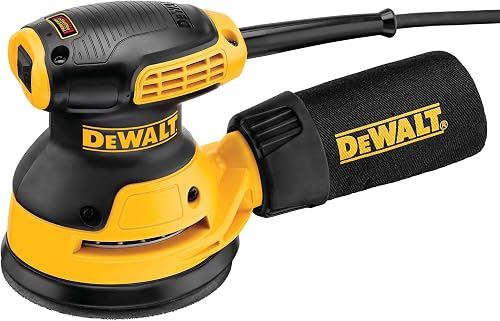
DEWALT Orbital Sander: Best for steady single-speed sanding
- 3.0 amp motor
- 12,000 OPM
- Separate counterweight
- Locking dust bag
The DWE6421 offers a straightforward 12,000 OPM speed and a short body that puts your hand closer to the work surface. A separate counterweight and rubber overmold address vibration and grip.
Pros
- 3.0 amp motor
- Short body for close control
- Dust-sealed switch
Cons
- Single speed
- Corded design
The corded DEWALT DWE6421 fits woodworkers who want a simple, steady 12,000 OPM sander. Its 3.0 amp motor and 5-inch hook-and-loop pad make it a familiar setup for sanding panels, shelves and trim.
The shorter body helps bring your hand closer to the workpiece. DEWALT includes a dust bag, and its separate counterweight and rubber overmold address vibration and grip during use.
There is no variable-speed control, so it's less flexible for tasks that call for slower sanding. Its dust-sealed switch is designed to protect the switch from dust ingestion, but use dust collection and protective gear as part of your shop routine.
Choose the DWE6421 if you prefer a corded tool with one set speed and a close-to-work feel. For use tips, see how to use a DeWalt orbital sander.
BOSCH ROS20VSC Palm Sander: Best for fine finish control
- 2.5 amp motor
- Variable speed from 7,500 to 12,000 OPM
- Pad dampening system
- Microfilter dust canister
The variable-speed control and pad dampening system make this Bosch a fit for finish work on flat and contoured surfaces. Its microfilter canister and included vacuum adapter offer two dust-handling options.
Pros
- Variable-speed control
- Microfilter canister
- Vacuum adapter included
Cons
- Corded power
- Included kit adds pieces to keep track of
The Bosch ROS20VSC is a good choice for controlled finish sanding. Its 2.5 amp motor has a variable speed range of 7,500 to 12,000 OPM, and a pad dampening system is designed to reduce swirl marks on flat and contoured surfaces.
A microfilter dust canister captures fine dust, shows its fill level and detaches for emptying. The kit also includes a vacuum adapter, sanding pad, disc, dampening ring and carrying bag.
Those accessories make it a more complete setup for a woodworker who wants multiple dust-handling options. Check your vacuum hose fit and disc pattern before adding more accessories.
Choose Bosch when fine surface prep and a useful accessory set matter. If you prefer another brand, see our best Bosch orbital sander and best Makita random orbital sander guides for more focused comparisons.
DEKOPRO Orbital Sander Corded Hand Sander: Best for varied grit starter kits
- 2.5 amp corded motor
- Six speeds
- Dust box
- 16 sanding discs
Six speed settings and included discs ranging from 60 to 1,000 grit give this kit flexibility for sanding and polishing tasks. The detachable dust box and rubber grip support routine shop use.
Pros
- Six speed settings
- 16 discs across varied grits
- Detachable dust box
Cons
- Corded design
- The listed voltage is 220 volts, so confirm compatibility with your power supply
The DEKOPRO kit suits woodworkers who want speed choices and a range of included paper grits. It has six speed settings and includes 16 discs spanning 60, 80, 120, 240, 400 and 1,000 grit.
The detachable dust box and rubber grip support routine sanding, while the hook-and-loop backing makes paper changes quick. DEKOPRO describes its motor as reaching up to 14,000 RPM.
One detail to check carefully is the stated 220 volt rating. Confirm that it matches your power supply before choosing this corded sander.
Choose it for a varied sanding kit if its voltage fits your shop. If you want fewer compatibility questions, compare the 120 volt corded picks above.
Dong Cheng 5-Inch Random Orbital Sander 3.2A: Best for a broad speed range
- 3.2 amp motor
- Six speeds from 8,000 to 12,800 OPM
- Dust box
- 20 sanding sheets
The six speed settings and 20 included sheets make this a versatile corded kit for woodworking and polishing. It also includes a dust box and can connect to a vacuum with a 32 mm outside diameter hose.
Pros
- Six speed settings
- 20 sanding sheets included
- Vacuum connection option
Cons
- Corded design
- Confirm the vacuum hose fit before relying on extraction
The Dong Cheng DSA02-125 is suited to buyers who want six speed settings and a broad sanding kit. It runs from 8,000 to 12,800 OPM and includes 20 sheets in 80, 120, 180, 240 and 320 grit.
Its dust box can connect to a vacuum hose with a 32 mm outside diameter, and the kit includes a tool bag. The 5-inch pad works across larger surfaces, while the compact form is intended for horizontal or vertical sanding.
Check the vacuum hose size before relying on the connection. The corded design also means you'll need an outlet or suitable extension cord within reach.
Choose this kit if you want several paper grits and speed settings with the sander. If your work primarily needs fine finish paper, plan to add the grits you use most.
HYCHIKA 5-Inch Random Orbital Sander: Best for quick grit changes
- Six speeds
- Up to 13,000 RPM
- Dust collection bag
- 12 sanding discs
Six speed settings and three included grits cover basic wood prep through finer sanding. The hook-and-loop pad supports quick paper changes, and the dust bag collects debris as you work.
Pros
- Six speed settings
- Three included grits
- Hook-and-loop paper changes
Cons
- Corded design
- Included grits cover a narrower range than some kits
HYCHIKA offers six speed settings and 12 discs for common sanding stages. Its 5-inch sander reaches up to 13,000 RPM, and the included paper comes in 80, 120 and 240 grit.
The dust bag attaches to a base with eight vacuum holes, and the hook-and-loop system supports fast changes between discs. That combination is useful when moving from rougher prep toward a smoother surface.
The included grit selection is narrower than the kits with more varied paper. You may need additional discs for very coarse material removal or a finer finishing pass.
Choose HYCHIKA if you want adjustable speed with a small starter set of common grits. Match the disc holes to the pad so dust collection can work as intended.
POTUINOM 165 PCS 5 Inch Sanding Discs: Best for stocking common grits
- 165 discs
- Grits from 40 to 600
- 8-hole dust extraction pattern
- 5-inch size
This assortment is a consumable option for compatible 5-inch random orbital sanders, with coarse through fine grits for different stages. Match the hole pattern and hook-and-loop backing to your sander before ordering.
Pros
- 165 discs in the set
- Multiple grits for staged sanding
- 8-hole dust pattern
Cons
- Not a sander
- Confirm pad and hole compatibility
POTUINOM's 165-disc assortment is a sanding-paper refill option for a compatible 5-inch random orbital sander. The set includes 40, 60, 80, 120, 150, 240, 320, 400 and 600 grit discs, with eight holes for dust extraction.
The coarse grits help with early material removal, while finer discs can prepare wood for finishing. Check both the hole layout and hook-and-loop fit against your sander before you order.
This is an accessory, not a sander, so it belongs with a tool that accepts 5-inch discs. It can be a convenient way to keep common grits on hand for a range of woodworking jobs.
Choose this assortment if your pad and dust holes match. For other dust-management setups, compare the best random orbital sander with vacuum attachment guide.
What should you compare before choosing a woodworking sander?
Compare speed control, power source, dust collection and paper compatibility first. Those details affect how easily the sander fits your wood, work area and finishing routine.
A variable-speed model lets you tune the rate to the task. It can be useful when you want faster removal on one pass and more control near a finished edge, while fixed-speed models keep the setup simple.
Corded sanders suit longer sessions near power. A cordless model can move between work areas more easily, but check battery compatibility and whether the tool includes a battery and charger.
Dust collection varies from a bag to a clear canister or vacuum connection. If you work indoors, look for a collector you can empty easily and check whether the dust port matches your vacuum; our guide to the best random orbital sander with vacuum attachment covers that setup.
Is a random orbital sander right for every woodworking job?
A random orbital sander is a strong general-purpose choice for broad, flat surfaces and finish prep, but it may not reach tight corners or remove material as quickly as a belt sander. The tool should match the surface and the amount of stock you need to remove.
For a small detail or narrow corner, a compact tool may reach where a 5-inch pad cannot. See our best small random orbital sander guide for smaller formats, or compare large random orbital sanders for broad workpieces.
An orbital sander can be used for different kinds of surface work, but pad movement and grit choice matter. Our guide explains what an orbital sander is for, and our article on using a random orbital sander walks through the basic technique.
How should you choose sanding speed and grit?
Start with a grit suitable for the surface condition, then work through progressively finer paper if the finish requires it. Use the sander's speed control when available, and test your approach on scrap wood before sanding a visible face.
Coarse paper removes material faster but leaves deeper scratches. Fine paper smooths the surface and prepares it for a finish, but it won't efficiently correct a deep gouge or a board that's far out of flat.
Keep the pad flat, avoid pressing hard and move at a steady pace. If you pause in one spot, the sander can leave a depression or visible sanding marks.
The included paper varies by kit, so check that its grits suit your projects. You may need to buy additional discs for a full coarse-to-fine progression.
Which electric random orbital sander should you choose?
Choose SKIL for a flexible corded tool with variable speed and a transparent dust container. Pick the DEWALT 20V MAX if you need cordless movement and already have the battery platform, or Bosch if fine-finish features and a microfilter canister are priorities.
For straightforward fixed-speed sanding, BLACK+DECKER and the corded DEWALT each offer a 12,000 OPM setup. If you want a starter kit with multiple grits, consider DEKOPRO, Dong Cheng or HYCHIKA after checking voltage and included paper.
Choose based on your workpiece size, dust setup and typical sanding stages. If you need a different brand comparison, see our guides to the best Festool random orbital sander, best air random orbital sander and best variable-speed random orbital sander.
For most woodworking benches, start with SKIL for adjustable speed and corded use; choose DEWALT 20V MAX for cordless movement. Match the pad and dust connection to your shop, then use the random orbital sander technique guide to make cleaner passes.
Our top 3 picks at a glance
-
1
Best for adjustable dust-conscious sanding
SKIL 5” Random Orbital Sander with Cyclonic
9.7/10 our score
See it on Amazon -
2
-
3
Frequently asked questions
What makes a random orbital sander useful for woodworking?
A random orbital sander combines pad rotation with an orbital motion, which helps reduce visible scratch patterns compared with sanding in a single direction. It's useful for smoothing panels, preparing finishes and blending edges.
Keep the pad moving and use a grit sequence suited to the wood and finish.
Is variable speed useful on a random orbital sander?
Variable speed lets you adjust the sanding rate for the task and material. It can help when you're moving from faster stock removal to a gentler finish pass.
Models such as the SKIL, Bosch and DEWALT 20V MAX offer speed control.
Fixed-speed models can still suit routine sanding when their speed fits your work.
Should I choose a corded or cordless random orbital sander?
Choose corded if you expect long sessions near an outlet and want to avoid battery changes. Choose cordless if you move between work areas or sand where power access is limited.
The DEWALT 20V MAX model needs a compatible battery and charger, sold separately.
How do I reduce dust while sanding wood?
Use the sander's dust bag or canister, connect a compatible vacuum when the tool supports it, and empty the collector before it gets full. Dust collection can reduce mess, but it won't capture every particle.
Wear suitable eye and respiratory protection, and follow the tool's instructions.


