9 Best Sanders for Wood Decks (November 2026)
The best sanders for wood decks include the SKIL 5” Random Orbital Sander with Cyclonic for broad deck boards, the SKIL Corded Multi-Function Detail Sander with Micro-Filter for deck edges and corners, and the DEWALT 20V MAX Orbital Sander for cordless deck work.
On this page (7 sections)
The best sander for wood decks is the SKIL 5” Random Orbital Sander with Cyclonic, because its 5-inch pad covers broad deck boards and its variable speed gives you more control during surface preparation. Choose a cordless DEWALT when moving around the deck matters, or a detail sander for corners, edges and small repairs.
A sander for deck boards needs enough coverage for long, flat surfaces, but control matters just as much. Weathered wood can have raised grain, old finish and uneven spots, so the best sander for deck boards should remove material steadily without making it easy to cut deep grooves.
For the broader differences between pad styles, see our guide to different types of sanders. The picks below are ordered by score, with the strongest matches for deck resurfacing first.
Our picks at a glance
-
1
 Best for broad deck boards
SKIL 5” Random Orbital Sander with Cyclonic
9.7/10 our score
See it on Amazon -
2
 Best for deck edges and corners
SKIL Corded Multi-Function Detail Sander with Micro-Filter
9.7/10 our score
See it on Amazon -
3

- 4
 Best for simple corded prepCheck it
- 5
 Best for tight deck detailsCheck it
- 6
 Check it
DEWALT 20V MAX Orbital Sander Cordless
Best cordless kit - 7
 Best for corded dust controlCheck it
- 8
 Best for close surface controlCheck it
- 9
 Check it
HYCHIKA 5-Inch Random Orbital Sander
Best for multi-grit prep
Which sanders are best for wood decks?
The SKIL 5-inch random orbital is the strongest general choice for deck boards, while the SKIL detail model is better for edges and corners. Cordless DEWALT models add movement around the deck, and the corded DEWALT picks provide continuous power.
Our score weighs specs, features and buyer feedback against what you're shopping for. We compared pad size, speed control, dust handling, power source and the type of deck work each tool suits.
| Product | Best for | Power | Speed | Included | Our score |
|---|---|---|---|---|---|
| SKIL 5” Random Orbital Sander with Cyclonic | broad deck boards | 2.8 amp corded electric | Up to 13,000 OPM | Dust box and 3 sanding sheets | 9.7 |
| SKIL Corded Multi-Function Detail Sander with Micro-Filter | deck edges and corners | 1.2 amp, 120V corded electric | Dust box and 12 sanding sheets | 9.7 | |
| DEWALT 20V MAX Orbital Sander | cordless deck work | 20V battery powered | Sander and dust bag | 9.6 | |
| BLACK+DECKER Orbital Sander | simple corded prep | 2.0 amp, 120V corded electric | 1 sanding sheet and dust bag | 9.5 | |
| BLACK+DECKER Detail Sander | tight deck details | 1.2 amp corded electric | 16,000 OPM | Mouse detail sander | 9.4 |
| DEWALT 20V MAX Orbital Sander Cordless | cordless kit | 20V battery powered | 8,000–12,000 OPM | Battery, charger, contractor bag and dust bag | 9.4 |
| DEWALT Orbital Sander Kit | corded dust control | 3 amp, 120V corded electric | Dust bag and carrying bag | 9.3 | |
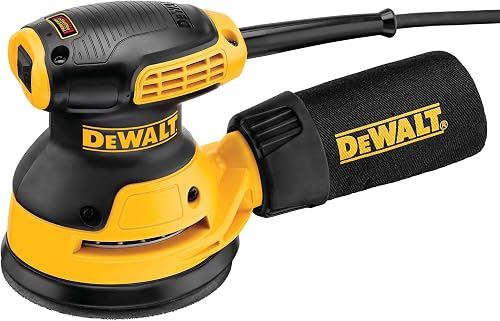
| DEWALT Orbital Sander | close surface control | 3 amp, 120V corded electric | Sander and dust bag | 9.2 | |
| HYCHIKA 5-Inch Random Orbital Sander | multi-grit prep | 2.5 amp, 120V corded electric | Up to 13,000 RPM | Dust bag, manual and 12 sanding discs | 8.6 |
SKIL 5” Random Orbital Sander with Cyclonic: Best for broad deck boards
- 2.8 amp motor
- 7,000–13,000 OPM variable speed
- 5-inch random orbital pad
- Cyclonic dust box
The 5-inch random orbital design covers broad boards while variable speed helps you adjust the pace for weathered wood and finish prep.
Pros
- Large working area
- Variable speed control
- Cyclonic dust collection
Cons
- Corded operation
- Only 3 sanding sheets included
The SKIL 5” Random Orbital Sander with Cyclonic is the best overall sander for deck boards in this group. Its 5-inch random orbital pad covers more surface per pass than a detail sander, making it a better fit for broad boards and general resurfacing.
The 2.8 amp motor runs at up to 13,000 OPM, and the variable speed control lets you reduce the pace when you need more control. That matters when you move from removing a weathered finish to smoothing the wood before a new coating.
Its X-flow dust collector uses a transparent container that is easy to empty. The sander includes a dust box and 3 sanding sheets, so you'll still need more abrasive paper for a full deck project.
Choose this model when you want a corded sander with a broad pad, variable speed and built-in dust handling. The cord is the main trade-off, especially when you are working far from an outlet.
SKIL Corded Multi-Function Detail Sander with Micro-Filter: Best for deck edges and corners
- 1.2 amp motor
- 14,500 OPM
- 3 additional attachments
- Micro-filtration and 1-1/4 in dust port
The compact detail pad and three attachments help reach corners, narrow surfaces and curved areas that a 5-inch orbital sander may miss.
Pros
- Useful attachments
- Dust box or vacuum connection
- 12 sanding sheets included
Cons
- Slower on broad boards
- Detail format is not the fastest choice for a full deck
The SKIL Corded Multi-Function Detail Sander with Micro-Filter is the best sander for deck edges, narrow areas and corners.
Its 4-in-1 design includes three attachments for fine finishing, large surfaces, corners, edges and curved contours.
The triangular profile attachment helps in hard to reach corners.
The finger extension suits narrow surfaces where a wide pad cannot sit flat.
The flexible pad follows curved surfaces more gently.
The 1.2 amp motor reaches 14,500 OPM.
That speed suits detail work, but the smaller format means it will take longer to cover a full run of deck boards than a 5-inch random orbital sander.
Dust control is flexible.
You can use the micro-filtration dust box or connect a vacuum through the 1-1/4 in dust port.
Empty the dust box often so airflow stays steady.
The box includes 12 sanding sheets, along with the three attachments.
Change sheets with the hook and loop system when cutting slows.
Pick it when stair edges, rail details or tight corners are part of the job.
For a whole deck, pair its detail role with a larger orbital sander rather than using it as the only tool.
DEWALT 20V MAX Orbital Sander: Best for cordless deck work
- Brushless motor
- 8,000–12,000 OPM variable speed
- Low-profile height
- One-handed locking dust bag
Cordless movement makes it easier to work across deck boards without managing a power cord. The battery and charger are sold separately.
Pros
- No power cord across the deck
- Brushless motor
- Variable speed
Cons
- Battery and charger sold separately
- Dust collector connection may need an additional connector
The DEWALT 20V MAX Orbital Sander is the best cordless sander for a deck when you want to move freely between boards.
Its brushless motor and 8,000 to 12,000 OPM variable-speed range give you adjustable control for different stages of prep.
Use a lower setting for final smoothing passes.
Use a higher setting for faster removal on weathered areas.
The low-profile height lets you stay close to the surface.
The 5-inch pad uses 8-hole hook-and-loop sanding paper.
That format makes paper changes quick between grits.
A one-handed locking dust bag supports basic dust collection.
Lock it in place before you start each board.
This is the tool-only version.
The battery and charger are sold separately, so it makes more sense if you already have the needed DEWALT 20V MAX battery system.
The dust port connects directly to the DWV010 or DWV012 dust collectors.
For other vacuum systems with 1-1/4 in hoses, DEWALT specifies a DWV9000 Universal Quick Connector.
Plan that connector before you start a large deck area.
BLACK+DECKER Orbital Sander: Best for simple corded prep
- 2.0 amp motor
- 12,000 OPM
- 5-inch pad
- Built-in dust collection bag
This compact 5-inch orbital sander offers a straightforward corded setup for deck preparation, paint removal and finish work.
Pros
- 5-inch working area
- Hook-and-loop paper changes
- Dust bag included
Cons
- Single-speed operation
- Only 1 sanding sheet included
The BLACK+DECKER Orbital Sander is a straightforward corded option for sanding deck boards, removing paint or preparing wood for a new finish.
Its 5-inch pad gives it the coverage expected from a general-purpose orbital sander.
That size suits long boards without the slower pace of a detail pad.
The 2.0 amp motor runs at 12,000 OPM.
Its random orbital action is designed for a high removal rate and a swirl-free finish.
Keep the sander moving and let the paper do the work.
Pressing hard can leave uneven spots on the wood.
The hook-and-loop system makes paper changes quick.
A built-in dust collection bag helps keep debris closer to the tool.
Empty the bag before it gets too full.
The box includes 1 sanding sheet and 1 dust bag, so plan on buying additional paper for a deck-sized project.
Choose it when you want a compact corded sander with simple controls.
Its single-speed design gives you less adjustment than the variable-speed SKIL and DEWALT models.
BLACK+DECKER Detail Sander: Best for tight deck details
- 1.2 amp motor
- 16,000 OPM
- Detail finger attachment
- Dust collection canister
The compact design, detail finger attachment and detail pad suit corners, edges and small repair areas on a deck.
Pros
- Reaches cramped spaces
- Three-position grip
- Continuous corded power
Cons
- Small detail pad
- Less suitable for sanding many broad boards
The BLACK+DECKER Detail Sander is the best fit here for tight deck details and small repair areas.
Its compact design reaches cramped spaces, while the detail finger attachment helps with narrow spots that a round orbital pad cannot cover well.
The detail sanding pad fits awkward angles around edges.
The 1.2 amp motor reaches 16,000 OPM.
That pace helps with fast and thorough removal in small zones.
Its compact body also helps when you need to work close to rails or posts.
The three-position comfort grip gives you more than one way to hold the tool.
Change your hold to match vertical and horizontal surfaces.
The dust collection canister helps keep the work surface clearer.
The dust-sealed switch helps protect the internal mechanisms.
This is a corded model, so it offers continuous power during a long detail session.
Pick it for corners, edges and small patches.
It is not the efficient choice for sanding every broad deck board because its detail pad covers less area per pass.
DEWALT 20V MAX Orbital Sander Cordless: Best cordless kit
- Brushless motor
- 8,000–12,000 OPM variable speed
- 5-inch pad
- 2.0Ah battery and charger included
This cordless kit includes the battery and charger, making it a simpler starting point for deck work away from an outlet.
Pros
- Battery and charger included
- Variable speed
- Dust bag included
Cons
- Battery adds weight
- Cordless runtime depends on the included 2.0Ah battery
The DEWALT 20V MAX Orbital Sander Cordless is the best cordless kit for a deck because it includes the 20V MAX battery and charger.
You can start without buying those parts separately.
Its brushless motor and variable speed range of 8,000 to 12,000 OPM suit both faster material removal and slower finishing passes.
Dial the speed down near edges for better control.
The 5-inch sander uses a replaceable 8-hole hook-and-loop pad.
That makes switching paper quick when you move to a finer grit.
The package includes a contractor bag and dust bag.
The included battery is 2.0Ah, so the available runtime depends on the work pace and the condition of the battery during the project.
Charge the battery fully before a long deck session.
The low profile helps you stay close to the board surface.
Choose this kit when freedom from a cord matters and you need a complete cordless starting set.
If you already own compatible batteries, the tool-only DEWALT may be the simpler match.
DEWALT Orbital Sander Kit: Best for corded dust control
- 3 amp motor
- 12,000 OPM
- Separate counterweight
- One-handed locking dust bag
The corded 5-inch format gives you continuous power, while the counterweight and dust bag support longer board-by-board prep.
Pros
- Continuous power
- Counterweight reduces vibration
- Dust collector connection option
Cons
- Single-speed operation
- Cord management is required
The DEWALT Orbital Sander Kit is the best corded choice for continuous deck work and dust control.
Its 3 amp motor spins the 5-inch pad at 12,000 OPM, so it gives you steady power without battery changes.
That suits long runs of boards where cordless runtime could slow you down.
A separate counterweight helps reduce vibration.
The shorter height keeps you closer to the work surface.
That close position makes it easier to control pressure on raised grain.
The rubber over-mold covers key areas of the sander for a more secure grip.
Hold it firmly but keep your arms relaxed.
The one-handed locking dust bag attaches to the tool.
The dust port is designed for the DEWALT DWV010 or DWV012 dust collectors, or a DWV9000 Universal Quick Connector with other vacuum systems using 1-1/4 in hoses.
This is a good pick when an outlet is available and you value continuous operation.
Its single speed gives you less control than the variable-speed picks.
DEWALT Orbital Sander: Best for close surface control
- 3 amp motor
- 12,000 OPM
- Shorter height
- Separate counterweight
The shorter body helps you stay close to the work surface while the 5-inch random orbital pad handles general deck-board preparation.
Pros
- Close-to-surface design
- Counterweight reduces vibration
- Dust bag included
Cons
- Single-speed operation
- Corded operation
The DEWALT Orbital Sander is a close-to-surface 5-inch palm sander for general deck preparation.
Its 3 amp motor reaches 12,000 OPM, giving it the same broad pad size and speed as the kit version.
The shorter height helps you get close to the work piece.
That helps on boards that sit near rails or low framing.
The separate counterweight reduces vibration.
The rubber over-mold covers key areas for a steadier hold.
The dust-sealed switch helps protect against dust entering the tool.
That matters when you sand weathered wood with loose debris.
The package includes the sander and dust bag.
It is a corded model with a single speed, so it suits buyers who want a simple setup near an outlet.
Choose it when close surface control matters more than variable speed or extra accessories.
If you want a carrying bag and a stated dust collector connection setup, the DEWALT Orbital Sander Kit is the fuller package.
HYCHIKA 5-Inch Random Orbital Sander: Best for multi-grit prep
- 300W motor
- 6 variable speeds
- Up to 13,000 RPM
- 12 sanding discs in 80, 120 and 240 grit
Six speeds and three included grits give you a flexible starting set for rougher weathered areas, general sanding and final smoothing.
Pros
- Six speed settings
- Three grits included
- Dust collection bag
Cons
- Corded operation
- Lower score for long deck projects than the leading picks
The HYCHIKA 5-Inch Random Orbital Sander is the best multi-grit starter option in this group.
Its 300W motor reaches 13,000 RPM, and six speed settings let you adjust the tool for different sanding stages.
Use lower speeds for finer finishing.
Use higher speeds for broader removal work.
The package includes 12 sanding discs: 4 with 80 grit, 4 with 120 grit and 4 with 240 grit.
That range gives you a starting point for rougher weathered areas, general smoothing and finer finishing.
The sander uses a hook-and-loop fastening system and includes a dust bag.
Swap discs quickly when you change grits.
Its ergonomic textured rubber grip is intended to improve control while the machine vibrates.
The dust bag helps keep debris near the tool during use.
Choose it when included abrasive variety matters.
The corded design and lower score make it less compelling than the leading picks for a large deck, but the grits give you more options before you buy additional paper.
What type of sander is best for deck boards?
A 5-inch random orbital sander is the best general sander for deck boards because it covers broad wood efficiently while staying easier to control than a more aggressive belt format.
The SKIL 5-inch model is the strongest match here because it adds variable speed and cyclonic dust collection.
Its pad size suits the width of most deck boards.
You can make steady overlapping passes without chasing small spots.
Variable speed also helps you slow down for smoothing.
A detail sander has a different role.
Its pointed or narrow attachments can reach stair corners, rail edges and small areas where a round pad cannot sit flat.
That makes detail tools useful around posts and built-in steps.
They also help with small repairs after the main boards are done.
The two detail picks in this guide are useful for those finishing tasks, not for covering an entire deck quickly.
Think of them as second tools for a deck project.
Use the 5-inch sander first for the field of the deck.
Then switch to a detail sander for edges and corners.
If you're deciding between the two main formats, read our belt sander vs orbital sander guide.
It explains why faster material removal can also require more control.
A belt sander can flatten wood fast but may dig in.
An orbital sander is often safer for finish preparation.
How should you sand a wood deck?
Start by clearing the deck and checking the boards for loose fasteners, damaged wood and raised areas. Use the sander flat on the board, keep it moving and avoid pressing down, since extra pressure can create uneven spots.
Work with the grain where practical and use a suitable abrasive sequence. Our guide to what type of sandpaper to use on wood explains how rougher and finer grits serve different stages.
Do not let a sander sit in one place while running. Make overlapping passes, check the surface often and stop when the old finish or rough fibers are removed enough for the next step.
For a general starting point, the HYCHIKA includes 80, 120 and 240 grit discs. The correct choice still depends on the condition of your boards and the finish you plan to apply.
What sandpaper is best for deck sanding?
The best sandpaper for deck sanding depends on whether you are removing a finish, smoothing weathered wood or preparing for a final coating.
Coarser abrasive removes material faster, while finer abrasive leaves a smoother surface.
Start by checking how much old finish remains on the boards.
Heavy finish usually needs a coarser grit first.
Weathered bare wood may need only a medium grit.
Move finer as the surface becomes more even.
Skipping grits can leave scratches that show under stain.
That is why a steady sequence matters on a deck.
Use the paper type that matches your sander's attachment system.
The SKIL and DEWALT orbital models use hook-and-loop pads, while the detail models use their own compatible sanding sheets and attachments.
Check the pad size before you order more paper.
Wrong sizes will not sit flat or stay secure.
Our best sandpaper for wood guide covers grit choice and paper selection in more detail.
Change paper when it stops cutting instead of pushing harder against the boards.
Worn paper can burnish the wood and slow progress.
Fresh paper also helps the dust holes work as intended.
Keep a few grits on hand for a full deck.
You will likely move from removal to smoothing during the job.
Test the grit on a small hidden area first.
That check helps you see how the wood responds.
How can you control dust while sanding a deck?
A dust bag, dust box or vacuum connection can reduce the amount of debris around the work area, but outdoor sanding still needs eye and breathing protection. Empty the collector before it becomes too full and keep the deck clear of people while sanding.
The SKIL 5-inch model uses a cyclonic dust box. The SKIL detail model offers micro-filtration and a 1-1/4 in dust port, while several DEWALT models use dust bags or connections for DEWALT dust collectors.
If you want a belt sander with a stronger dust focus for a different project, see our guide to best belt sanders with dust collection. For small detail work away from an outlet, our best cordless detail sander picks may also help.
Wear eye protection and a suitable dust mask or respirator for the material and finish you are removing. Follow the sander and finish instructions for safe cleanup and disposal.
Can you use a sander on deck edges and nearby boards?
Yes.
Use a detail sander for narrow deck edges, corners and small repair zones, then use a 5-inch orbital sander on the broad board faces.
That split lets each tool do the work it handles best.
A round pad can bridge over tight corners and miss low spots.
A detail attachment can follow those lines more closely.
Keep the pad flat where possible and avoid rounding over sharp edges.
Lift the pad slightly when you reach the end of a pass.
That habit can reduce edge rounding on the boards.
Work slowly near rail posts and stair edges.
Check your progress often with your hand.
Feel for raised grain and missed finish.
A jigsaw is a cutting tool rather than a deck sanding tool.
It cannot smooth wood the way a sander can.
If your project also involves cement board, use the correct jigsaw blade for cement board instead of trying to adapt a sanding accessory for cutting.
Use the right tool for each material.
That keeps the finish safe and the edges clean.
Which sander should you choose for your deck?
Choose the SKIL 5” Random Orbital Sander with Cyclonic when you need the best sander for wood decks and want a 5-inch pad, variable speed and a cyclonic dust box.
It suits broad boards and general resurfacing work.
Choose the DEWALT 20V MAX Orbital Sander Cordless when cordless movement and an included battery matter.
That kit lets you start work without a separate battery purchase.
Pick the SKIL Corded Multi-Function Detail Sander or BLACK+DECKER Detail Sander for corners, edges and small areas.
Those tools reach spots a round pad cannot cover well.
Choose the DEWALT Orbital Sander Kit for continuous corded power.
It suits long deck sessions near an outlet.
Choose the HYCHIKA when a multi-grit starter set is your priority.
Its included grits help you start removal and smoothing work.
Match the tool to the part of the deck you are sanding.
Use a 5-inch orbital for the main boards.
Add a detail sander for edges and corners.
That pairing gives you coverage and control.
Our top 3 picks at a glance
-
1
Best for broad deck boards
SKIL 5” Random Orbital Sander with Cyclonic
9.7/10 our score
See it on Amazon -
2
Best for deck edges and corners
SKIL Corded Multi-Function Detail Sander with Micro-Filter
9.7/10 our score
See it on Amazon -
3
Frequently asked questions
What is the best sander for wood decks?
The SKIL 5” Random Orbital Sander with Cyclonic is the best sander for wood decks in this group because its 5-inch pad covers broad boards and its variable speed helps with different sanding stages.
Choose the DEWALT 20V MAX Orbital Sander when cordless movement matters, or a detail sander for corners and edges.
Is an orbital sander good for deck boards?
Yes. A 5-inch random orbital sander is a useful sander for deck boards because it balances surface coverage with control.
Models such as the SKIL and DEWALT picks use hook-and-loop sanding pads for quick paper changes.
Keep the sander moving and let the abrasive do the work instead of pressing hard.
Should I use a belt sander or orbital sander on a deck?
An orbital sander is usually easier to control for deck resurfacing and finish preparation. A belt sander can remove material faster, but it needs more care because aggressive sanding can create dips or uneven areas.
Read our belt sander versus orbital sander guide before choosing between the two formats.
What grit should I use to sand deck boards?
Start with a coarse or medium grit only when the boards have a weathered finish or uneven coating that needs removal. Move to a finer grit for smoothing before applying a new finish.
The right sequence depends on the wood condition, so use our guide to what type of sandpaper to use on wood and check the finish manufacturer's instructions.
How do I control dust when sanding a deck?
Use the sander's dust bag, dust box or vacuum connection when available, and wear suitable eye and breathing protection. The SKIL random orbital uses a cyclonic dust box, while several DEWALT models use dust bags or dust collector connections.
Outdoor sanding still creates airborne dust, so keep other people away from the work area.