9 Best Table Saw Fences (November 2026)
The best table saw fences and fence upgrades include the POWERTEC Universal Tandem Featherboards for Table Saw for feed control, the O'SKOOL Miter Gauge for Table Saw for supported crosscuts, and the GOINGMAKE Compact Table Saw Miter Gauge for compact saws.
On this page (4 sections)
The best table saw fence upgrade depends on the problem you need to solve: add an auxiliary face for more support and accessory tracks, or replace a damaged rip fence with a model that fits your saw. Miter gauges and featherboards improve other parts of the setup, but neither replaces the rip fence.
A fence should lock parallel to the blade and stay put during a rip cut. If it slips, sits out of line, or lacks enough face height for your work, first identify whether you need a replacement fence, an add-on face, or a separate alignment fix.
For crosscuts, use a miter gauge or sled in the table slot. Our guides to table saw fence with T-track and universal table saw fence cover two common upgrade paths.
Our picks at a glance
-
1
 Best for feed control
POWERTEC Universal Tandem Featherboards for Table Saw
9.7/10 our score
See it on Amazon -
2

-
3
- 4
 Check it
BOW Products XT XTENDER T-Track Table Saw
Best for tall fence support - 5
 Check it
Woodpeckers Auxiliary Rip Fence
Best for compact saw extensions - 6
 Check it
Rockler Table Saw Crosscut Sled with Telescoping
Best for controlled crosscuts - 7
 Check it
GOINGMAKE Table Saw Miter Gauge with Long
Best for long crosscut stock - 8
 Check it
POWERTEC BS900RF Rip Fence for POWERTEC BS900
Best for the BS900 band saw - 9
 Check it
BOW Products XT XTENDER XT536 Table Saw
Best for shorter fence extensions
The best table saw fence upgrades for different setups
An auxiliary face is the closest match when you want more guidance or T-slots on your current rip fence. The other picks help with feed control, crosscuts, and specific saw compatibility, so match each one to its actual job.
POWERTEC Universal Tandem Featherboards for Table Saw: Best for feed control
- Two featherboards
- Miter slot and T-slot mounting
- Stackable setup
Two featherboards and several mounting options help hold stock against a fence during a cut. They add feed control, but don't serve as a fence.
Pros
- Works with T-slots and miter slots
- Includes brackets and stacking hardware
- Can mount horizontally or vertically
Cons
- Requires a compatible slot or track
- Does not replace or align a rip fence
The POWERTEC tandem featherboards are feed-control accessories, not fences. Their two boards can mount in T-slots or miter slots, and the included brackets allow horizontal or vertical mounting where the saw or track supports it.
Use featherboards to keep stock guided against a fence as you feed it. The kit also includes spacers and longer screws for stacking the boards, which can help with setups that need pressure at more than one height.
The maker describes the boards as designed to provide feed control and holding action with minimal kickback. For related table-saw safety parts, see splitter versus riving knife.
They don't correct fence alignment or replace a rip fence, so start with a stable, properly aligned fence before adding them.
Choose this set when your fence is sound but you want added feed control. Check that your saw has a compatible T-slot or miter slot for the included mounting options.
O'SKOOL Miter Gauge for Table Saw: Best for supported crosscuts
- 22–36 in extension fence
- 27 positive angle stops
- Reversible fence
The extendable fence supports wider crosscut workpieces, and the flip stop helps set repeated lengths. This miter gauge runs in the miter slot, so it isn't a rip fence.
Pros
- Reversible for either side of the blade
- Adjustable fit for a compatible miter slot
- Includes flip stop and scale tape
Cons
- Requires calibration before relying on its scale
- Faceplate material is user supplied
The O'SKOOL miter gauge is for crosscuts and angled cuts, with an extension fence that ranges from 22 to 36 in. Its reversible setup lets you place the fence on either side of the blade to suit your table layout.
The gauge offers positive stops from 0° to 60° in 5° steps, plus a 22.5° stop. An adjustable flip stop helps repeat cut lengths, and the front T-track accepts a user-supplied 3/4 in plywood faceplate.
Before relying on its scale tape, install and calibrate it. The four expansion washers adjust the fit in a compatible 3/4 x 3/8 in miter slot, but this setup guides crosscuts rather than rip cuts.
Choose it if you need a longer crosscut fence and repeat stops. If you're deciding between a gauge and rollers, see our guide to best table saw guide rollers.
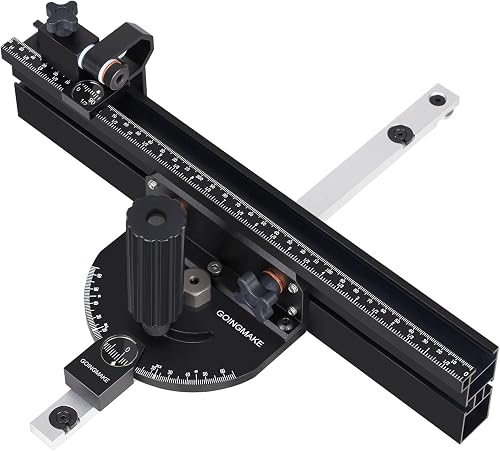
GOINGMAKE Compact Table Saw Miter Gauge: Best for compact saws
- 14 in fence
- 360 mm miter bar
- 11 positive angle stops
Its compact fence and miter bar suit smaller saw tables and crosscuts. The adjustable bar fit addresses play in compatible slots, but it does not guide rip cuts.
Pros
- Compact fence for portable saws
- Has a flip stop for repeat cuts
- Angle scale supports settings between stops
Cons
- Shorter support than extended miter gauges
- Needs calibration for accurate setup
The GOINGMAKE compact miter gauge fits a different need: a shorter setup for portable saws and other machines with compatible 3/8 x 3/4 in T or U slots. Its 360 mm fence and miter bar take less room than the longer crosscut options here.
It has 11 positive angle stops and a flip stop for repeat lengths. The adjustable rings on the miter bar let you tune the fit in the slot, while the fence scale is marked in inches and millimeters.
As with other miter gauges, confirm the slot size and calibrate the gauge before cutting to a measurement. This is an angle-cut accessory, not a replacement for the saw's rip fence.
Choose it for compact crosscut setups, especially where table space and storage matter. For blade choices that affect the cut, read what rip and crosscut saw blades do.
BOW Products XT XTENDER T-Track Table Saw: Best for tall fence support
- 46 in aluminum fence extension
- 5 in tall face
- Three T-slots
This tall extension adds a larger guide face and T-slots for compatible accessories. It clamps to an existing fence, so check the required clamps and your fence shape.
Pros
- Three T-slots for accessories
- Can be positioned for infeed or outfeed use
- Fits portable, cabinet, and band saw fences
Cons
- Clamps are sold separately
- Adds a face to an existing fence rather than replacing it
The 46 in BOW XT XTENDER adds a 5 in tall face to an existing fence, with three T-slots for compatible accessories. Its aluminum extrusion can be positioned for infeed, centered, or outfeed use when paired with the required clamps.
This is an add-on platform rather than a complete fence and rail replacement. The T-slots accept 1/4 and 5/16 in T-bolts, while BOW T-Track clamps are sold separately.
The taller surface can provide more support when guiding tall boards or panels. Match the clamp system to your fence and consider how the added height affects the work and accessories you plan to use.
Choose the 46 in XTENDER when you want a tall accessory face with extra reach. See how track placement affects an upgrade in our table saw fence with T-track guide.
Woodpeckers Auxiliary Rip Fence: Best for compact saw extensions
- 36 in fence
- Two 7 in material supports
- Built-in T-track slots
This auxiliary fence adds infeed and outfeed support to a compact machine. Its clamping blocks add 2 in to the fence width, which matters when setting the saw scale.
Pros
- Installs without modifying the existing fence
- Includes two material supports
- T-slots accept accessories
Cons
- Track clamps are not included
- Designed for fences under 3-1/4 in tall
The Woodpeckers Auxiliary Rip Fence is a 36 in extension designed for compact saws and fences under 3-1/4 in tall. If you are choosing the saw too, see our best compact table saws.
It includes two 7 in material supports for the infeed and outfeed sides of the workpiece.
It clamps to an existing fence without drilling or permanent changes, but standard track clamps are sold separately. The clamping blocks add exactly 2 in to the fence width, a measurement to account for when using the saw's scale.
Seven built-in T-slots accept accessories such as featherboards and stops. You can position the auxiliary face ahead of, behind, or across the blade, depending on the intended support setup.
Choose it when your compact saw needs a longer face and material support. Measure your current fence height and account for the 2 in added width before setting a cut.
Rockler Table Saw Crosscut Sled with Telescoping: Best for controlled crosscuts
- Telescoping fence from 25 to 38-1/4 in
- Micro-adjust flip stop
- Hold-down clamp
A sled guides crosscuts and miters through the miter slots, while its telescoping fence supports longer stock. It is a separate cutting aid, not a rip fence upgrade.
Pros
- Includes an adjustable miter bar
- Has a replaceable zero-clearance insert
- Flip stop supports repeat lengths
Cons
- Takes more storage space than a miter gauge
- Use is limited to crosscut and miter setups
The Rockler crosscut sled guides work through standard miter slots and includes a fence that extends from 25 to 38-1/4 in. Its micro-adjust flip stop helps set repeat lengths, and a hold-down clamp secures the workpiece to the sled.
A 1/2 in phenolic base, adjustable miter bar, and replaceable zero-clearance insert round out the setup. The sled is designed for crosscuts and miters from 90° to 45°, not for ripping stock along a fence.
Because a sled takes up more space than a miter gauge, consider where you'll store it between cuts. It can make sense when crosscut support and repeatability matter more than a compact accessory.
Choose this sled for controlled crosscuts and miters on longer stock. For the separate track-based cutting method, read how a track saw differs from a circular saw with a guide.
For a circular-saw option, compare the best DeWalt circular saw. For terminology, see whether a Skilsaw is a circular saw.
For a rail and saw together, compare track saw kits.
GOINGMAKE Table Saw Miter Gauge with Long: Best for long crosscut stock
- Fence extends from 21 to 38 in
- Micro-adjust flip stop
- 13 angle stops
The long fence and micro-adjust flip stop suit repeat crosscuts on longer pieces. Confirm your miter slot dimensions before choosing this gauge.
Pros
- Fence extends for longer workpieces
- Includes inch and millimeter scales
- Adjustable miter bar fit
Cons
- Requires calibration before using its scales
- Guides crosscuts rather than rip cuts
The GOINGMAKE long miter gauge extends from 21 to 38 in, giving longer stock more fence support during crosscuts. Its micro-adjust flip stop has a magnifier on the pointer, and the fence has inch and millimeter scales.
Thirteen positive angle stops cover common settings, while the adjustable miter bar is designed for 3/8 x 3/4 in T and U slots. The maker describes the flip stop adjustment as precise, but you should calibrate the gauge and verify your setup before relying on its scale.
This gauge can handle repeat crosscuts without turning a rip fence into a measuring tool. For a comparison of rail-based setups, see our guide to the best table saw measure tape.
Choose it if long crosscut stock and a micro-adjust stop are priorities. Confirm that your table's miter slot matches before buying.
POWERTEC BS900RF Rip Fence for POWERTEC BS900: Best for the BS900 band saw
- Direct-clamp design
- Cam lever lock
- Adjustable clamping range
This is a dedicated band saw fence for the POWERTEC BS900 and compatible saw tables. Check its table size and saw fit carefully before considering it.
Pros
- No rails required
- Cam lever locks the fence
- Adjustable clamping range
Cons
- Not a table saw fence
- Compatibility depends on saw and table size
The POWERTEC BS900RF is a rip fence for the POWERTEC BS900 band saw and compatible band saw tables, not a table saw fence. It clamps directly to the table with a cam lever, so no rails are required.
Its adjustable clamping range is 11-3/8 to 12 in. The stated fit includes most 9 in band saws, but compatibility depends on table size and model, so check those measurements carefully.
This pick belongs here as a reminder that the phrase “rip fence” covers fences for different saws. A band saw fence won't fit a table saw simply because both tools use fences for straight cuts.
Choose it only for a compatible band saw table. If you need a table saw upgrade, compare the mounting approach of an auxiliary face or a fence made for your saw.
BOW Products XT XTENDER XT536 Table Saw: Best for shorter fence extensions
- 36 in aluminum fence extension
- 5 in tall face
- Three T-slots
The shorter XTENDER adds accessory tracks and a taller face to an existing fence. Its separate clamps and feed supports are additional parts, so plan the full setup.
Pros
- T-slots accept compatible accessories
- Can be positioned forward, centered, or back
- Designed for several saw types
Cons
- XT2 clamps are sold separately
- Does not replace the saw's fence and rail system
The BOW XT536 is the 36 in version of the XTENDER fence, with a 5 in tall face and three T-slots. It adds reach and accessory mounting to an existing fence, while the 46 in model above offers more length.
The milled rear slots allow forward, centered, or rear positioning when used with two XT2 clamps, which are sold separately. The bottom slot accepts BOW XT1 Feed Supports, also sold separately.
Check the space around your saw and the length of stock you handle before choosing between the 36 and 46 in faces. The shorter version may suit a compact table where the longer extension would be awkward.
Choose the XT536 when you want the XTENDER face in a shorter length. Check the clamp and feed-support requirements before planning the full setup.
What type of table saw fence upgrade should you choose?
Choose a replacement rip fence when the original is damaged or can't lock securely, and choose an auxiliary fence face when the original works but needs more height, reach, or accessory tracks. Crosscut accessories solve a different problem and should be judged by slot fit and workpiece support.
A fence upgrade should match the saw's mounting system, table dimensions, and the cut you make most often. If the fence still locks but sits out of line, check whether alignment or repair is possible before replacing the complete system.
When does a fence extension make sense?
A fence extension makes sense when the existing rip fence works but offers too little face area or no convenient accessory tracks. The BOW XTENDER models add a taller face and T-slots, while Woodpeckers adds material supports and a 36 in auxiliary face.
Extensions clamp to an existing fence, so verify the required clamp type and fence dimensions. They don't automatically improve a fence that shifts, fails to lock, or sits out of alignment.
What if the saw needs a full fence and rail system?
A full replacement can make sense when the fence or rails are damaged, incompatible, or too limited for the work. Before choosing a system, confirm the saw model, table width, mounting points, rail length, and clearance around the shop.
A universal option still needs to fit the saw and the available space. Use the universal table saw fence guide to compare fit questions before buying.
How do you choose a table saw fence guide?
Choose a table saw fence guide by matching its mounting method to the saw, then check whether you need a rip fence, an auxiliary face, or a crosscut guide. A fence guide only helps when it stays secure and tracks the intended path.
Measure the fence height, table width, rail spacing, and miter slot before ordering. For a rail-based cutting setup away from a table saw, compare the best cordless track saw and best track saw guide rail guides.
How do you check fence alignment?
Check alignment against the blade using the saw maker's procedure and a reliable measuring method. The fence should be parallel to the blade for rip cuts, and it should lock without shifting when you apply normal pressure.
If you can't verify alignment, don't rely on an accessory face to correct it. Resolve the fence or saw setup first, then add featherboards or other feed aids as appropriate.
Should you upgrade the fence or add a miter gauge?
Upgrade the rip fence for rip cuts, and add a miter gauge or sled for crosscuts and angled cuts. These tools run in different parts of the saw and guide the work in different directions.
A long miter gauge fence may support a crosscut, but it doesn't replace the rip fence. Match the guide to the cut and follow the saw maker's safety instructions.
Which table saw fence should you pick?
Pick the Woodpeckers auxiliary fence if your compact saw needs infeed and outfeed support, or the BOW XTENDER if you want a taller face with T-slots. Choose a miter gauge or sled for crosscuts, and buy the POWERTEC rip fence only for a compatible band saw.
Before ordering, check saw fit, clamp needs, and slot dimensions. For a rip fence replacement, confirm the full fence and rail system matches the saw rather than relying on a similar name or appearance.
The right table saw fence upgrade is the one that fixes a specific setup problem and matches the cut you make. Measure first, then choose a fence face, replacement, or crosscut guide to suit the job.
Our top 3 picks at a glance
-
1
Best for feed control
POWERTEC Universal Tandem Featherboards for Table Saw
9.7/10 our score
See it on Amazon -
2
-
3
Frequently asked questions
Can you replace a table saw fence without replacing the rails?
Sometimes, but fit depends on the saw and fence system. Auxiliary fence faces such as the BOW XTENDER and Woodpeckers ARF-BSCS clamp to an existing fence, while a replacement rip fence may need compatible rails and mounting points.
Measure the fence and check the maker's fit guidance before buying.
How do you choose a table saw fence upgrade?
Start with the problem: a fence that won't lock square may need alignment or repair, while a short or low fence may benefit from an auxiliary face. For repeat crosscuts, a miter gauge or sled works in the miter slot, not along the rip fence.
Check mounting, slot size, and any separate clamps.
What is a T-track table saw fence?
A T-track fence has slots that accept compatible bolts, letting you attach accessories such as featherboards, stops, or custom faces. The BOW XTENDER and Woodpeckers auxiliary fence both include T-slots.
Check bolt size and track placement when matching an accessory to a fence.
Can a miter gauge replace a table saw fence?
No. A miter gauge guides work across the blade for crosscuts and angled cuts, while the rip fence guides stock parallel to the blade for rip cuts.
Keep the tool matched to the cut, and use the saw maker's safety guidance for each setup.


