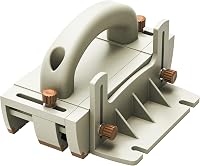
How to Choose a Magnetic Table Saw Featherboard
Choose a table saw magnetic featherboard only when its magnets match your tabletop and can hold the required pressure. Check the tabletop material, magnetic holding strength, adjustment range, blade clearance and feed direction before buying.
On this page (8 sections)
- Does your table saw surface work with a magnetic featherboard?
- How much holding strength does a table saw magnetic featherboard need?
- Where should you place a magnetic featherboard?
- What should you check before buying a magnetic featherboard?
- Which products help with table saw feed control?
- How do magnetic and slot-mounted featherboards compare?
- What are the common setup mistakes?
- Is a magnetic featherboard right for your table saw?
A table saw magnetic featherboard is a good choice when your saw has a ferrous tabletop and you want fast, tool-free positioning. It is the wrong choice when the magnets cannot hold securely, the surface is aluminum, or the featherboard cannot stay clear of the blade and fence.
The main decision is not the feather material alone. Check the tabletop, holding force, placement, pressure, and clearance as one setup.
A magnetic base can save time when you move the featherboard between cuts. It also makes placement easier when you are changing stock width or feed direction.
However, a quick setup is useful only if the base stays fixed during the cut.
Magnetic mounting suits a saw you use often with a clean, flat, magnetic tabletop. It can suit a smaller shop where you change setups during one session and want the accessory moved without reaching for tools.
It suits you less if your tabletop is painted, coated, dusty, or broken by slots and inserts where the base must sit. In those cases the base may feel firm at rest yet shift when the workpiece pushes through the feathers.
Think about the work you do most days. Ripping boards of similar width may need only one position, while mixed stock may reward a base you can lift and reset quickly.
Consider also the space around the cut. You need smooth tabletop before the blade, plus room for the base, knobs, and body without crowding the fence or the blade path.
Side pressure has a narrow useful range in daily use. Too little pressure lets stock drift from the fence, while too much makes feeding slow and uneven.
A featherboard should support a steady feed rather than force the board into place. If you push hard to move stock past the feathers, the setup is likely too tight or poorly placed.
Care matters more than it first seems. Wipe the tabletop and the magnet face before use, and remove fine dust that can form a small gap under the base.
Check the base after each change of blade height, bevel angle, fence position, or stock width. A position that cleared the blade before may no longer be safe after any of those adjustments.
Before changing any table saw setup, review how to use a table saw safely. A featherboard is a feed-control accessory, not a replacement for safe blade handling or correct saw setup.
Use it as part of a calm routine. Set the position with the saw unplugged, test the feed path by hand, and stop to reset if the base moves or the stock binds.
Does your table saw surface work with a magnetic featherboard?
A magnetic featherboard needs a surface that lets its magnets hold firmly. Check the tabletop material first, because a magnet will not create a dependable grip on every saw surface.
Cast iron and steel tables generally give a magnetic base something to hold. Aluminum and many nonmagnetic surfaces do not.
Some saws also have painted, coated or uneven areas that can reduce contact.
Clean the area before placing the base. Dust, chips and pitch can create a small gap between the magnet and the table, reducing contact.
Wipe the surface and check that the base sits flat.
You also need enough smooth tabletop around the cut. A magnetic featherboard cannot help if the base must sit partly over a miter slot, a gap, a raised insert or an uneven extension.
If your table is not magnetic, look for a featherboard designed for a miter slot or T-track. The BOW Products model below includes a 3/4 in miter bar and T-track mounting parts, while the Hedgehog model includes an aluminum miter clamp for a standard 3/4 in slot.
How much holding strength does a table saw magnetic featherboard need?
The featherboard needs enough holding strength to resist the side pressure created by the workpiece and your feed motion. The correct setup holds the board against the fence without making the stock difficult to push.
Do not judge holding strength by the magnet count alone. The base must stay stable when pressure changes as the board passes through the feathers.
A small movement can let the workpiece drift from the fence.
Set the featherboard with light contact first. Feed a scrap board by hand with the saw unplugged.
If the board binds, reduce the pressure or move the featherboard slightly farther from the fence.
The feathers should press the stock toward the fence, not down into the tabletop. A featherboard placed too low can increase drag.
One placed too high may fail to control the board near the cut.
For a safer overall setup, pair side pressure with a suitable push tool. Our guide to the best table saw push block explains when a push block can keep your hands farther from the blade while maintaining control.
Where should you place a magnetic featherboard?
Place the featherboard on the infeed side of the blade, before the cut begins. The feathers should contact the stock before it reaches the blade and keep it aligned with the fence through the approach.
Keep the featherboard far enough from the blade that the workpiece is controlled without the accessory entering the blade path. The exact location depends on the saw, fence position, stock width and featherboard shape.
Make sure the base does not interfere with the fence. Check that the fence can move through its full adjustment range and that the workpiece can pass without striking the featherboard body.
For ripping, the usual goal is steady pressure toward the fence. For other operations, the safest position may change.
Always unplug the saw while checking clearance, then rotate the blade by hand if needed to confirm that nothing can contact it.
A featherboard is most useful when it supports a repeatable feed path. If the stock is bowed, twisted or too short to control safely, repositioning the featherboard will not solve the underlying problem.
What should you check before buying a magnetic featherboard?
Check five points before buying: tabletop compatibility, base strength, adjustment range, feather pressure and blade clearance. These determine whether the accessory will fit your saw and help with your usual cuts.
Tabletop and base compatibility
Confirm that your tabletop is ferrous if the product depends on magnets. Measure any raised areas, slots or breaks in the surface where the base needs to sit.
A magnetic base may be convenient on a cast-iron table, but a slot-mounted model can be more flexible if you use multiple machines. Consider whether you want one featherboard for a table saw, router table and bandsaw.
Adjustment and placement range
Look for enough adjustment to place the feathers before the blade while still clearing the fence. A featherboard with limited movement may work on one setup but become awkward when you cut narrow or wide stock.
Also consider feed direction. A reversible design can help when the accessory needs to work on the left or right side of the workpiece.
Contact pressure and material
The feathers should provide steady side pressure without damaging the workpiece. Softer or more flexible materials may suit delicate wood, while a rigid design can provide a different feel during feeding.
Replaceable feathers can matter if you expect regular use. A one-piece body may be simpler, while a replaceable design gives you a way to maintain the contact surface.
Clearance around the blade
A featherboard must never enter the blade path. Check the body, base, knobs, mounting hardware and workpiece together.
Remember that the blade can rise, tilt or change position. Recheck clearance after changing blade height or bevel angle.
Which products help with table saw feed control?
These products solve related feed-control and safety problems, but they are not identical. The BOW Products and Hedgehog models are featherboards, while the MICROJIG model is a splitter system for full kerf blades.
MICROJIG GRR-RIPPER MJ SPLITTER Steel Pro
The MICROJIG GRR-RIPPER MJ SPLITTER Steel Pro is for older table saws without a standard riving knife that use full kerf blades. It includes 4 steel-core splitters with offsets of 0.000, 0.003, 0.006 and 0.009 in, plus 4 Kerf Keepers for a kerf range of 0.118 to 0.145 in.
This is not a magnetic featherboard, so it does not provide the side pressure that keeps stock against the fence. Its role is behind the blade, where the splitter helps keep the cut open and the workpiece aligned.
The package includes 4 splitters, 4 Kerf Keepers, a drill guide, a 3/16 in drill bit and screws. The splitters have a steel core and ABS polymer shell, and the system is made in the USA.
Choose it when your saw needs a safety upgrade for a full kerf blade and does not have a standard riving knife. It is not the right pick if your main need is quick side pressure against the fence.
BOW Products EVA Featherboard Table Saw
The BOW Products EVA Featherboard Table Saw suits woodworkers who want a featherboard for a table saw, router table or bandsaw with multiple mounting options. Its closed-cell EVA feathers use a living-hinge design, and the package includes a 3/4 in AnchorPRO miter bar, ergonomic knobs, standard EVA feathers and T-track mounting hardware.
The 3/4 in miter bar mounts to a 3/8 x 3/4 in miter slot. Its two 1 1/2 in T-bolts use a 5/16-18 thread and fit 1/4 to 3/4 in T-tracks.
The EVA material is designed to provide contact while reducing marking on softwood. The feathers are replaceable and reversible, which can help you maintain the contact surface as your setup changes.
Choose it when you want one featherboard that can move between compatible machines and mounting methods. It does not use a magnetic base, so you do not need a ferrous tabletop for its included mounting options.
Hedgehog Spiral Featherboard for Table Saws
The Hedgehog Spiral Featherboard for Table Saws suits buyers who value one-handed adjustment and use a standard 3/4 in miter slot. Its spiral design pivots with a single knob, and the package includes the Hedgehog body and a cast CNC-milled aluminum miter clamp.
The aluminum expanding miter bar fits a 3/4 in wide by 3/8 in deep miter slot. Measure your slot before buying because it does not fit 5/8 in slots.
The impact-resistant polymer body is designed to flex and maintain pressure. Its reversible design supports left-side and right-side feed operations, while the spiral shape is intended to reduce kickback and vibration.
Choose it when fast one-handed positioning matters and your table has the required miter slot. It is not a magnetic model, so it will not provide the quick surface placement of a true magnetic featherboard.
How do magnetic and slot-mounted featherboards compare?
A magnetic featherboard is fastest to reposition on a compatible ferrous surface. A slot-mounted featherboard can be more dependable across nonmagnetic tables, but it needs a suitable miter slot or track.
| Feature | Magnetic featherboard | Slot-mounted featherboard |
|---|---|---|
| Main requirement | Ferrous, reasonably clean tabletop | Compatible miter slot or T-track |
| Repositioning | Usually quick and tool-free | May require loosening a knob or bolt |
| Table flexibility | Best on compatible metal surfaces | Works where the slot or track fits |
| Stability check | Confirm the base does not slide | Confirm the bar expands or locks correctly |
| Best use | Frequent changes on one compatible saw | Multiple compatible machines or tables |
Magnetic mounting can be convenient for changing stock width. Slot mounting may give you a more defined path because the hardware stays inside the slot.
Your choice should follow the saw you already own. Do not buy a magnetic model first and assume the tabletop will support it.
A magnetic base works best on a ferrous tabletop that is flat, smooth, and clean enough for full contact. It lets you lift the featherboard, move it forward or back, and reset it without loosening hardware in a slot.
That speed helps when you change stock width often or test a new feed path. It also helps when the featherboard must sit in a spot that a slot or track cannot reach.
The trade-off is dependence on the surface. Dust, pitch, paint, or a small step near an insert can reduce the grip, and the base may shift under pressure during a cut.
A slot-mounted featherboard gives a more repeatable location because the bar or bolt stays in a fixed channel. Once set, it tends to return to the same place after tightening.
That repeatability can help with routine ripping, where you want the same pressure and clearance each time. It can also help when you move one featherboard among a table saw, router table, and bandsaw that share a compatible slot or track.
The trade-off is setup time. You may need to loosen a knob, slide the hardware, and tighten it again, and some slots are difficult to reach or clean.
Slot mounting also depends on the slot itself. Measure the width and depth before buying, since a bar made for one size may not lock properly in another.
Magnetic mounting suits one compatible saw and frequent changes in position. Slot mounting suits nonmagnetic tables, shared use across machines, or work where a fixed reference matters more than speed.
Neither style removes the need for a dry run. Check the full feed path with the saw unplugged, confirm clearance around the blade and fence, and test pressure on scrap before cutting good stock.
For more product comparisons, see our guide to the best table saw featherboard. It can help you compare mounting styles, adjustment methods and feed-control needs.
What are the common setup mistakes?
The most common mistakes are placing the featherboard too close to the blade, using too much pressure, ignoring the tabletop material and failing to check the full feed path. A careful dry run with the saw unplugged catches most placement problems.
Do not press the stock so hard against the fence that feeding becomes jerky. Excess pressure can increase drag and make it harder to keep a steady pace.
Do not place the featherboard after the blade when your goal is to guide the stock into the cut. The board should control the workpiece before it reaches the blade.
Do not assume a clean-looking table is clean enough for magnets. Fine dust can still create a gap under the base.
Do not leave the featherboard in place while changing the blade, raising the blade or adjusting the fence without checking clearance again. Any change to the saw setup can change the safe position of the accessory.
Finally, use a push block or push stick when the cut brings your hands close to the blade. A featherboard controls stock movement, but it does not replace a tool that keeps your hands at a safer distance.
Is a magnetic featherboard right for your table saw?
A magnetic featherboard is right for you when your saw has a compatible metal tabletop, the base can hold against the needed side pressure, and the accessory can sit before the blade without interfering with the fence.
Choose a slot-mounted model if your tabletop is nonmagnetic or if you move the featherboard among saws with compatible miter slots. Choose a splitter when your main concern is keeping the kerf open behind a full kerf blade on an older saw.
If you are still comparing saw types, read What Is the Difference Between a Circular Saw and a Table Saw? and How Does a Miter Saw Differ from a Table Saw?. For a larger work area, our guide to the best table saw extension may also help.
The final rule is simple: pick the mounting system your tabletop supports, then choose the featherboard that gives steady pressure without restricting the feed. If your work involves masonry rather than table saw stock, use a separate guide to choosing a worm drive concrete saw.
Frequently asked questions
What is a table saw magnetic featherboard?
A table saw magnetic featherboard uses magnetic bases to hold a featherboard against a compatible ferrous saw surface. It applies steady side pressure to keep stock against the fence.
Check that your tabletop attracts the magnets and that the base stays clear of the blade, miter slot and fence.
Do magnetic featherboards work on aluminum table saws?
A magnetic featherboard may not hold on an aluminum tabletop because aluminum is not ferromagnetic. Check the saw surface before buying, and use a miter-slot or T-track featherboard when magnets cannot create a secure hold.
Where should a magnetic featherboard go on a table saw?
Place it before the blade on the infeed side, with the feathers pressing the workpiece toward the fence without making the board hard to push. Keep the base, knobs and body away from the blade path, and check the setup with the saw unplugged.
Can a featherboard prevent all table saw kickback?
A featherboard helps keep stock against the fence and can reduce movement that contributes to kickback, but it cannot prevent every hazard. Use the blade guard and riving knife when appropriate, keep your hands away from the blade, and follow safe feed practices.