Which Table Saw Should You Buy?
Buy the table saw type that matches your available space and largest regular cuts: choose a portable saw for limited room, a jobsite saw for mobility, or a cabinet saw for a permanent woodworking shop.
On this page (11 sections)
- Which table saw type should you buy?
- What size table saw fits your workspace?
- How much rip capacity do you need?
- What motor and blade size should you choose?
- Do you need a table saw or a circular saw?
- Which safety features should you check?
- How important is dust collection?
- What should you spend on a table saw?
- When should you choose a sliding table saw?
- How should you compare table saw features?
- Which table saw should you buy for your projects?
The table saw you should buy depends on your available space, the material you cut most often and whether the saw must move. Choose a compact portable or jobsite saw for limited room, a larger jobsite model for sheet goods and trim, or a stationary cabinet saw for a permanent shop.
A table saw is most useful when you need repeated straight cuts along a fence. It is not automatically the best choice for every project.
A circular saw may be easier for breaking down full sheets, while a miter saw is better for repeated crosscuts and angle cuts.
Start by measuring the space around the saw, not only the saw itself. You need room to feed material, receive it after the cut, stand safely and move the fence without hitting walls or stored tools.
Which table saw type should you buy?
Buy the table saw type that solves your largest regular task without overwhelming your workspace. Portable and jobsite saws suit flexible spaces, hybrid saws suit serious home shops, and cabinet saws suit permanent production areas.
Portable table saws
A portable table saw is the practical choice when you need a fixed blade and fence but cannot dedicate a full workshop bay. It can sit on a bench, a folding stand or another stable support, depending on the model.
Portable saws are easier to store than cabinet saws, but their smaller tables can make large sheets harder to control. Add suitable infeed and outfeed support before cutting long or heavy stock.
Look for a clear fence adjustment, a stable base and a blade guard that stays in place during normal work. Check the saw's rip capacity against the widest boards or panels you expect to cut.
Jobsite table saws
A jobsite saw is designed around transport and setup. It suits remodelers, trim workers and home users who need to move the saw between a garage, driveway and project area.
A rolling stand can make a large difference when the saw is heavy. Telescoping rails also help the machine store in a smaller footprint after the work is finished.
The trade-off is that a jobsite saw still needs a clear cutting zone when operating. A folding stand does not remove the need for material support, safe footing or room behind the saw.
The DEWALT DWE7491RS is an example of this category. Its 10-inch blade, 15 amp motor, 4,800 rpm speed and 32-1/2-inch rip capacity suit larger ripping tasks than a compact portable saw.
Hybrid table saws
A hybrid table saw fits a buyer who wants more stability than a portable saw but does not need a full industrial setup. It usually makes sense when the saw will stay in one workshop and the owner values a heavier work surface.
Review the motor, fence, dust collection and available floor space together. A heavier saw can make repeat cuts easier to manage, but it also takes more effort to move if the shop layout changes.
Our guide to the best hybrid table saw can help you compare this middle category with portable and cabinet designs.
Cabinet table saws
A cabinet table saw is for a permanent woodworking shop with enough room for material flow and dust collection. Its main advantage is a shop-centered setup rather than quick transport.
Choose this type when you regularly cut hardwood, sheet material or furniture parts and can keep the saw assembled. You also need a plan for electrical service, dust extraction, storage and safe clearance around the blade.
For larger professional workflows, compare the best table saw industrial options. Cabinet saws are a poor fit when you must carry the machine up stairs or clear it away after every project.
What size table saw fits your workspace?
Choose a saw by its operating footprint, including the material path, stand and support surfaces. A compact body can still require a long clear area for feeding and receiving boards.
Measure the following before you buy:
- The storage footprint with the stand folded, if it folds.
- The working footprint with the stand open.
- The distance from the blade to the nearest wall.
- The space in front of the blade for feeding stock.
- The space behind the blade for the completed cut.
- The width needed to extend the fence.
- Doorways, stairs and turns on the route to the setup area.
If you work in a garage, mark the saw's footprint on the floor with tape. Add the length of your longest regular board and stand in the operator position to see whether cars, shelves or doors interfere.
A small workshop often benefits from a portable saw that can be stored vertically or moved against a wall. A larger shop can use a permanent support table, but the support must not restrict the fence or contact the moving stock.
For home-focused choices, see our best table saw for home use guide. If you are still learning basic cuts, our best table saw for beginners guide covers simpler buying priorities.
How much rip capacity do you need?
Rip capacity tells you how wide a board or panel you can cut between the blade and the fence. Choose capacity around your widest repeated cut, then add support for material that extends beyond the table.
A narrow rip capacity can handle trim, smaller boards and many furniture parts. Larger capacity helps with shelving, cabinet panels and other sheet materials, but it also requires more room for the fence rails and the workpiece.
The DEWALT DWE7491RS provides a 32-1/2-inch rip capacity. Its rack and pinion telescoping fence system is intended to make fence adjustments fast and accurate, while the flip-over ripping fence supports narrow cuts.
That capacity does not mean every large panel is safe to hold by hand. Long boards and full sheets can twist, sag or shift if they lack support.
Use a suitable outfeed table, roller support or a second person when the material size requires it.
If your main work involves breaking down full panels before final sizing, read our panel saw vs table saw comparison. A panel saw may fit that workflow better when large sheet handling is the main task.
What motor and blade size should you choose?
Choose motor power and blade size according to the stock you cut regularly, while checking the saw's depth and angle capacity. A 10-inch table saw gives a useful balance for general woodworking, but blade diameter alone does not determine the whole cutting experience.
The DEWALT DWE7491RS uses a 10-inch blade and a 15 amp corded electric motor with a stated speed of 4,800 rpm. Its depth of cut is 3-1/8 inches at 90 degrees and 2-1/4 inches at 45 degrees.
Those figures help you judge whether the saw can handle the thicknesses in your normal work. They do not remove the need to secure the material, set the blade correctly and keep the fence parallel to the blade.
A smaller portable saw can be easier to store and carry. A larger saw may give more table support and capacity, but it also needs more space and a more deliberate setup.
Do you need a table saw or a circular saw?
Choose a table saw for repeatable rip cuts at a fixed station. Choose a circular saw for mobility, quick breakdown cuts and work that cannot be brought to a table saw.
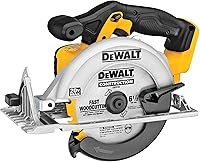
The DEWALT 20V MAX Circular Saw DCS391B has a 6-1/2-inch blade, a 5,150 rpm motor and a 0 to 50-degree bevel capacity. It is battery powered, and its battery and charger are not included.
Its magnesium shoe is designed to keep the tool light while supporting cut accuracy, and the rubber over-molded grip supports control during use. A circular saw can be a better first tool when you work on site or need to cut sheet goods into smaller pieces before bringing them to a table saw.
It does not replace a table saw for every task. A table saw keeps the blade fixed while you guide the work along a fence, which is useful for repeated rips and narrow strips.
For a related angle-cut comparison, see how a miter saw differs from a table saw. A miter saw is built around crosscuts and angle work, while a table saw is built around stock moving across a blade and along a fence.
Which safety features should you check?
Choose a table saw with a blade guard, riving knife and stable support, then use a push tool when your hands would approach the blade. Safety parts only help when they are installed, adjusted and used for the cut in front of you.
Check whether the blade guard can be adjusted without unnecessary delays and whether the riving knife aligns with the blade. Keep the fence parallel to the blade and inspect the workpiece for knots, warping or other movement risks before cutting.
A pushblock helps you keep your hands away from the blade while maintaining control of smaller stock. It is an accessory, not a substitute for a guard, riving knife, correct fence setup or a clear cutting plan.
The MICROJIG GRR-RIPPER GR-100 has a fully adjustable design, a high-friction grip and 3-directional force for downward, inward and forward control of the workpiece. Its balance support is intended to help stabilize smaller cuts, including cuts down to 1/4 inch.
The GR-100 is 4 inches long by 4.5 inches wide by 4.5 inches high and weighs 16 ounces. It includes 1 GRR-RIPPER GR-100 and 1 set of illustrated instructions.
Use a pushblock when the workpiece size and cut allow it to sit securely on the table. Keep the tool's contact surfaces clean and replace the setup if the stock cannot remain stable against the fence.
If dado cuts are part of your plans, check table saws that can use dado blades before buying. Dado compatibility varies, so confirm the saw's approved setup and instructions rather than assuming a standard arbor will accept every blade set.
How important is dust collection?
Dust collection matters most when the saw runs indoors or near finished work areas. Choose a table saw with a dust port that matches your vacuum or extraction setup, then keep the collection path clear.
The DEWALT DWE7491RS has a 2-1/2-inch dust collection port that can connect to a vacuum. This can help direct dust away from the cutting area, but it does not make open cutting dust-free.
Place the vacuum where its hose will not cross the operator's path or pull against the workpiece. Empty the collector before it becomes too full, and inspect the hose for blockages when suction drops.
Dust collection should also influence the saw's location. A permanent cabinet saw may suit a dedicated extraction system, while a portable jobsite saw may need a compact vacuum that can move with it.
What should you spend on a table saw?
Set your budget after deciding the saw type, capacity and support needs. A low-cost saw is only useful if it gives you enough rip capacity, stability and adjustment range for the work you actually do.
A compact budget saw can make sense for occasional small projects. Avoid choosing by price alone if you will soon need a larger fence, more table support or a stand that the basic model does not include.
For lower-cost comparisons, see best table saw under 200 and best table saw under 500 dollars. If you are buying around a sale event, our best table saw on sale guide can help you compare the whole setup rather than only the headline price.
The DEWALT DWE7491RS is a substantial jobsite package because it includes a rolling stand, push stick, miter gauge, rip fence, 2 blade wrenches, blade guard assembly and a 10-inch 24-tooth carbide blade. It weighs 110 pounds, so its rolling stand matters when moving it.
Its 21-7/8-inch by 26-3/8-inch table provides a working surface, while the telescoping fence rails retract for a smaller stored package. The 15 amp motor is intended for hardwood ripping, and the 2-1/2-inch dust port supports vacuum connection.
This model suits a home shop or jobsite where you need more capacity than a compact portable saw and can manage a 110-pound machine. Its trade-off is size and weight.
Measure the route and operating area before choosing it for a small room.
For a shop-centered comparison, read the best table saw for woodworking shop guide. Cabinet projects may also call for a different fence, dust and stability setup, so compare the best table saw for cabinet making options.
When should you choose a sliding table saw?
Choose a sliding table saw when controlled panel movement and crosscut support are central to your work. The sliding table can help guide larger stock, but it adds space and changes the way you plan the shop layout.
A sliding table needs room for the table to travel and for the material to extend beyond the blade. Measure that full movement before bringing one into a crowded garage.
Compare the table saw with sliding table options if you regularly cut panels or need a supported crosscut workflow. A standard jobsite table saw may be easier to store when your work changes from week to week.
How should you compare table saw features?
Compare features in the order they affect your cuts: capacity, fence control, stability, safety parts, dust collection and storage. A long feature list matters less than a fence and table that match your material size.
Use this checklist:
- Match the saw type to the space and transport needs.
- Confirm the rip capacity for your widest repeated cut.
- Check blade diameter and depth of cut for your stock thickness.
- Look for a stable stand or a safe permanent base.
- Confirm that the fence adjusts smoothly and locks securely.
- Check the blade guard and riving knife arrangement.
- Match the dust port to your vacuum or extraction system.
- Confirm what accessories are included.
- Measure the full operating footprint and delivery route.
- Plan where boards will rest before and after the blade.
The right choice is often the saw you can set up correctly every time. A large machine that blocks the work area may produce fewer useful cuts than a smaller saw with clear access and reliable support.
Which table saw should you buy for your projects?
Buy a portable table saw when storage space is limited and your cuts are smaller. Buy a jobsite saw when you need transport, a stand and more room for boards or panels.
Buy a hybrid or cabinet saw when the machine can stay in a permanent shop.
For a broad home-workshop choice, the DEWALT DWE7491RS combines a 10-inch blade, 15 amp motor, rolling stand, 32-1/2-inch rip capacity and 2-1/2-inch dust port. A circular saw remains the more flexible option for mobile breakdown work, while a GRR-RIPPER supports controlled handling of small stock at a fixed saw.
Choose the saw that fits your biggest regular cut, your available floor space and your setup habits. If cabinet projects are your main goal, compare the best cabinet table saw options before deciding whether a portable saw will remain useful as your work grows.
Frequently asked questions
Which table saw should a beginner buy?
A beginner should usually start with a portable or jobsite table saw if space and budget matter most. Choose a model with a stable stand, an adjustable fence, a blade guard and a riving knife.
Before buying, confirm that its rip capacity and dust port match the projects you plan to build.
Is a portable table saw good enough for woodworking?
A portable table saw can handle many woodworking tasks, including ripping boards, cutting trim and sizing sheet material when its fence and table support are suitable. It gives up some mass and workspace compared with a cabinet saw, so use outfeed support and make sure the saw is stable before cutting.
What is the difference between a jobsite and cabinet table saw?
A jobsite table saw is designed to move and set up quickly, while a cabinet table saw is intended to stay in a workshop. Jobsite models favor portability and compact storage.
Cabinet models favor a heavier permanent base, larger work support and a shop-centered workflow.
Do I need a table saw or a circular saw?
Choose a table saw for repeatable rip cuts and controlled work along a fence. Choose a circular saw when you need a lighter tool for breaking down sheet goods or cutting material away from a shop setup.
A circular saw with a guide can cover some tasks, but it does not create the same fixed cutting station.
Can a portable table saw cut large boards?
A portable table saw can cut large boards if its rip capacity, table support and stand are adequate for the material. The DEWALT DWE7491RS has a 32-1/2-inch rip capacity and a rolling stand, but large sheets still need safe support before and after the blade.