Table Saw vs Track Saw: Which Should You Choose? (November 2026)
Choose a table saw for repeatable rips and a track saw for breaking down large panels in place. In a table saw vs track saw comparison, the better choice depends on the cuts you repeat and whether you have room to feed material through a saw.
On this page (7 sections)
A table saw suits repeatable rips, while a track saw suits large panels and cuts made on the workpiece. In a table saw vs track saw choice, consider what you cut most, how much room you have, and whether you need the same width many times.
A table saw holds the blade in a fixed position as you guide material past it. A track saw moves across material while its rail guides the cut.
Those different workflows matter more than a simple power comparison. A compact table saw can travel to a job, and a track saw can make precise cuts, but each asks you to set up the work in a different way.
 Best for portable repeat cuts
DEWALT 15 Amp 8-1/4 in. Compact Portable
Table saw vs track saw: what is the main difference?
A table saw moves the material through a stationary blade; a track saw moves the blade over supported material. That changes how you handle long boards, plywood sheets and repeated cut widths.
On a table saw, the fence sets the distance between the blade and the edge of the stock. Keep the material supported and feed it steadily through the cut.
With a track saw, you place a rail along the cut line and run the saw along it. You can work on a large panel without lifting it onto a table, provided the panel is supported safely beneath the cut.
The tools also differ in how setup affects repeatability. A fence stays set for a series of matching rips, while a track usually needs to be positioned for each new cut line.
| Product | Best for | Guide length | Setup | Compatibility | Our score |
|---|---|---|---|---|---|
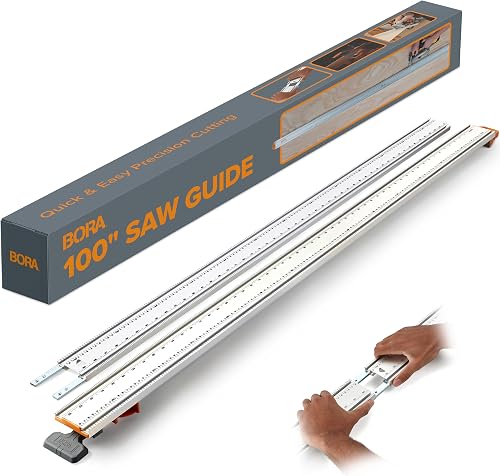
| BORA NGX Circular Saw Guide Rail | guided circular saw cuts | 100 in | 50 in clamp edge plus 50 in extension | Circular saws, routers and jigsaws | 9.6 |
| DEWALT 15 Amp 8-1/4 in. Compact Portable | portable repeat cuts | 9.6 | |||
| SKIL 15 Amp 10-Inch Jobsite Table Saw | a folding-stand shop setup | 9.5 | |||
| WEN CT1065 10-Amp 6.5-Inch Plunge Cut Sidewinder | plunge cuts on panels | 9.5 |
Does a track saw work like a circular saw with a guide?
Both can follow a straight guide, but a track saw is designed to ride on its rail. A circular saw can use a separate straightedge or guide rail, which may take more care to align and clamp.
For a closer look at those differences, see how a track saw differs from a circular saw with a guide. If you already own a circular saw, a guide rail can be a practical way to make cleaner panel cuts without adding a track saw.
The BORA NGX Circular Saw Guide Rail joins a 50 in clamp edge and a 50 in extension for a 100 in guide, and its Quick Lock clamp helps secure the rail. It works with circular saws, but it is not itself a track saw.
Which saw is better for ripping boards?
A table saw is usually the easier choice for repeated rip widths. Its fence gives you a set reference, so you can feed several boards through without repositioning a guide for every cut.
That can help when preparing cabinet parts, shelf stock or furniture pieces that need matching widths. The table saw still needs clear infeed and outfeed space, and long stock may need extra support.
A track saw can rip boards too, especially when a board is too wide or awkward to feed across a table. Lay the stock flat, align the rail and make the cut from above.
For occasional cuts, that flexibility can outweigh the extra setup. For a long run of identical narrow strips, the fence workflow is typically more direct.
How does fence repeatability compare with rail setup?
A table saw's fence is designed to set a consistent distance from blade to cut edge. Rack and pinion fence rails, found on the DEWALT and SKIL models here, help make adjustments smooth and controlled.
A track saw can also make repeat cuts, but you need to maintain the same offset from the guide to the desired cut edge. Stops, marks or a repeatable measuring routine can help, though each repositioning adds a chance for setup variation.
If you work mostly with boards and strips, browse table saws for woodworking shops. If large sheet goods are your main concern, a panel saw vs table saw comparison can help you weigh other ways to manage panels.
Which saw handles plywood and large panels better?
A track saw is generally easier to use for breaking down a full sheet of plywood. You can support the panel on a work surface and bring the saw to the cut instead of feeding the sheet through a table.
This is useful when a sheet is too large to control safely on your table saw or when your shop lacks long infeed and outfeed space. Support the material across the cut path so the offcut does not bind or fall as the cut finishes.
A table saw can still rip plywood into narrower pieces. It works best when you can manage the sheet's size, keep it stable and maintain clear space around the saw.
A table saw's rip capacity tells you how far the fence can be set from the blade, but it doesn't remove the need for safe handling. The DEWALT compact model has a 24.5 in rip capacity; that helps with certain sheet cuts, though a full sheet still requires careful support and control.
Can either saw make an internal cut?
A plunge track saw can start a cut within a panel, which helps with openings that do not begin at an outside edge. You need to plan the depth and support the material, and follow the saw's instructions for the cut.
A conventional table saw is designed for stock fed into the blade, not for lowering a panel onto an exposed blade. Don't try to make a plunge cut that way.
The WEN CT1065 is a plunge cut saw with an adjustable depth up to 2-1/3 in and bevel cuts up to 45 degrees. It is compatible with WEN CT9502 track and CT992F clamps, which are separate items.
Which is easier to move and store?
A track saw is easier to carry in separate pieces, while a portable table saw needs a place to set up and feed stock. Your vehicle, stairs, storage area and worksite layout can decide which setup feels manageable.
A track saw typically packs into a case or can be stored with its rail along a wall. Long rails still need space, and you may need clamps or a support surface at the job.
A portable table saw combines the saw, fence and table in one unit. The DEWALT model weighs 54 lb and has a compact size for transport and storage; the SKIL model has an integrated folding stand.
If you'll move the saw often, check the full packed setup, not just the saw. A long rail may be awkward in a small vehicle, while a table saw can be heavy to lift in and out.
The best track saw kit options can help you compare a saw and rail setup. For buyers weighing current options, see track saw deals and corded track saws.
Which one makes sense for a small workshop?
Choose the tool that needs less free space during your most common cut. A small shop may have room to store a table saw but not enough clear floor to feed long boards through it.
A track saw can use a bench or low supports for panel work, then be put away. You still need room to lay out the track and maneuver around the sheet.
A table saw needs safe space at the front and back of the blade. If that area is crowded by walls, shelves or other tools, routine cuts can become awkward.
Consider setup time as well as storage. A fence based cut may be quick once the saw is ready, while a rail based cut needs alignment and support for each panel.
Which saw is safer for your work?
Neither design is automatically safe; use the tool that lets you control the material and follow its manual. Keep hands away from the blade path and use the guards and safety parts supplied with the saw.
A table saw requires attention to feeding direction, workpiece support and kickback risks. Use the guard, riving knife and push stick as directed, and avoid cuts the manual prohibits.
A track saw requires a stable panel, a secured rail and enough support beneath the cut. Check that the blade depth suits the material and that the offcut can move without pinching the blade.
Don't choose a tool solely because one looks easier to control. Your skill, the size of the material and the workspace all affect whether you can make the cut safely.
Which saw should you choose for your projects?
Pick a table saw for frequent, matching rips; pick a track saw for panels, long cuts and work done away from a fixed station. If you make both kinds of cuts, choose the tool that removes the bigger bottleneck first.
Choose a table saw if you cut boards to repeat widths, have space for stock movement and want a fence ready for the next piece. A compact model such as the DEWALT emphasizes transport and storage, while the SKIL includes a folding stand and a 10 in blade.
Choose a track saw if sheet goods are hard to maneuver, your workspace is small or you need plunge cuts in a panel. A rail system also makes sense when you can support the workpiece flat and don't mind positioning the guide.
For a circular saw owner, a guide rail may fill some of the same panel cutting needs. Decide whether that setup covers your actual cuts before adding a dedicated track saw.
Our score weighs specs, features and buyer feedback against what you're shopping for. Match the tool to your repeated tasks, available space and material size, then check the manual for safe setup before cutting.
Frequently asked questions
Is a track saw better than a table saw for plywood?
A track saw is often easier for breaking down a full plywood sheet because you can place the sheet on supports and guide the saw across it. A table saw can make repeatable rips, but the sheet needs clear space to move through the saw and support on both sides.
Can a track saw replace a table saw?
A track saw can handle many long straight cuts, panel breakdowns and some plunge cuts, but it does not provide the table saw's fence based workflow for repeated narrow rips. If you need both kinds of work, consider which cuts happen most often and whether you can keep the other tool's setup.
Which saw is easier to move around?
A track saw is usually easier to carry between work areas because the saw and track separate, while a portable table saw still needs a stable stand or bench and room for stock. The DEWALT compact table saw weighs 54 pounds, so plan for lifting and storage space.
Can you make repeat cuts with a track saw?
Yes, you can repeat cuts by marking consistent offsets, using stops or setting up the same guide position each time. A table saw's rip fence makes repeated widths more direct, so it is often the quicker choice when many boards need the same rip.
Do you need a track saw if you own a circular saw?
Not always. A circular saw with a clamped guide can make straight cuts, while a track saw rides on its matching rail and may offer plunge cutting; choose based on how often you cut panels and whether the added setup suits your work.


