9 Best Handheld Belt Sanders for Woodworking (November 2026)
The best handheld belt sanders for woodworking include the WEN 6307 Variable Speed Detailing File Sander for tight corners and details, the SKIL 6 Amp 3 x 18 in Belt Sander for general corded woodworking, and the WEN Benchtop Belt and Disc Sander for fixed workshop sanding.
On this page (7 sections)
- The best belt sanders for woodworking
- How do you choose the best belt sander for woodworking?
- Is a belt sander better for flattening boards or removing finishes?
- How should you manage dust and belt wear?
- What other belt sander formats should you consider?
- More guides on this topic
- Which best belt sander for woodworking should you buy?
The best belt sander for woodworking is the WEN 6307 for detail work, while the SKIL 3 x 18 in model is the stronger general-purpose corded choice. Pick the DEWALT for cordless jobs, or choose a benchtop belt and disc sander when you want fixed support.
We compared handheld and benchtop models for flattening boards, removing wood finishes, sanding edges and working around curves. The best handheld belt sander should match the belt size, speed control and power source to the amount of material you need to remove.
That match matters because a wide belt can cover a panel quickly, while a narrow belt can reach a corner that a wide belt would gouge. Speed control also changes the result, since lower speeds give more time to steer and higher speeds remove material faster.
Power choice shapes where you can work. A corded sander runs as long as the outlet allows, while a cordless sander frees you from the cord but depends on the battery platform you already own.
If you're still comparing tool types, our guide to different types of sanders explains where belt, disc, orbital and detail sanders fit. For a combined machine, see our picks for the best belt disc sanders for woodworking.
Our picks at a glance
-
1
 Best for tight corners and details
WEN 6307 Variable Speed Detailing File Sander
9.7/10 our score
See it on Amazon -
2
 Best for general corded woodworking
SKIL 6 Amp 3 x 18 in Belt Sander
9.6/10 our score
See it on Amazon -
3
- 4
 Best for cordless large jobsCheck it
- 5
 Check it
Woodskil 4.3A Belt Disc Sander Combo
Best for adjustable benchtop angles - 6
 Check it
Jellas 7Amp Handheld Belt Sander
Best for aggressive finish removal - 7
 Check it
BUCKTOOL Bench Belt Disc Sander
Best for direct-drive bench sanding - 8
 Check it
VEVOR 7A Belt Sander 3 x 21 in
Best for handheld and benchtop flexibility - 9
 Check it
CRAFTSMAN Electric 7 Amp Belt Sander
Best for simple close-edge sanding
The best belt sanders for woodworking
The WEN 6307 leads for tight details, while the SKIL is the best broad-use corded handheld option. The remaining picks cover cordless sanding, aggressive finish removal and stable benchtop work.
Our score weighs specs, features and buyer feedback against what you're shopping for. We checked belt size, control, dust collection, setup flexibility and the kind of woodworking each model suits.
WEN 6307 Variable Speed Detailing File Sander: Best for tight corners and details
- 1/2 x 18 in belt
- Variable speed from 1080 to 1800 FPM
- 55-degree pivot
- Auto-tracking belt system
The narrow belt and 55-degree pivot suit tight corners, contours and small workpieces. Variable speed and tool-free belt changes make it easier to match the tool to the job.
Pros
- Compact 2.4 lb body
- Auto-tracking belt
- Includes 3 abrasive belts and dust port attachment
Cons
- Narrow belt covers less area
- Less suited to flattening wide boards
The WEN 6307 is the best belt sander for woodworking when your project has tight corners, narrow edges or unusual contours. Its 1/2 x 18 in belt reaches places that a standard 3 in belt cannot.
The belt pivots up to 55 degrees, so you can angle the sanding surface toward the work. A variable speed dial covers 1080 to 1800 feet per minute, giving you more control than a single-speed detail tool.
This is also the lightest handheld option here at 2.4 lb. The auto-tracking system keeps the belt aligned without tensioning or adjustment, while tool-free installation makes grit changes faster.
WEN includes 3 abrasive belts, a dust port attachment and a 2-year warranty. Choose it for detail work and odd angles, not for quickly flattening a wide board.
It suits model work, furniture repair and small edge shaping where control matters more than coverage. The trade-off is slower progress on broad panels, so keep a wider belt sander in mind for flat boards.
SKIL 6 Amp 3 x 18 in Belt Sander: Best for general corded woodworking
- 6 A motor
- Pressure control indicator
- Auto-track belt alignment
- Flush edge sanding
The 3 x 18 in belt gives a useful balance of coverage and control for wood surfaces. Pressure control, auto tracking and flush edge sanding make it a practical first corded belt sander.
Pros
- Pressure control warns against excess force
- Fits standard 1-1/4 in vacuum hoses
- Sands close to an edge
Cons
- Corded 120 V design
- Heavier than the WEN detailing sander
The SKIL 6 Amp 3 x 18 in belt sander is the best corded belt sander for general woodworking. Its belt gives more coverage than a detail file sander without moving into the larger footprint of a 3 x 21 in tool.
The pressure control indicator warns when you're applying too much force. That matters when flattening boards because pressing down can make the belt remove material unevenly instead of keeping the work surface flat.
Auto-track alignment keeps the belt centered. The tool also supports flush edge sanding and fits standard 1-1/4 in vacuum hoses, so it works well for panel edges and cleaner indoor sanding.
The 6 A motor is designed for wood surfaces. Pick this model when you want a balanced corded tool with clear feedback, edge access and dust control.
It suits general shop work where you move between panels, edges and boards in the same session. The cord still limits reach, so plan your outlet position before starting a long pass.
WEN Benchtop Belt and Disc Sander: Best for fixed workshop sanding
- 1 x 30 in belt
- 5 in sanding disc
- 3160 FPM belt speed
- Two dust ports
This fixed machine combines a 1 x 30 in belt with a 5 in disc for sanding, shaping and deburring. Its heavy-duty base helps keep the benchtop setup steady.
Pros
- Two sanding surfaces
- Includes miter gauge and abrasives
- Separate dust ports
Cons
- Not handheld
- Needs bench space
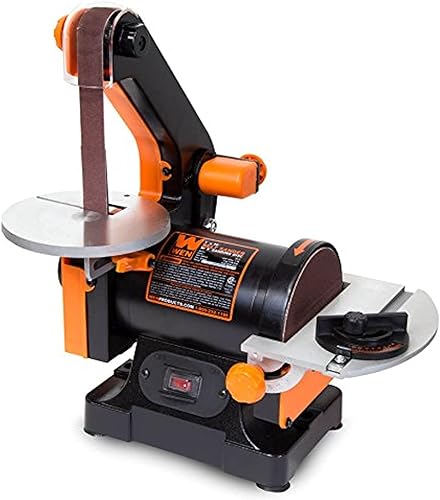
The WEN Benchtop Belt and Disc Sander is the best benchtop belt sander when you need two fixed sanding surfaces. For a bench setup that also includes a grinder, compare bench grinder and belt sander combos.
It combines a 1 x 30 in belt with a 5 in sanding disc.
The belt reaches up to 3160 FPM, and the disc reaches up to 3450 RPM. Use the belt for longer edge work and the disc for smaller edges, splinters and shaping tasks.
Its heavy-duty base is designed to reduce walking and wobbling during operation. The machine also includes a miter gauge, an 80-grit sanding disc, a 100-grit sanding belt and 2 dust ports.
At 16 lb, this is a workshop tool rather than a portable sander. Choose it when repeatable support matters more than carrying the tool to the workpiece.
It suits a fixed bench where small parts need steady passes and both hands stay free to guide the work. The trade-off is bench space and setup time, so leave room around the machine for dust hoses and safe access.
DEWALT 20V MAX* Belt Sander: Best for cordless large jobs
- Brushless motor
- Variable speed trigger and 25-speed dial
- Tool-free belt changes
- AirLock dust collection compatibility
The DEWALT gives cordless users a broad 3 x 21 in sanding surface and variable control. It is a strong fit for large jobs where moving a cord would slow the work.
Pros
- Brushless motor
- Two-handed overmolded auxiliary handle
- Quick-release belt system
Cons
- Tool only
- Battery-powered platform
The DEWALT 20V MAX* is the best cordless belt sander for large jobs where a power cord would limit movement. Its 3 x 21 in sanding surface covers a broad area, and the brushless motor is designed for demanding applications.
A variable speed trigger and 25-speed selection dial let you adjust the sanding action to the material and task. The quick-release system changes belts without tools, while the overmolded auxiliary handle supports two-handed use.
Dust collection works with a tool-free DEWALT AirLock system, sold separately. The box includes a DEWALT dust bag, 80-grit sandpaper and a dust port swivel.
This is a tool-only package, so account for the battery platform before choosing it. Pick the DEWALT when cordless access and broad coverage matter more than a ready-to-run corded setup.
It suits site work and large panels where moving around the workpiece matters most. The trade-off is battery planning, so check runtime needs and keep a charged spare within reach for longer sessions.
Woodskil 4.3A Belt Disc Sander Combo: Best for adjustable benchtop angles
- 4 x 36 in belt
- 6 in disc
- 0 to 90-degree belt position
- Two dust exhaust ports
The Woodskil provides a long belt, a 6 in disc and a belt position that moves from horizontal to vertical. It suits a workshop that needs contour sanding and angled support.
Pros
- Adjustable belt position
- Miter gauge
- Includes 2 dust ports and 2-year warranty
Cons
- 25 lb benchtop machine
- Needs a stable work area
The Woodskil 4.3A Belt Disc Sander Combo is the best benchtop choice for adjustable sanding positions. Its 4 x 36 in belt can move from 0 to 90 degrees, while the 6 in disc handles smaller work.
The 3/4 HP motor provides up to 1732 FPM on the belt and 3570 RPM on the disc. The work table adjusts from 0 to 45 degrees and includes a miter gauge for supported angled work.
Separate dust exhaust ports serve the belt and disc sides. The machine includes a transparent guard for checking the belt, 2 sandpapers and a 2-year warranty.
At 25 lb, it needs a stable place in the shop. Choose it if you need a long belt and adjustable position for shaping, contour sanding and bevel work.
It suits a workshop that shapes parts at changing angles without moving the workpiece to another tool. The trade-off is size and weight, so give it a firm bench and clear space for the full belt travel.
Jellas 7Amp Handheld Belt Sander: Best for aggressive finish removal
- 3 x 21 in belt
- 7 A motor
- 6 speed dials
- 10 sanding belts included
The 7 A motor and 3 x 21 in belt suit large, flat surfaces and finish removal. Its clamps also allow it to work as a bench sander when you need a fixed setup.
Pros
- 10 abrasive belts included
- Dust bag and 2 vacuum adapters
- 10 ft power cord
Cons
- Aggressive sanding needs careful pressure
- Corded design
The Jellas 7Amp Handheld Belt Sander is the best handheld belt sander for aggressive finish removal across large, flat surfaces. Its 3 x 21 in belt and 7 A motor suit boards, floors and other broad workpieces.
Six speed dials let you adjust the tool to the task. Jellas includes 10 aluminum oxide belts: 2 each in 40, 60, 80, 120 and 180 grit.
The tool can also be fixed to a table with 2 metal C clamps, turning it into a bench sander. A lock-on button, soft grip and 10 ft cord help during longer sanding sessions.
Dust collection includes a detachable bag and adapters for 35 mm and 32 mm vacuum connections. Use the arrow on each belt in the same direction as the arrow on the machine to reduce scratches and support proper belt operation.
It suits stripping finishes and levelling broad surfaces where fast removal saves time. The trade-off is aggressive cutting, so use light pressure and test the grit on a hidden area first.
BUCKTOOL Bench Belt Disc Sander: Best for direct-drive bench sanding
- 4 x 36 in belt
- 6 in disc
- 0 to 90-degree belt tilt
- Direct-drive motor shaft
The BUCKTOOL is a large fixed sander for bevels, contours and edge work. Direct drive removes the need to adjust a separate belt tension system.
Pros
- Belt tilts from horizontal to vertical
- Miter gauge
- Cast aluminum base and worktables
Cons
- Large 16.1 kg machine
- Not portable for room-to-room sanding
The BUCKTOOL Bench Belt Disc Sander is the best direct-drive option for a fixed workshop station. It combines a 4 x 36 in belt with a 6 in disc and a 3/4 HP fully enclosed induction motor.
The belt tilts from horizontal to vertical, and the driven drum supports curved workpieces. Two cast aluminum worktables and a cast aluminum base give the machine a firm platform for bevels, edges and contours.
The direct-drive design connects the belt and disc to the motor shaft. That means there is no separate belt tension adjustment to manage.
A quick belt replacement system and track control also help with routine setup.
This is the heaviest option here at 16.1 kg. Choose it when the sander will stay in one workshop location and you want a large belt with a disc on the same machine.
It suits regular edge work where repeatable support matters more than portability. The trade-off is floor space and weight, so plan a permanent bench position with room for dust collection around both sides.
VEVOR 7A Belt Sander 3 x 21 in: Best for handheld and benchtop flexibility
- 6 speeds from 630 to 1200 FPM
- Handheld or benchtop use
- Two clamps
- 10 sanding belts included
The VEVOR switches between handheld and clamped benchtop use. Six speeds and 10 included belts make it useful for rough removal through finer sanding.
Pros
- Two operating modes
- 630 to 1200 FPM range
- Dust bags and vacuum adapter
Cons
- Heavier 8.8 lb handheld body
- Lower score for less established finish control
The VEVOR 7A Belt Sander is the best handheld and benchtop belt sander for buyers who want both setups. Its 3 x 21 in belt works by hand, or the included 2 clamps can secure the tool to a work surface.
Six speeds range from 630 to 1200 FPM. Lower speeds suit more controlled detail sanding, while higher speeds help remove rough surfaces faster.
VEVOR includes 10 belts, with 2 each in 40, 60, 80, 120 and 180 grit. The package also includes 2 dust collection bags, a vacuum adapter, 2 bench clamps and a pair of carbon brushes.
At 8.8 lb, it is heavier than the compact models. Pick it if switching between portable and fixed sanding is more useful than having the lightest handheld body.
It suits DIY projects that move between a workbench and larger pieces that need handheld reach. The trade-off is weight during long handheld passes, so rest your arms and let the belt do the cutting.
CRAFTSMAN Electric 7 Amp Belt Sander: Best for simple close-edge sanding
- 3 x 21 in belt
- 800 FPM maximum speed
- Angled belt design
- Three-position overmolded handle
The CRAFTSMAN focuses on straightforward material removal with an angled belt that reaches closer to adjoining surfaces. It suits buyers who want a simple corded handheld tool.
Pros
- Tool-free belt release
- On-board dust bag
- Three-position handle
Cons
- 800 FPM maximum speed
- Fewer included abrasives
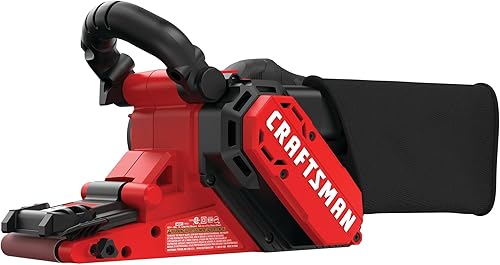
The CRAFTSMAN Electric 7 Amp Belt Sander is the best simple corded option for close-edge sanding. Its angled 3 x 21 in belt design reaches closer to adjoining surfaces while removing material at up to 800 FPM.
A tool-free belt release makes changes straightforward. The three-position overmolded handle gives you different grip positions, and the on-board dust bag collects sanding debris during use.
This package includes the CMEW213 belt sander, dust bag and sanding belt. It has fewer included abrasives than the Jellas or VEVOR, so plan to buy the grits your project needs.
Choose the CRAFTSMAN when you want a familiar, direct corded tool for boards and edge work. Its 800 FPM maximum speed is more moderate than several 7 A alternatives.
It suits straightforward material removal where a simple setup matters more than variable speed range. The trade-off is fewer included belts, so check the grit you need before starting the job.
How do you choose the best belt sander for woodworking?
Choose a belt sander by belt size, speed control, power source and whether you need handheld or fixed support. A 3 x 18 in belt is a balanced general choice, while a 3 x 21 in belt covers more surface during board and finish work.
A narrow 1/2 x 18 in belt is better for tight corners and small details. The WEN 6307 also pivots up to 55 degrees, which helps when the sanding angle matters more than coverage.
For a workshop machine, compare the belt and disc together. The WEN, Woodskil and BUCKTOOL models add a disc for smaller edges and shaping, but they require bench space.
Before buying, check the available work area, power source and dust setup. A corded tool suits a permanent shop outlet, while the DEWALT suits jobs where a battery platform is already part of your tools.
For compatible abrasives, see our guide to the best sanding belts and discs. If your tool uses the common 3 x 21 in format, compare the best 3x21 sanding belts before ordering replacement belts.
Is a belt sander better for flattening boards or removing finishes?
A belt sander is useful for fast material removal, but it is not a replacement for a planer when you need uniform thickness across a board. Use a belt sander for high spots, surface coatings and broad areas where controlled hand movement is possible.
Start with a coarse or medium belt only when the surface needs that level of removal. Keep the tool moving with the grain, use light pressure and make overlapping passes so one spot does not become lower than the surrounding wood.
Mark high spots with a pencil before you start, then check the surface often as the belt cuts. That habit helps you see progress and stops a small dip from turning into a hollow that is hard to blend back in.
For flattening, work in a steady rhythm and lift the sander at the end of each pass instead of digging in. A wide belt can remove a lot in one spot, so slower passes with lighter pressure usually give a flatter result.
Choose the grit to match the task, since coarse belts strip faster and finer belts smooth the surface after removal. Move through grits in order rather than jumping ahead, because leftover coarse scratches can show through a fine finish.
A support stand can change how you work with a handheld model. Our guide to the best belt sander stands covers fixed setups, while the belt sander vs planer comparison explains which tool fits flattening and thickness work.
If the board needs major thickness changes, treat the belt sander as a cleanup tool after a planer or jointer has done the heavy work. That order keeps the surface flat and saves belts from doing slow, uneven removal.
For finish removal, keep the same light touch and watch edges where coatings often build up. Test your pressure on a spare piece first, then work across the whole panel so the finish lifts evenly.
How should you manage dust and belt wear?
Use the dust bag or vacuum connection that matches the sander, and clear dust from the work area before changing belts. Dust collection helps reduce airborne debris, but it does not replace eye and breathing protection.
Empty the bag or check the vacuum often, since a full bag can reduce suction and let dust spill back into the work area. A clean workspace also makes it easier to see scratches, belt tracking problems and uneven sanding as you go.
A belt cleaner can remove packed material from an abrasive belt and may help it cut more consistently. See the best sanding belt cleaner picks for maintenance options.
Clean the belt when it starts to rub rather than cut, and stop the tool before you handle the abrasive. That simple step can extend belt life and keep the surface finish more even.
Keep the belt aligned and replace it when the abrasive is worn or the surface is damaged. Follow the direction arrow on belts that have one, especially with the Jellas model.
Store spare belts flat and away from moisture so the abrasive stays ready for the next job. Check the belt for tears or loose seams before fitting it, because a damaged belt can mark the wood and strain the tool.
Wipe down the sander after use and clear dust from around the rollers and vents. Regular care keeps the belt tracking true and helps the motor run without extra heat from packed debris.
What other belt sander formats should you consider?
A mini belt sander suits narrow work and detail sanding, while an air belt sander needs an appropriate compressed-air setup. The best mini belt sander guide is useful when a full-size 3 in belt feels too large.
You can also convert a drill for certain sanding tasks with the right attachment. Compare the best belt sander attachment for drill options when occasional use matters more than buying a dedicated sander.
For brand-specific searches, see the best sanding belt GXK51 guide and our best VEVOR belt sander comparison. Replacement parts also matter over time, including the best belt sander wheels and best belt sander pads.
If you prefer freedom from a power cord, compare the best cordless belt sander options. Cordless models trade outlet access for battery planning, while corded models can run as long as the work requires.
More guides on this topic
- Best Benchtop Belt Sanders for Woodworking
- Best Air Belt Sanders
Which best belt sander for woodworking should you buy?
Choose the WEN 6307 for tight corners, narrow work and angled detail sanding. Choose the SKIL 3 x 18 in for the best balance of belt coverage, pressure control, edge access and corded woodworking use.
Pick the DEWALT when cordless movement matters, or choose the WEN benchtop model when you want a belt and disc in one fixed machine. For aggressive finish removal, the Jellas adds a 3 x 21 in belt, 6 speed settings and 10 included belts.
If you sand small parts at a bench, the Woodskil or BUCKTOOL gives you a longer belt and a disc for shaping. Both need stable bench space, so choose based on the room you have and the angles you use most.
If you want one tool to move between handheld and fixed use, the VEVOR offers clamps and a broad included belt set. The CRAFTSMAN is the simpler pick when you want close-edge sanding without extra setup.
Match the final choice to the work you do most often. Detail work favours the narrow WEN, general corded work favours the SKIL, and large cordless jobs favour the DEWALT.
Check belt size, included abrasives and dust setup before you buy, since those details shape daily use. A tool that fits your space and power source will get used more and give better results.
Our top 3 picks at a glance
-
1
Best for tight corners and details
WEN 6307 Variable Speed Detailing File Sander
9.7/10 our score
See it on Amazon -
2
Best for general corded woodworking
SKIL 6 Amp 3 x 18 in Belt Sander
9.6/10 our score
See it on Amazon -
3
Frequently asked questions
What is the best belt sander for woodworking?
The best belt sander for woodworking depends on the job. The WEN 6307 is the strongest choice for tight corners and details, while the SKIL 3 x 18 in model is a better general corded option.
Choose the DEWALT for cordless work and a benchtop combo for fixed sanding.
Is a 3 x 21 belt sander good for woodworking?
Yes. A 3 x 21 in belt sander covers a broad area and suits flattening boards, smoothing large panels and removing finishes.
It needs steady movement and light pressure because a wide, fast belt can remove material quickly.
What is the best corded belt sander?
The SKIL 6 Amp 3 x 18 in belt sander is the best corded choice for most woodworking because it combines a useful belt size with pressure control, auto tracking, flush edge sanding and vacuum compatibility. Choose the Jellas for a 3 x 21 in belt and more included abrasives.
Can a belt sander flatten a board?
A belt sander can help flatten small high spots and remove finishes from a board, but it requires careful technique. Mark the surface, keep the sander moving with the grain and use light, even pressure.
For major thickness changes, a planer or jointer is usually the better tool.
What grit should you use with a belt sander?
Use a coarse grit for fast material removal, a medium grit to smooth the surface and a fine grit for the final pass. The Jellas and VEVOR include belts from 40 through 180 grit.
Start with the least aggressive grit that can do the job.