9 Best Benchtop Belt Sanders for Woodworking (November 2026)
The best benchtop belt sanders for woodworking include the WEN 6307 Variable Speed Detailing File Sander for tight corners, the BUCKTOOL 2x42 Belt Sander 6 in Bench Grinder for a mixed woodworking shop, and the WEN Benchtop Belt and Disc Sander (best compact combo sander).
On this page (6 sections)
The best benchtop belt sander for most woodworking shops is the BUCKTOOL 2 x 42-inch belt sander and 6-inch bench grinder. Its tilting belt, two worktables and 4480 FPM belt speed cover shaping, edge sanding and sharpening in one fixed machine.
Choose the WEN 6515T if you need a smaller belt-and-disc combo. Pick Woodskil or the larger BUCKTOOL 4 x 36-inch model when broad belt contact matters more than a compact footprint.
A stationary belt sander is useful for shaping small wooden workpieces, smoothing edges and refining bevels. It is different from a handheld belt sander, which moves across the surface instead of keeping the abrasive in one place.
For a wider overview, our guide to different types of sanders explains where belt, disc, orbital and detail sanders fit.
Our picks at a glance
-
1
 Best for tight corners
WEN 6307 Variable Speed Detailing File Sander
9.7/10 our score
See it on Amazon -
2
 Best for a mixed woodworking shop
BUCKTOOL 2x42 Belt Sander 6 in Bench Grinder
9.6/10 our score
See it on Amazon -
3
- 4
 Check it
Woodskil 4.3A Belt Disc Sander Combo
Best for broad wooden workpieces - 5
 Check it
DEWALT 20V MAX XR Cordless Bandfile Power
Best for portable detail sanding - 6
 Check it
BUCKTOOL Bench Belt Disc Sander for Woodworking
Best for direct-drive sanding - 7
 Best for variable-speed metal and wood workCheck it
- 8
 Check it
Jellas 7Amp Handheld Belt Sander
Best for a handheld belt sander bench setup - 9
 Check it
VEVOR Oscillating Belt and Spindle Sander
Best for curved and contoured edges
The best benchtop belt sanders for woodworking
The best benchtop belt sander depends on your workpiece size, belt format and need for angle control. The products below are ordered by score, with the most useful overall match first.
WEN 6307 Variable Speed Detailing File Sander: Best for tight corners
- 1/2 x 18 in belt
- 1080 to 1800 FPM variable speed
- 55-degree pivoting belt
- Tool-free belt changes
- Dust port attachment
The narrow pivoting belt suits small workpieces, tight corners and odd contours. Its compact 2.4 lb body is easier to guide than a full-size benchtop machine.
Pros
- Variable speed
- 55-degree belt pivot
- Auto-tracking belt system
Cons
- Narrow belt covers less area
- Handheld design rather than a fixed benchtop body
The WEN 6307 is the highest-scoring choice for tight corners and small details. Its 1/2 x 18-inch belt reaches narrow areas that are awkward for a wide fixed belt.
The variable speed dial runs from 1080 to 1800 feet per minute. That range lets you slow the belt for more control or increase speed when removing material from a suitable workpiece.
Its belt pivots up to 55 degrees, so you can approach angled edges and unusual contours without holding the tool at an awkward position. The auto-tracking system aligns the belt without tensioning or adjustment.
Tool-free belt installation makes grit changes faster during a project. The package includes three abrasive belts, a dust port attachment and a two-year warranty.
Choose it for detail sanding, tight corners and small wooden parts. If you need a fixed machine for long edges, choose one of the wider belt sanders below.
BUCKTOOL 2x42 Belt Sander 6 in Bench Grinder: Best for a mixed woodworking shop
- 2 x 42 in belt
- 6 in grinding wheel
- 0 to 90-degree belt angle
- Horizontal and vertical sanding
- Two worktables
This combo machine gives a woodworking bench both a belt sander and a 6-inch grinder. The cast iron base and two worktables suit projects that move between shaping, sharpening and finishing.
Pros
- Fast 2 x 42 belt
- Tilting belt housing
- Cast iron base
Cons
- Metalworking-focused grinder adds bulk
- Large 24.53 in height
The BUCKTOOL 2 x 42-inch combo is the best bench top belt sander for a mixed woodworking shop. Its 4480 FPM belt removes material quickly, while the 6-inch grinding wheel adds a second type of bench work.
The belt tilts from 0 to 90 degrees and the housing moves between horizontal and vertical positions. That range helps when you switch from edge sanding to longer workpieces or sharpening tasks.
Two worktables support different jobs. The cast iron belt table suits sharpening and metal work, while the cast aluminum table works with wood material.
A cast iron base with rubber feet helps limit vibration. The quick-release tension and tracking mechanism also make belt changes easier.
Choose this model when you want a fast 2 x 42 belt and a grinder in one machine. Its 24.53-inch height and metalworking focus make it less suitable for a very small bench.
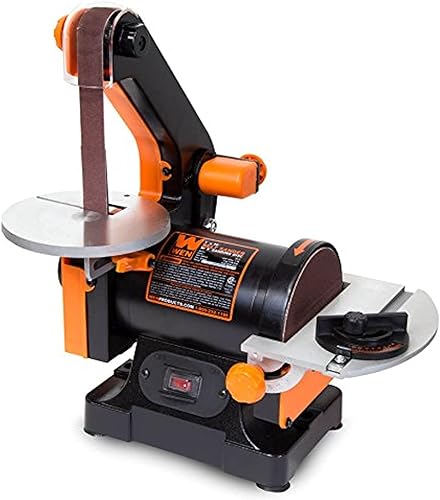
WEN Benchtop Belt and Disc Sander: Best compact combo sander
- 1 x 30 in belt
- 5 in sanding disc
- Two dust ports
- Miter gauge
- Heavy-duty base
The 1 x 30-inch belt and 5-inch disc cover edge sanding, bevels and small shaping tasks in one compact machine. Its 11.5 x 11.5-inch footprint is easier to place than larger combo sanders.
Pros
- Compact footprint
- Belt and disc in one tool
- Two dust ports
Cons
- Narrower belt than larger combo machines
- Lower belt speed than the BUCKTOOL 2 x 42
The WEN 6515T is the best compact combo sander in this group. It pairs a 1 x 30-inch belt with a 5-inch disc, giving you two sanding surfaces without the footprint of a larger 4 x 36-inch machine.
The 2.3 A motor drives the belt at up to 3160 FPM and the disc at up to 3450 RPM. Use the belt for straight edges and the disc for smaller end-grain or bevel work.
A heavy-duty base helps prevent walking and wobbling. The beveling work table and miter gauge support angled workpieces.
Two dust ports allow separate vacuum connections for the belt and disc. The package includes an 80-grit disc, a 100-grit belt, a miter gauge and a two-year warranty.
Choose it when storage space is limited and you want both sanding formats. The 1-inch belt is narrower than the belts on the larger combo machines.
Woodskil 4.3A Belt Disc Sander Combo: Best for broad wooden workpieces
- 4 x 36 in belt
- 6 in disc
- 0 to 90-degree belt adjustment
- 0 to 45-degree worktable
- Dual dust ports
The 4 x 36-inch belt gives more contact area for long edges and wider boards. Its adjustable belt and worktable also support beveling and contour work.
Pros
- Long 4 x 36 belt
- Adjustable worktable
- Separate dust exhaust ports
Cons
- 25 lb machine needs a planned bench location
- Slower belt speed than several smaller belts
The Woodskil 4.3A combo is the best choice for broad wooden workpieces. Its 4 x 36-inch belt gives more sanding contact than the 1 x 30-inch WEN and suits long edges.
The belt adjusts from 0 to 90 degrees, while the worktable adjusts from 0 to 45 degrees. That combination supports flat sanding, vertical sanding and angled work.
The 3/4 HP motor provides up to 1732 FPM and 3570 RPM. The lower belt speed can give more control, but it removes material more slowly than the BUCKTOOL 2 x 42-inch model.
Separate dust ports serve the belt and disc. A transparent guard helps you see the belt, and the machine includes a two-year warranty.
Choose it for longer boards, broad edges and contour work. At 25 lb, it needs a stable bench location with enough room around the 19.29 x 16.14-inch body.
DEWALT 20V MAX XR Cordless Bandfile Power: Best for portable detail sanding
- 20V battery power
- 5600 ft/min maximum speed
- 104-degree rotating arm
- Tool-free belt changes
- Variable speed dial and trigger
The rotating arm and cordless power suit detail work where a fixed belt sander cannot reach. It is a bare tool, so plan around the separate battery requirement.
Pros
- Cordless mobility
- Rotating contact arm
- Variable speed control
Cons
- Not a fixed benchtop sander
- Bare tool only
The DEWALT DCM200B is the best portable detail option, but it is not a traditional fixed benchtop machine. Its 20V battery power and 104-degree rotating arm help you reach awkward areas without routing a workpiece to a stationary belt.
The variable speed dial and trigger control the belt, which reaches up to 5600 feet per minute. Tool-free belt changes make it easier to switch belts during detail work.
The changeable contact arm supports different applications, while the rotating arm stores in a compact position. The included item is the bare tool only, so the battery is not part of this package.
Choose it when mobility matters more than a fixed work table. For repeatable edge sanding at a bench, a dedicated stationary model is easier to position.
BUCKTOOL Bench Belt Disc Sander for Woodworking: Best for direct-drive sanding
- 4 x 36 in belt
- 6 in disc
- 0 to 90-degree belt angle
- Direct-drive motor
- Two cast aluminum worktables
The direct-drive layout removes a separate belt-tension adjustment from the drive system. Its 4 x 36-inch belt, 6-inch disc and two worktables suit repeated edge and contour work.
Pros
- Direct-drive design
- Large belt and disc
- Horizontal and vertical sanding
Cons
- Heavy 16.1 kg body
- Large 23.82 x 11.61 in footprint
The BUCKTOOL BG4603-1 is the best direct-drive option for woodworking. Its 4 x 36-inch belt and 6-inch disc give broad sanding coverage, while the direct-drive design removes the need to adjust a separate drive-belt tension.
The 3/4 HP induction motor runs at up to 2161 FPM and 3450 RPM. The belt tilts from 0 to 90 degrees, and the driven drum can sand curved workpieces.
Two cast aluminum worktables support the belt and disc. The adjustable worktable and miter gauge help with bevels and angled cuts.
The cast aluminum base has rubber feet to limit vibration. A quick belt replacement design and track control function simplify belt changes and alignment.
Choose it for a large woodworking bench where direct drive and broad belt contact matter. Its 16.1 kg weight and 23.82-inch length make it a permanent shop tool rather than a portable sander.
VEVOR Belt Grinder Sander: Best for variable-speed metal and wood work
- 30 x 1 in belt
- 550W motor
- VFD variable speed
- Circular and flat grinding modes
- Horizontal and vertical use
The VFD gives this 30 x 1-inch machine a wider speed-control focus than a basic fixed-speed sander. It fits buyers who work across wood, metal, plastic or glass and need flat and circular grinding modes.
Pros
- Stepless speed control
- Two grinding modes
- Three sanding belts included
Cons
- 1-inch belt is narrow
- More focused on grinding and polishing than broad board sanding
The VEVOR Belt Grinder Sander is best for buyers who want variable speed across wood, metal, plastic or glass work. Its 550W motor, VFD control and 30 x 1-inch belt give it a different focus from standard woodworking combo sanders.
The belt line speed is 26 m/min, with stepless speed control for faster removal or finer sanding. It offers circular and flat grinding modes, so it can work on more than straight edges.
The machine supports horizontal and vertical use. Its reinforced steel body and detachable workbench let you change the working position.
The package includes 100, 180 and 240 grit belts, a circular grinding wheel, a flat grinding rack and an M6 Allen wrench. The motor reaches 5500 RPM.
Choose it when speed control and mixed-material grinding matter. Its narrow 1-inch belt is less efficient for broad wooden boards than a 4 x 36-inch belt.
Jellas 7Amp Handheld Belt Sander: Best for a handheld belt sander bench setup
- 3 x 21 in belt
- 6-dial variable speed
- Two metal C clamps
- Dust bag
- 10 sanding belts
The Jellas can work as a handheld sander or clamp to a table as a bench sander. The 3 x 21-inch belt and included grits make it useful for larger flat surfaces when you want a flexible setup.
Pros
- Handheld and clamped use
- Many included belt grits
- Detachable dust bag
Cons
- Requires clamping for fixed use
- Not a dedicated benchtop machine
The Jellas is the best handheld belt sander for a bench setup when you want one tool to serve two roles. Its 3 x 21-inch belt works by hand, or you can turn the tool over and secure it to a table with the two metal C clamps.
A six-dial speed control adjusts the stated speed from 120 to 400 RPM. The lock-on button can reduce hand pressure during longer sanding sessions.
The package includes 10 aluminum oxide belts: two each of 40, 60, 80, 120 and 180 grit. A detachable dust bag collects dust, and the design supports 32 mm and 35 mm vacuum ports.
Install the belt with its arrow facing the same direction as the arrow on the machine. Run it for about one minute before sanding so you can check alignment, then adjust tracking if needed.
Choose it when you need a flexible belt sander bench arrangement without buying a dedicated fixed machine. It requires more setup for stable bench use than the stationary models.
VEVOR Oscillating Belt and Spindle Sander: Best for curved and contoured edges
- 24 x 3.86 in sanding belt
- Five sanding sleeves
- 5/8 in oscillating stroke
- 0 to 45-degree tilting table
- Dust port
This machine adds oscillating spindle sanding to a belt format, making it useful for curved and contoured furniture parts. The sleeves and table inserts give more shape options than a straight belt alone.
Pros
- Five sleeve sizes
- Oscillating action
- Tilting worktable
Cons
- Less suited to long straight edges
- Heaviest machine here at 37.5 lb
The VEVOR oscillating belt and spindle sander is the best choice for curved and contoured edges. Its 24 x 3.86-inch belt and five sanding sleeves cover shapes that a straight belt cannot reach as easily.
The five sleeves measure 1/2, 3/4, 1, 1-1/2 and 2 inches. The 5/8-inch oscillating stroke helps the abrasive move across the work area instead of staying on one narrow line.
Its 0 to 45-degree tilting table supports angled sanding. The machine also includes five table inserts and integrated storage slots for sleeves and inserts.
A 1.38-inch inside diameter and 1.52-inch outside diameter dust port can connect to a vacuum hose. The 4 A motor runs at up to 2400 RPM.
Choose it for furniture parts, curved edges and contour sanding. It is less suitable than a standard belt sander for long straight edges, and its 37.5 lb weight makes it a permanent bench tool.
How we compared these bench top belt sanders
We compared belt size, speed, angle adjustment, worktable support, dust collection and the type of work each machine suits. Our score weighs specs, features and buyer feedback against the needs of a woodworking searcher.
A 4 x 36-inch belt gives more contact area for long edges. A 2 x 42-inch belt is narrower but faster in this group, while a 1 x 30-inch belt keeps the machine smaller.
Combo sanders add a disc for end grain, bevels and small surfaces. That extra surface takes more bench space, so measure the available area before choosing a belt disc sander.
Variable speed is useful when you need to slow down for control or adjust the abrasive action. Fixed-speed machines can be simpler, but they give you fewer choices when the material or task changes.
For a broader comparison, see our guide to the best belt disc sanders for woodworking.
What should you look for in a best benchtop belt sander?
Look for a belt size that matches your workpieces, a stable base and an angle range that supports the edges you shape most often. Dust ports and easy belt changes also matter because sanding creates frequent cleanup and grit changes.
A wider belt can smooth a longer edge with fewer passes. A narrow belt may be easier to control on small parts, but it covers less area.
Check the machine's dimensions and weight against your bench. The smallest fixed option here measures 11.5 x 11.5 x 15.5 inches, while larger models need much more length or height.
A belt sander stand can help when your bench height or available surface is not suitable. See our guide to the best belt sander stand before planning a fixed setup.
How do you use a bench top belt sander safely?
Use eye protection, keep loose clothing away from the belt, secure the machine or workpiece, and let the abrasive reach full speed before contact. Keep your hands clear of the belt path and disconnect power before changing belts or making adjustments.
Start with a coarse belt only when you need faster material removal. Move to a finer grit for smoothing, and avoid pressing hard because extra force can damage the workpiece or overload the abrasive.
Connect the dust port when the machine supports one. Empty dust collection often, and keep wood dust away from heat and electrical parts.
Check belt tracking before sanding. If the belt wanders, stop the machine and make the adjustment described for that model.
Should you choose a belt sander or another sander?
Choose a benchtop belt sander for fast edge shaping and material removal on small workpieces. Choose an orbital sander for a finer general surface finish, and choose a spindle sander when curved edges are the main job.
A handheld belt sander gives you more movement across a large surface. Our guide to the best belt sander for woodworking compares that format with fixed sanding options.
If you're new to handheld sanding, read what is a hand sander before deciding which format fits your work.
A belt grinder is a different tool class with a stronger focus on grinding and polishing. Read our belt sander vs belt grinder guide if you work with both wood and metal.
What is the best benchtop belt sander for woodworking?
The best benchtop belt sander for most woodworking shops is the BUCKTOOL 2 x 42-inch combo, because its fast belt, adjustable position and two worktables cover several bench tasks. Pick the WEN 6515T for a compact belt-and-disc machine, or Woodskil for a longer 4 x 36-inch belt.
Choose the WEN 6307 when tight corners matter most. Choose DEWALT when cordless detail work matters, Jellas when you want a clampable handheld tool, and the VEVOR oscillating model when curved edges need sleeve sanding.
A benchtop belt sander is best when the workpiece is small enough to guide safely and the job needs controlled shaping or smoothing. If your main goal is changing board thickness, compare the tool with a planer in our belt sander vs planer guide.
Our top 3 picks at a glance
-
1
Best for tight corners
WEN 6307 Variable Speed Detailing File Sander
9.7/10 our score
See it on Amazon -
2
Best for a mixed woodworking shop
BUCKTOOL 2x42 Belt Sander 6 in Bench Grinder
9.6/10 our score
See it on Amazon -
3
Frequently asked questions
What is the best benchtop belt sander for woodworking?
The best benchtop belt sander depends on the work. The BUCKTOOL 2 x 42-inch combo is the strongest general choice for a mixed shop, while the WEN 6515T fits compact belt-and-disc work.
Choose Woodskil or BUCKTOOL's 4 x 36-inch model for longer edges and wider boards.
What is the difference between a belt sander bench and a handheld belt sander?
A belt sander bench holds the machine in a fixed position while you guide the workpiece. A handheld belt sander moves across the wood instead.
Some handheld models, such as the Jellas, can be clamped to a table, but a dedicated bench top belt sander usually gives a more stable setup.
What belt size is best for woodworking?
A 4 x 36-inch belt gives broad contact for long edges and larger boards. A 2 x 42-inch belt offers a useful balance of speed and control, while a 1 x 30-inch belt takes less bench space.
Match the belt size to the workpieces you sand most often.
Can a benchtop belt sander replace a planer?
A benchtop belt sander can smooth and shape surfaces, but it is not a direct replacement for a planer. A planer removes material across a board to create a more even thickness, while a belt sander is better for edge shaping, smoothing and small corrections.
See our belt sander vs planer guide for the difference.