9 Best Reciprocating Saw Blades for Pruning (November 2026)
The best reciprocating saw blades for pruning trees include the Diablo Demo Demon Carbide Tipped Reciprocating Saw for carbide pruning cuts, the EZARC Arc Edge Reciprocating Saw Blades for long reach on large limbs, and the WORKPRO Wood Pruning Reciprocating Saw Blade Set for mixed branch sizes.
On this page (3 sections)
The best reciprocating saw blade for pruning trees depends on branch size and reach. The Diablo Demo Demon is the top pick for clean wood pruning with a 9 in carbide edge, while a 12 or 15 in arc blade suits larger limbs.
Pruning blades usually have coarse teeth and larger gullets to move wood chips out of the cut. For green wood, wet branches or resinous limbs, choose a blade made for pruning and keep the cut supported so the blade doesn't bind.
Our picks at a glance
-
1
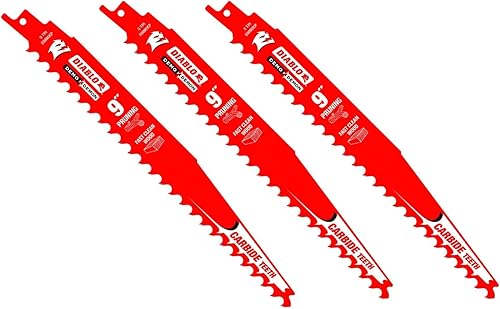 Best for carbide pruning cuts
Diablo Demo Demon Carbide Tipped Reciprocating Saw
9.7/10 our score
See it on Amazon -
2
 Best for long reach on large limbs
EZARC Arc Edge Reciprocating Saw Blades
9.5/10 our score
See it on Amazon -
3
 Best for mixed branch sizes
WORKPRO Wood Pruning Reciprocating Saw Blade Set
9.4/10 our score
See it on Amazon
- 4
 Check it
EZARC Reciprocating Saw Blades
Best for regular 9-inch pruning - 5
 Best for a 9-inch Bosch pruning setCheck it
- 6
 Check it
WORKPRO 15-Inch Arc Edge Reciprocating Saw Blades
Best for a five-blade long-reach set - 7
 Check it
SEDY 12 Inch Japanese Teeth Reciprocating Saw
Best for 12-inch arc-edge reach - 8
 Check it
ASPRO Arc Curved Reciprocating Saw Blades
Best for wet and resinous branches - 9
 Check it
ANGELSWORD 12&15“ Arc Shaped Reciprocating Saw Blades
Best for two long blade lengths
Which reciprocating saw blades for pruning fit different jobs?
The Diablo is the strongest fit for clean wood pruning, while longer arc blades suit large limbs and shorter sets cover routine branch work. We compared blade length, tooth pattern, pruning features and the range of tasks each product is designed to handle.
Our score weighs specs, features and buyer feedback against what you're shopping for. Blade compatibility still matters, so check your saw manual and the blade's fit notes before buying.
| Product | Best for | Length | Teeth | Pack | Our score |
|---|---|---|---|---|---|
| Diablo Demo Demon Carbide Tipped Reciprocating Saw | carbide pruning cuts | 9 in | 3 TPI | 3 blades | 9.7 |
| EZARC Arc Edge Reciprocating Saw Blades | long reach on large limbs | 15 in | 6 TPI | 3 blades | 9.5 |
| WORKPRO Wood Pruning Reciprocating Saw Blade Set | mixed branch sizes | 5 TPI | 10 blades | 9.4 | |
| EZARC Reciprocating Saw Blades | regular 9-inch pruning | 9 in | 5 TPI | 5 blades | 9.3 |
| BOSCH RP95 5 pc. 9 In. | a 9-inch Bosch pruning set | 9 in | 5 TPI | 5 blades | 9.1 |
| WORKPRO 15-Inch Arc Edge Reciprocating Saw Blades | a five-blade long-reach set | 15 in | 6 TPI | 5 blades | 8.8 |
| SEDY 12 Inch Japanese Teeth Reciprocating Saw | 12-inch arc-edge reach | 12 in | 6 TPI | 5 blades | 8.6 |
| ASPRO Arc Curved Reciprocating Saw Blades | wet and resinous branches | 12 in | 6 TPI | 3 blades | 8.4 |
| ANGELSWORD 12&15“ Arc Shaped Reciprocating Saw Blades | two long blade lengths | 6 TPI | Five blades, two lengths | 8.1 |
How does the best reciprocating saw blade for pruning compare?
The best match depends on the branch diameter and the room you have to move the saw. A 9 in blade offers more control in close work, while a longer blade adds reach but needs a steady grip and aligned cut.
Diablo Demo Demon Carbide Tipped Reciprocating Saw: Best for carbide pruning cuts
- 9 in blade
- Carbide tipped
- Designed for pruning and clean wood
- Perma-SHIELD non-stick coating
A carbide edge and 3 TPI tooth design suit pruning and clean wood cutting. The oversized blade body is intended for intense cutting tasks.
Pros
- Carbide cutting edge
- Designed for pruning and clean wood
- Three blades per pack
Cons
- 9 in length offers less reach than longer pruning blades
- Designed for clean wood, not wood with nails
Diablo's 9 in Demo Demon is designed for pruning and clean wood cutting. Its 3 TPI carbide tooth design has large gullets to clear chips, and the Perma-SHIELD coating is intended to reduce gumming and friction.
The oversized blade body is intended for intense cuts, but its 9 in length is less suited to reaching around large limbs than the 12 and 15 in picks below. Diablo says its carbide edge can last up to 50 times longer than standard pruning blades, a maker claim rather than a guarantee for every job.
Choose it for clean wood pruning where carbide and chip removal matter. For general wood-cutting options beyond pruning, see our guide to best reciprocating saw blades for wood.
EZARC Arc Edge Reciprocating Saw Blades: Best for long reach on large limbs
- 15 in arc edge
- 6 TPI Japanese style teeth
- Designed for wet, dry and green wood
- Three blades per pack
The extra-long arc edge is designed for larger branches and limbs, with deep gullets to clear chips. EZARC says it cuts wood up to 300 mm in diameter.
Pros
- Extra reach for larger branches
- Arc profile and deep gullets
- Designed for wet and green wood
Cons
- Not compatible with Ryobi reciprocating saws
- Long blade needs careful alignment to avoid side pressure
EZARC's 15 in Arc Edge blade is designed for larger branches, limbs and wet or green wood. Its curved profile, triple-ground offset teeth and deep gullets aim to keep the cut smooth and move chips clear.
EZARC gives a cutting capacity of up to 300 mm in diameter. The extra reach can help when a limb is awkwardly placed, but the long blade needs good support and a straight cut to avoid side pressure.
The shank fits many major brands, though EZARC says it's not compatible with Ryobi reciprocating saws. Consider this set for large limbs; for root cuts, see our guide to the best reciprocating saw blade for tree roots.
WORKPRO Wood Pruning Reciprocating Saw Blade Set: Best for mixed branch sizes
- 6 in and 9 in blades
- 5 TPI
- HCS construction
- Organizer case included
Two blade lengths help match the cut to the branch. WORKPRO recommends the 6 in blades for branches under 100 mm and the 9 in blades for branches under 150 mm.
Pros
- Two useful lengths
- Made for wet wood and branches
- Organizer case included
Cons
- HCS construction is aimed at wood pruning
- Shorter blades have less reach for thick limbs
The WORKPRO set gives you both 6 in and 9 in pruning blades, so you can choose a shorter blade for a small branch and a longer one for a wider cut. WORKPRO recommends the 6 in blades for branches under 100 mm and the 9 in blades for branches under 150 mm.
The 5 TPI HCS blades are designed for wet wood and branches. Five blades of each length and an organizer case make this a practical set for routine yard work where branch sizes vary.
Pick it if you want multiple short and medium blades in one set. If a 12 in pruning blade better matches your reach needs, compare our best 12-inch reciprocating saw pruning blade.
EZARC Reciprocating Saw Blades: Best for regular 9-inch pruning
- 9 in blade
- 5 TPI
- Fleam-ground teeth and deep gullets
- Five blades per pack
These 9 in blades are designed for tree trimming, wet wood and pruning. The aggressive 5 TPI pattern balances fast cutting with a more controlled cut than a very coarse pattern.
Pros
- Five blades per pack
- Designed for wet wood and pruning
- Universal shank fits many saw brands
Cons
- Not recommended for wood with nails
- No longer blade option in the pack
EZARC's 9 in 5 TPI blades are made for pruning, tree trimming and wet wood. Fleam-ground teeth and deep gullets are designed to cut aggressively while clearing wood fibers between strokes.
The five-pack gives you spares for recurring landscaping work. EZARC says these blades also suit plastic pipes, but they're not recommended for wood with nails.
Choose this set when your branches fit a standard 9 in blade and you want more than one replacement on hand. For heavier wood cuts, our best reciprocating saw blades for hardwood covers a different tooth and blade selection problem.
BOSCH RP95 5 pc. 9 In.: Best for a 9-inch Bosch pruning set
- 9 in high-carbon steel
- 5 TPI
- Precision ground blade
- Five blades per pack
Bosch's RP95 is a 9 in high-carbon steel blade set designed for wood pruning. Its precision-ground edge and 5° tilt angle are intended to support faster cuts.
Pros
- Five pruning blades
- High-carbon steel
- Designed for wood
Cons
- No extended reach for larger branches
- Wood focused, so it isn't a demolition blade
Bosch's RP95 is a 9 in high-carbon steel blade with 5 TPI for wood pruning. Its precision-ground edge and 5° tilt angle are designed to support fast cuts and longer blade life.
This five-piece set makes sense if you want several pruning blades in a familiar length. It lacks the extra reach of arc-edge options, so choose a longer blade when limbs are too wide or awkward for 9 in.
WORKPRO 15-Inch Arc Edge Reciprocating Saw Blades: Best for a five-blade long-reach set
- 15 in arc edge
- 6 TPI Japanese style teeth
- CR-V steel
- Five blades per pack
A 15 in arc profile and deep chip gullets suit larger branches, green wood and outdoor cleanup. The five-blade pack fits buyers who want several long pruning blades.
Pros
- Long reach for limbs
- Arc edge and triple-ground teeth
- CR-V steel construction
Cons
- Long blade can be harder to control in tight spaces
- No shorter blades for small branches
WORKPRO's 15 in arc-edge blades use 6 TPI Japanese-style teeth and CR-V steel. Triple-ground offset teeth and deep chip gullets are designed to clear wet wood chips and green fibers during coarse cuts.
This five-pack suits repeat outdoor pruning where reach is more useful than a compact blade. The long body can be awkward in tight spaces, so use a shorter blade for small branches near a trunk or fence.
SEDY 12 Inch Japanese Teeth Reciprocating Saw: Best for 12-inch arc-edge reach
- 12 in arc edge
- 6 TPI Japanese style teeth
- Deep gullets
- Five blades and storage box
The 12 in arc edge gives more reach than a standard 9 in pruning blade while remaining shorter than 15 in options. Its coarse teeth and deep gullets are designed for branches and green wood.
Pros
- Middle length for added reach
- Arc edge and deep gullets
- Five blades with storage box
Cons
- No specific branch diameter guidance
- Longer than needed for small, close cuts
SEDY's 12 in arc-edge blades offer a middle length between 9 and 15 in options. The 6 TPI Japanese-style teeth and deep gullets are designed for branches, green wood and pruning, with five blades and a storage box in the set.
The product details don't give a branch diameter limit, so use the branch and saw as your guide. Choose this set when you need extra reach but want a blade shorter than 15 in.
ASPRO Arc Curved Reciprocating Saw Blades: Best for wet and resinous branches
- 12 in curved arc edge
- 6 TPI fleam-ground teeth
- U-groove chip clearance
- Three blades per pack
The curved edge and U-shaped groove are designed to clear chips and wood fibers in wet or resinous wood. Its 12 in length suits medium-to-thick branches and small logs.
Pros
- Designed for wet and green wood
- U-groove and deep gullets
- Three blades per pack
Cons
- No shorter blade for small branches
- Arc shape may feel less familiar than straight blades
ASPRO's 12 in curved blades are designed for wet, green and resinous wood. The U-shaped groove and deep gullets are intended to clear loose chips and stringy fibers, while the fleam-ground 6 TPI teeth cut aggressively.
Three blades come in the set. This is a useful fit for medium-to-thick branches and small logs, especially when damp fibers tend to build up around the cut.
ANGELSWORD 12&15“ Arc Shaped Reciprocating Saw Blades: Best for two long blade lengths
- 12 in and 15 in arc-shaped blades
- 6 TPI
- CR-V steel
- Five blades per pack
This set combines 12 in and 15 in arc-shaped blades for different branch sizes. The 6 TPI teeth are designed for branches, wet wood, firewood and logs.
Pros
- Two longer blade lengths
- Arc shape and triple-ground teeth
- Fits many major saw brands
Cons
- No short blade for close pruning
- Branch diameter guidance is based on the longer blade options
ANGELSWORD includes both 12 in and 15 in arc-shaped blades, giving you two longer sizes for different limbs. The 6 TPI triple-ground offset teeth are designed for branches, wet wood, firewood and logs.
The set has no short blade, so it may be less handy for close trimming around small branches. Choose it if your pruning jobs often need reach and you want two longer lengths available.
How do you choose a reciprocating saw pruning blade?
Choose a pruning blade by branch diameter, blade reach, tooth pattern and saw compatibility. A longer blade can reach further into a tree, but a blade that is too long for the available space can be harder to guide accurately.
What blade length suits a branch?
A blade should extend past the branch through the full stroke without the saw body striking nearby limbs. For smaller branches and close cuts, a 6 or 9 in blade is easier to manage than a 15 in blade.
For thick or awkward limbs, a 12 or 15 in blade adds reach. Keep the blade supported and aligned, because twisting or pushing sideways can bend or break it.
Do arc-edge blades help on round branches?
Arc-edge blades can keep more of the cutting edge in contact with a round branch. Their shape and tooth profiles are designed to reduce friction and binding on larger limbs, though a straight blade can be simpler to position for small, precise cuts.
Use a curved blade when its longer reach and profile suit the branch. For basic saw selection, our guide to how to match a saw blade to the tool and material explains how blade purpose, material and tool fit work together.
Can one blade cut both green and dry wood?
Many pruning blades are designed for both wet or green wood and dry wood, but chip removal matters more when the cut is damp or stringy. Coarse teeth and deep gullets can help carry fibers out of the cut.
Check the blade's stated use before cutting wood with nails or other debris. A pruning blade is built for wood, and a different blade may suit mixed or demolition material better; our overview of best reciprocating saw blades covers broader uses.
How should you keep the blade from binding?
Support the branch so it doesn't pinch the blade as the cut closes. Keep the saw aligned with the cut and avoid twisting, heavy pressure or using the blade as a lever.
For large branches, cut in a position where the saw and blade have room to move safely. If the cut is above shoulder height or beyond a stable reach, use a safer access method rather than stretching with a running saw.
Which pruning blade should you pick?
Pick Diablo for a 9 in carbide blade designed for clean wood pruning, WORKPRO's mixed set for routine branches in two sizes, or an arc-edge 12 or 15 in blade for larger limbs and more reach. Check your saw's shank fit and choose the shortest blade that clears the branch.
If you need to choose a blade for a different saw type, our guide to best 10 inch table saw blades explains why blade shape and tool compatibility matter. A reciprocating saw is also different from a jigsaw in how it moves and handles cuts, as explained in what is the difference between a jigsaw and a reciprocating saw.
Our top 3 picks at a glance
-
1
Best for carbide pruning cuts
Diablo Demo Demon Carbide Tipped Reciprocating Saw
9.7/10 our score
See it on Amazon -
2
Best for long reach on large limbs
EZARC Arc Edge Reciprocating Saw Blades
9.5/10 our score
See it on Amazon -
3
Best for mixed branch sizes
WORKPRO Wood Pruning Reciprocating Saw Blade Set
9.4/10 our score
See it on Amazon
Frequently asked questions
What TPI is best for pruning with a reciprocating saw?
A coarse tooth pattern around 5 or 6 TPI is common for pruning because it can clear wood chips as it cuts through branches. A lower TPI blade can cut aggressively, while a finer pattern may feel slower in green wood.
Match the tooth pattern to the branch and keep the blade steady through the cut.
Are curved reciprocating saw blades better for pruning?
A curved or arc edge can keep more teeth in contact with a round branch and help reduce binding. It can be useful on larger limbs, but a straight blade is often easier to position for smaller branches or close cuts.
Choose by branch size, reach and the space around the cut.
What blade length should I use for tree branches?
Use a blade long enough to pass through the branch without the saw body hitting nearby wood. Six and 9 in blades suit smaller branches, while 12 and 15 in blades add reach for larger limbs.
Long blades need careful control, so avoid twisting or pressing sideways.
Can a reciprocating saw prune green wood?
Yes. Choose a wood pruning blade with coarse teeth and deep gullets, since green and wet fibers can clog a blade with a fine tooth pattern.
Support the branch when possible, keep the saw aligned and let the tool do the cutting rather than forcing the blade.