9 Best Table Saw Blades for Woodworking (November 2026)
The best table saw blades for woodworking include the WEN BL1060 10-Inch 60-Tooth Fine-Finish Professional Woodworking for fine crosscuts, the DEWALT Table Saw Blade for clean everyday cuts, and the Revvstark 10 Inch 80T Table Saw Blades for fine panel cuts.
On this page (5 sections)
The best table saw blades for woodworking balance cut speed and finish: a 40-tooth blade suits general work, while 60- and 80-tooth choices favor cleaner cuts. Match blade diameter, arbor, kerf and speed rating to your saw before you buy.
A blade that works well for ripping a stack of boards may leave a rougher edge on a visible crosscut. For most shops, the useful choice is the blade that fits your regular stock and finish needs, not the one with the largest tooth count.
Our picks at a glance
-
1
 Best for fine crosscuts
WEN BL1060 10-Inch 60-Tooth Fine-Finish Professional Woodworking
9.7/10 our score
See it on Amazon -
2
-
3

- 4
 Check it
WEN BL1040 10-Inch 40-Tooth Carbide-Tipped Professional Woodworking
Best for mixed shop tasks - 5
 Check it
DEWALT 10 in. 24 Tooth General Purpose
Best for faster rip cuts - 6
 Best for smooth crosscutsCheck it
- 7
 Check it
Luckyway 10 Inch Table Saw Blade 80T
Best for a spare fine-cut blade - 8
 Check it
FOXBC 8-1/4 Inch Table Saw Blade
Best for compatible compact saws - 9
 Check it
MarvTool 10-Inch 60-Tooth Woodworking Saw Blade
Best for varied wood panels
Which table saw blades for woodworking suit different cuts?
The WEN BL1060 is the top fine-finish choice, while the DEWALT 40-tooth blade is a strong everyday pick. Use the 24-tooth DEWALT for faster ripping and reserve 80-tooth options for smoother cuts in wood and panels.
WEN BL1060 10-Inch 60-Tooth Fine-Finish Professional Woodworking: Best for fine crosscuts
- 10-inch diameter
- 60 carbide-tipped teeth
- 5/8-inch arbor
- 1/10-inch kerf
A 60-tooth carbide-tipped blade aimed at fine-finish wood cutting. WEN lists it for hard and softwoods and most 10-inch table saws.
Pros
- Fine-finish tooth count
- Thin kerf
- WEN lists table saw compatibility
Cons
- Not the lowest tooth count for fast ripping
The WEN BL1060 pairs a 10-inch diameter with 60 carbide-tipped teeth for fine-finish wood cutting. WEN lists it for hard and softwoods and says it fits most 10-inch table saws, jobsite saws and miter saws.
Its 5/8-inch arbor is common on many 10-inch saws, but confirm the arbor and blade clearance in your saw manual. The 1/10-inch kerf is a thin cut width, which can be useful when reducing material waste or when your saw has limited power.
Choose this blade when finish quality matters more than the fastest rip rate. Its tooth count also makes it a sensible option for crosscuts in solid wood and sheet goods.
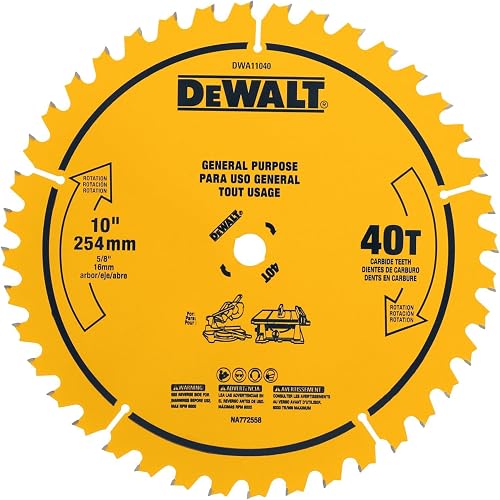
DEWALT Table Saw Blade: Best for clean everyday cuts
- 10-inch blade
- 40 teeth
- Ultra-sharp carbide
- Optimized tooth geometry
A 40-tooth wood blade with fine-finish positioning and optimized tooth geometry. It suits buyers who want one blade for a mix of routine cuts.
Pros
- 40-tooth middle ground
- Carbide-tipped teeth
- Designed for clean cutting
Cons
- Arbor and kerf need confirmation for your saw
The DEWALT 40-tooth blade is a balanced option for routine cuts where you want a cleaner edge than a low-tooth ripping blade can provide. Its optimized tooth geometry and ultra-sharp carbide are designed for accuracy and clean cutting.
The 40-tooth count sits between a faster, lower-tooth rip blade and a finer, higher-tooth blade. That makes it a useful choice if you would rather avoid frequent blade changes for everyday woodworking.
Confirm the blade diameter and arbor before buying, since those details are not included in the product information here. If you want a wider comparison of 10-inch options, see best 10 inch table saw blades.
Revvstark 10 Inch 80T Table Saw Blades: Best for fine panel cuts
- 10-inch diameter
- 80 carbide teeth
- 5/8-inch arbor
- Wood and composite applications
An 80-tooth option for wood and composite materials, including plywood, MDF and panels. Check the saw's manual for compatible blade and speed limits.
Pros
- High tooth count for fine cuts
- Broad stated wood and panel applications
- 5/8-inch arbor
Cons
- High tooth count may cut more slowly in thick stock
Revvstark's 80-tooth blade is intended for wood and composite cutting, including plywood, MDF, chipboard and panels. Its 5/8-inch arbor and 10-inch diameter match many saw setups, though your saw's manual is the final guide.
A high tooth count can help produce a smoother edge in thinner stock and crosscuts. Feed the work at a steady pace and avoid forcing the blade, especially in dense or thick material.
Revvstark also lists plastic and laminated panels among its uses. For specialized materials, verify the material and blade combination with the saw and blade makers rather than assuming a woodworking blade is suitable for every sheet.
For metal work, see table saw blades for metal.
WEN BL1040 10-Inch 40-Tooth Carbide-Tipped Professional Woodworking: Best for mixed shop tasks
- 10-inch diameter
- 40 carbide-tipped teeth
- 5/8-inch arbor
- 1/10-inch kerf
A general-purpose woodworking blade for hard and softwoods. Its 40 teeth make it a practical middle option for mixed cutting tasks.
Pros
- General-purpose tooth count
- Thin kerf
- WEN lists table saw compatibility
Cons
- Fewer teeth than fine-finish choices
The WEN BL1040 is a general-purpose 10-inch woodworking blade with 40 carbide-tipped teeth. WEN lists it for both hard and softwoods and for most 10-inch table saws, jobsite saws and miter saws.
Its 5/8-inch arbor and 1/10-inch kerf make the fit details easy to compare with the BL1060. The lower tooth count favors a more versatile pace across routine cuts, though it won't be as focused on fine crosscuts as a 60- or 80-tooth blade.
Choose it when you want a single blade for mixed shop tasks. If hardwood is your main material, compare more options in our guide to the best table saw blade for hardwood.
DEWALT 10 in. 24 Tooth General Purpose: Best for faster rip cuts
- 10-inch blade
- 24 teeth
- Ultra-sharp carbide
- Hardwood, softwood and sheet material applications
A 24-tooth blade suited to buyers who prioritize faster, less refined cuts, especially along the grain. DEWALT describes its tooth geometry as designed for accuracy.
Pros
- Low tooth count for ripping tasks
- Carbide-tipped teeth
- Stated uses include sheet goods
Cons
- Less suited to fine crosscuts than higher-tooth blades
The DEWALT 24-tooth blade is the low-tooth option here for faster cuts along the grain. DEWALT lists hardwood, softwood, trim, plywood, OSB and sheet material among its compatible materials.
A lower tooth count leaves more space between teeth to clear chips during a rip. The tradeoff is a rougher edge than a higher-tooth blade may leave, so plan to sand or make a finishing pass when the cut will show.
For a blade focused on ripping, see our best table saw blade for ripping. Use the 24-tooth pick when speed and stock removal matter more than a polished crosscut edge.
FOXBC 10-Inch Table Saw Blade: Best for smooth crosscuts
- 10-inch diameter
- 80 teeth
- 0.098-inch kerf
- 5/8-inch arbor
This 80-tooth blade is intended for fine wood cuts, including oak, pine, plywood and moulding. FOXBC specifies a 5/8-inch arbor.
Pros
- High tooth count
- Thin kerf
- Named wood and sheet-good uses
Cons
- Confirm compatibility and speed limits before use
FOXBC's 80-tooth blade is positioned for ultra-finish wood cutting, with stated uses that include oak, pine, melamine, plywood and moulding. It has a 0.098-inch kerf and 5/8-inch arbor.
The tooth count favors finish over rapid stock removal. It can be a fit for trim or panels where a clean edge matters, provided the blade diameter and speed suit your saw.
If your work includes melamine, check the dedicated best table saw blade for melamine guide for options tailored to that surface. This pick remains a broad woodworking choice, so assess the specific cut and material first.
Luckyway 10 Inch Table Saw Blade 80T: Best for a spare fine-cut blade
- Two 10-inch blades
- 80 carbide-tipped teeth
- 5/8-inch arbor
- 0.1-inch kerf
A two-blade set with 80 teeth per blade for fine wood cutting. It names oak, pine, plywood, laminate and moulding among its uses.
Pros
- Two blades in the set
- High tooth count
- 5/8-inch arbor
Cons
- Confirm the saw's blade requirements
Luckyway's set includes two 10-inch, 80-tooth blades with 5/8-inch arbors. Each has a 0.1-inch kerf and is described for fine wood cutting, including oak, pine, melamine, plywood, laminate and moulding.
A two-blade set can keep a spare available when one blade needs cleaning or sharpening. Check whether the blades match your saw's diameter, arbor and speed requirements before putting either into service.
Choose this set if you want a high-tooth-count option for finish work and value having a spare on hand. Its broad material mentions do not replace checking the instructions for a specific material or cut.
FOXBC 8-1/4 Inch Table Saw Blade: Best for compatible compact saws
- 8-1/4-inch diameter
- 60 teeth
- 0.079-inch kerf
- 5/8-inch arbor
A 60-tooth finish blade for saws that require an 8-1/4-inch diameter. Check that the diameter, arbor and blade type match your saw.
Pros
- 60 teeth for finish cuts
- Thin kerf
- Stated uses include hardwood and plywood
Cons
- Not for saws requiring a 10-inch blade
This FOXBC blade is the compact-saw option, with an 8-1/4-inch diameter, 60 teeth and a 5/8-inch arbor. It is intended for hardwood, softwood and plywood, with a 0.079-inch kerf.
Do not choose it just because its tooth count matches a 10-inch blade. A table saw must use the blade diameter specified by its maker, and this one will not replace a 10-inch blade where that size is required.
If your saw takes 8-1/4-inch blades, this option offers a thin kerf and finish-oriented tooth count. Verify the saw's maximum blade size, arbor and any required knockout before purchase.
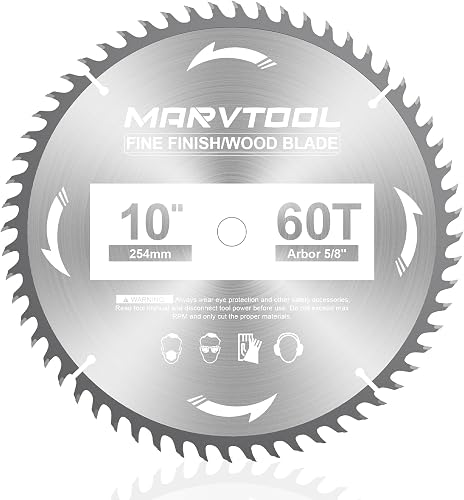
MarvTool 10-Inch 60-Tooth Woodworking Saw Blade: Best for varied wood panels
- 10-inch diameter
- 60 tungsten carbide teeth
- 5/8-inch arbor
- Wood and panel applications
A 60-tooth option for wood, plywood and several panel materials. MarvTool also names laminated and double-laminated plastics among its applications.
Pros
- 60-tooth count
- 5/8-inch arbor
- Broad stated panel uses
Cons
- Confirm kerf and saw compatibility before buying
MarvTool's 60-tooth blade is a 10-inch choice for wood and panel work. Its 5/8-inch arbor is listed for most 10-inch table and miter saws, and its stated applications include plywood, particleboard, MDF and coated boards.
This tooth count aims for a balance between a fine cut and a practical feed rate. The maker also describes grooves intended to dissipate heat and reduce noise and vibration, but the product information does not specify a kerf.
Choose it if you want a 60-tooth blade for varied wood panels. Confirm the kerf, speed rating and fit with your saw before ordering.
How did we choose these woodworking saw blades?
We compared the stated tooth counts, blade sizes, arbor sizes, kerfs and intended materials against common woodworking tasks. Our score weighs specs and features against what you're shopping for.
The picks cover low-tooth blades for ripping, 40-tooth general-purpose blades and 60- to 80-tooth options for finer cuts. We favored products with clear compatibility details where available, while reminding you to check your saw manual.
A blade's advertised use doesn't guarantee a flawless edge in every wood species or setup. Sharpness, feed rate, fence alignment, blade height and work support all affect the result.
| Product | Best for | Diameter | Tooth count | Kerf | Our score |
|---|---|---|---|---|---|
| WEN BL1060 10-Inch 60-Tooth Fine-Finish Professional Woodworking | fine crosscuts | 10 in | 60 | 1/10 in (2.4 mm) | 9.7 |
| DEWALT Table Saw Blade | clean everyday cuts | 10 in | 40 | 9.7 | |
| Revvstark 10 Inch 80T Table Saw Blades | fine panel cuts | 10 in | 80 | 9.7 | |
| WEN BL1040 10-Inch 40-Tooth Carbide-Tipped Professional Woodworking | mixed shop tasks | 10 in | 40 | 1/10 in (2.4 mm) | 9.6 |
| DEWALT 10 in. 24 Tooth General Purpose | faster rip cuts | 10 in | 24 | 9.6 | |
| FOXBC 10-Inch Table Saw Blade | smooth crosscuts | 10 in | 80 | 0.098 in | 9.4 |
| Luckyway 10 Inch Table Saw Blade 80T | a spare fine-cut blade | 80 each | 8.6 | ||
| FOXBC 8-1/4 Inch Table Saw Blade | compatible compact saws | 8-1/4 in | 60 | 0.079 in | 8.3 |
| MarvTool 10-Inch 60-Tooth Woodworking Saw Blade | varied wood panels | 10 in | 60 | 8.1 |
What should you check before buying a table saw blade?
Check the blade diameter, arbor, kerf and maximum RPM against your saw manual before buying. These fit details matter more than the tooth count if the blade cannot mount or clear the saw properly.
Which tooth count works for general woodworking?
A 40-tooth blade is a practical general-purpose choice for mixed ripping and crosscutting. A 24-tooth blade can move through ripping cuts faster, while 60- and 80-tooth blades are better candidates when you want a smoother finish.
Tooth count is only one part of cut quality. Read how saw blade tooth count affects cut quality for the tradeoffs among speed, edge finish and stock thickness.
Does blade kerf matter?
Kerf is the width of material removed by the blade. A thin kerf removes less wood and can suit lower-powered saws, but you should check the blade and saw guidance for compatibility and stability.
A thin kerf also requires a matching riving knife or splitter where the saw manual calls for one. Do not remove safety parts to fit a blade.
Are table saw and miter saw blades interchangeable?
Some blades are marketed for both tools, but the saw's size, speed and application requirements still apply. The WEN options here are described for both 10-inch table saws and miter saws.
The cutting task differs too: a table saw guides material through a stationary blade, while a miter saw brings a blade down through supported stock. See how a miter saw differs from a table saw when choosing a blade for a particular tool.
Can one woodworking blade cut every material?
No. Woodworking blades are not universal material blades, and a blade described for wood or panels should not be assumed safe for metal or every plastic.
Follow the blade and saw makers' material guidance.
For plastics, start with the material-specific best table saw blade for plastic guide. For aluminum, see the best table saw blade for aluminum and choose only a setup explicitly suited to the task.
Does blade size matter more than brand?
Yes, fit comes first. A quality blade that is too large, has the wrong arbor or exceeds the saw's speed limit is not a suitable choice.
After checking fit, compare tooth count and intended use. If you're choosing by brand, see our best Diablo table saw blades guide for that brand's options.
Do portable table saws need a different blade?
They may, depending on the saw's required diameter, arbor and power. Some portable saws use 8-1/4-inch blades, while others take 10-inch blades, so check the manual before choosing.
Our guide to best portable table saw blades focuses on those saws. Use the blade size and limits specified for your exact model.
What other table saw parts affect a clean cut?
A flat, correctly sized throat plate or insert helps support stock close to the blade. A blade guard and riving knife also contribute to safe operation, so keep the saw's safety equipment installed as directed.
See the guides to best table saw blade inserts and the best table saw blade guard when replacing those parts. If you use a Craftsman saw, the Craftsman table saw blade wrench guide can help identify a compatible wrench.
More guides on this topic
- Best Table Saw Blades for Cutting Metal
- Best Table Saw Blades for Cutting Acrylic
- Best Thin Kerf Table Saw Blades
Which table saw blade is best for your woodworking?
Choose a 40-tooth blade for a mix of routine cuts, a 24-tooth option for frequent ripping, and a 60- or 80-tooth blade when a finer edge matters. Match the blade to your saw first, then narrow the choice by wood type and finish.
For everyday woodworking, the WEN BL1040 and DEWALT 40-tooth blade are sensible starting points. If your priority is a clean crosscut, consider the WEN BL1060 or an 80-tooth option that fits your saw.
Our top 3 picks at a glance
-
1
Best for fine crosscuts
WEN BL1060 10-Inch 60-Tooth Fine-Finish Professional Woodworking
9.7/10 our score
See it on Amazon -
2
-
3
Frequently asked questions
What tooth count is best for woodworking on a table saw?
A 40-tooth blade is a useful general-purpose choice for routine table saw woodworking. Choose fewer teeth for faster ripping, or more teeth when a cleaner crosscut matters.
The right count also depends on the wood, feed rate and finish you need.
Is a 60-tooth table saw blade good for woodworking?
Yes. A 60-tooth blade can suit finer woodworking cuts, especially crosscuts and finish work.
It may cut more slowly than a lower-tooth blade, so choose based on the task and the saw's allowed blade size and speed.
Can I use an 80-tooth blade on a table saw?
Yes, if the blade diameter, arbor, kerf and speed rating fit your saw. An 80-tooth blade is often chosen for finer cuts in wood and panels.
Check your saw manual and the blade instructions before installing it.
Should I use the same blade for ripping and crosscutting?
A general-purpose blade can handle routine versions of both tasks, but a dedicated ripping blade usually has fewer teeth and a crosscut blade has more.
If you often rip long boards, compare a table saw blade for ripping with a fine-finish option.
Can a table saw cut metal with a woodworking blade?
Don't use a woodworking blade for metal unless the saw and blade makers explicitly approve that material and setup. Metal cutting needs the correct blade type, work support and operating procedure.
See our guide to a table saw blade for metal before choosing a blade for that job.