6 Best Scroll Saw Blades for Wood (November 2026)
The best scroll saw blades for wood include the FOXBC 3-Inch Hobby Scroll Saw Blades Pin for vintage pinned saws, the Olson Reverse Tooth Scroll Saw Blades 5″ for underside splinter control, and the Olson Saw PG49802 Precision Ground Scroll Saw for precise hardwood cuts.
On this page (7 sections)
- The best scroll saw blades for wood by cutting job
- How we compared these scroll saw replacement blades
- What TPI means for wood scrollwork
- Pin end or plain end: which replacement blade fits?
- How to reduce splintering on wood cuts
- How to keep replacement blades ready
- Which are the best scroll saw blades for wood?
The best scroll saw blades for wood are the Flying Dutchman Ultra Reverse 60 pc Variety Pack for woodworkers who need several 5-inch pinless sizes and underside splinter control. The Olson PG49802 is a strong choice for precise 18 TPI work, while FOXBC is the fit-focused pick for selected vintage 3-inch pinned saws.
A replacement blade should match your saw before it matches your project. Check the blade length, end style and the amount of room between pins or clamps, then choose tooth spacing for the wood and cut shape.
If considering diamond blades, check diamond scroll saw blades for saw fit.
For a quick overview of tooth patterns, compare these scroll saw blade types. If your saw uses clamps instead of a familiar blade holder, review the guide to scroll saw blade clamps.
Our picks at a glance
-
1
 Best for vintage pinned saws
FOXBC 3-Inch Hobby Scroll Saw Blades Pin
9.6/10 our score
See it on Amazon -
2
 Best for underside splinter control
Olson Reverse Tooth Scroll Saw Blades 5″
9.5/10 our score
See it on Amazon -
3
 Best for precise hardwood cuts
Olson Saw PG49802 Precision Ground Scroll Saw
9.4/10 our score
See it on Amazon
- 4
 Check it
Flying Dutchman Ultra Reverse 60 pc Variety Pack
Best for mixed wood projects - 5
 Check it
Flying Dutchman Ultra Reverse #5 Blade Pack
Best for repeat #5 cuts - 6
 Check it
Hiizug 5 Inch Plain End Scroll Saw
Best for beginners needing TPI choices
The best scroll saw blades for wood by cutting job
The best scroll saw blades for wood depend on fit first, then tooth pattern and TPI. The picks below are ordered by score, with each one aimed at a different replacement-blade need.
FOXBC 3-Inch Hobby Scroll Saw Blades Pin: Best for vintage pinned saws
- 36 blades
- 3 in pin end
- 15, 18 and 24 TPI
- SK5 Japanese carbon steel
This pinned 3-inch set fits machines that require 3-inch pin-end blades with 2-3/4 inches between pins. The 15, 18 and 24 TPI choices cover ordinary wood scrollwork and finer cuts.
Pros
- Three TPI choices
- Fits selected vintage hobby saws
- Corrosion-resistant SK5 Japanese carbon steel
Cons
- Only for machines requiring 3-inch pin-end blades
- Shorter than standard 5-inch blades
FOXBC is the top choice when your machine requires a 3-inch pin-end blade. The set has 36 blades in 15, 18 and 24 TPI, giving you three tooth spacings for general wood scrollwork and more detailed cuts.
The blades are 3 inches long, with 2-3/4 inches between pins. That measurement matters because a pinned blade can be the wrong size even when the overall length looks close.
FOXBC identifies the blades as corrosion-resistant SK5 Japanese carbon steel. The stated compatible materials include hard and soft wood, plastic, copper and other soft metals, but this roundup focuses on its wood use.
The fit list includes selected vintage Dremel Moto-Saw, Moto-Jig Saw, Moto-Shop, Craftsman, Delta and Emco Lux hobby saws. Use those machine names only as a starting point, then confirm that your saw requires the same 3-inch pin-end format.
Choose the 15 TPI option for a more open tooth pattern, the 18 TPI option for a middle ground, and the 24 TPI option when the cut calls for finer teeth. The best choice still depends on the wood thickness and the curve you need to follow.
Olson Reverse Tooth Scroll Saw Blades 5″: Best for underside splinter control
- 36 blades
- 5 in length
- Reverse tooth design
- High carbon steel
Olson's 5-inch reverse tooth assortment suits woodworkers who want a blade design aimed at reducing splintering under the workpiece. It is a straightforward replacement option with 36 high carbon steel blades.
Pros
- Reverse tooth design
- 5-inch blade length
- 36 blades included
Cons
- The details do not identify TPI choices
- Compatibility should be checked before ordering
Olson's FR49202 is the best fit here for woodworkers who want a 5-inch reverse tooth blade in a 36-blade assortment. Reverse teeth place cutting action on the underside as well as the top side, which can help reduce splintering on the bottom face.
The pack uses high carbon steel and contains 36 blades. The stated compatible material is plastic, while the product name and reverse-tooth design make it relevant to ordinary scroll saw replacement work.
Because the data does not identify the blade end style or TPI choices, confirm those details for your saw and project.
This option makes sense when your main concern is a cleaner underside and you already know that 5-inch blades suit your machine. It is less useful as a first buy when you need several known TPI choices or a clearly stated pinless format.
A reverse tooth blade still needs a steady feed rate. Let the teeth do the cutting, keep the work supported, and avoid forcing the blade through a tight turn.
Olson Saw PG49802 Precision Ground Scroll Saw: Best for precise hardwood cuts
- Plain end
- 18 TPI
- 5 in length
- Double tooth design
The Olson PG49802 is a 5-inch, 18 TPI plain-end blade for wood. Its precision ground and double tooth designs suit detailed work where controlled straight and radius cuts matter.
Pros
- Plain-end pinless format
- 18 TPI for detailed work
- Double tooth design
Cons
- Single stated TPI
- Designed for scroll saw machines that accept plain ends
The Olson PG49802 is the precision pick for 5-inch, 18 TPI plain-end cutting in wood. Its precision ground teeth and double tooth design are aimed at controlled straight and radius cuts, including work in hardwoods.
Plain-end means pinless, so the blade is held by the saw's clamps rather than by cross pins. That makes the clamp setup part of the compatibility check.
Read how long scroll saw blades are before comparing this blade with a shorter pinned option.
The product data identifies the blade as 5 inches long and 18 TPI. That combination gives you a clear starting point for detailed wood cuts, while the double tooth design is intended to support cutting performance in hardwoods.
This is a focused choice rather than a mixed starter pack. Choose it when you want the same 18 TPI format repeatedly and your saw accepts plain ends.
Pick a variety pack instead if you are still learning which blade size feels right for your work.
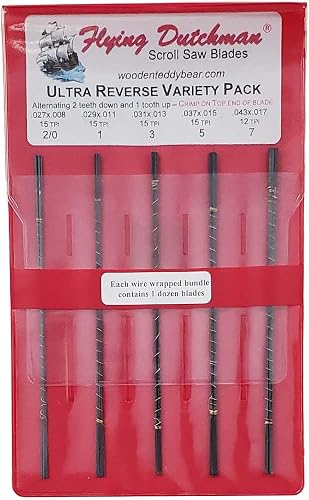
Flying Dutchman Ultra Reverse 60 pc Variety Pack: Best for mixed wood projects
- 60 pinless blades
- 5 in length
- Sizes #2/0, #1, #3, #5 and #7
- Every third tooth reversed
This variety pack gives you five Ultra Reverse sizes for changing wood thicknesses and cut patterns. Every third tooth is reversed to help prevent underside splintering.
Pros
- Five blade sizes
- Pinless format
- 60 blades in the pack
Cons
- Requires a scroll saw that accepts plain ends
- More sizes to sort and store
The Flying Dutchman Ultra Reverse variety pack is the best all-around choice for changing wood projects because it includes five 5-inch pinless sizes: #2/0, #1, #3, #5 and #7.
Every third tooth is reversed. That pattern is designed to help prevent splintering on the underside while keeping the cut fast and smooth.
The blades are milled and made from hardened steel alloy, with 60 blades in the pack.
A variety pack is useful when one project calls for a delicate blade and the next needs a more substantial one. Smaller sizes can suit intricate shapes, while larger sizes may feel more suitable for broader cuts, but choose based on your material and the control your saw gives you.
The pinless format requires a scroll saw with clamps that hold plain ends securely. If your saw's blade holder is unfamiliar, compare it with the advice in How to Choose Replacement Scroll Saw Blade Clamps.
This is the easiest recommendation for a woodworker who does not want to commit to one blade size. It also creates a storage task, so label or separate the sizes after opening the pack.
Flying Dutchman Ultra Reverse #5 Blade Pack: Best for repeat #5 cuts
- 72 pinless blades
- 5 in length
- #5 size
- Every third tooth reversed
The #5 Ultra Reverse pack is for scroll saw users who already know that this size suits their projects. The 72-blade supply favors repeat work over experimenting with several sizes.
Pros
- 72 blades
- Consistent #5 size
- Reverse teeth help limit underside splintering
Cons
- Less flexible than a mixed-size pack
- Requires a pinless scroll saw
The Flying Dutchman Ultra Reverse #5 pack is the best choice for repeat work that suits a #5 blade. It contains 72 5-inch pinless blades, all in the #5 size, so you get a large supply without paying for sizes you do not plan to use.
Like the variety pack, this design reverses every third tooth. That arrangement is intended to reduce underside splintering while preserving a fast, smooth cut.
The blades are milled and made from hardened steel alloy.
A single-size pack works well when your patterns, wood thicknesses and preferred cutting feel are already familiar. It is less flexible for a beginner who is still deciding between fine detail work and broader cuts.
The #5 format also needs a saw that accepts 5-inch plain-end blades. Check the blade holder and the working length before ordering, especially if you are replacing a pinned blade.
Choose this pack when running out of one dependable size is the main problem. Choose the 60-piece variety pack when you need to compare several sizes across different designs.
Hiizug 5 Inch Plain End Scroll Saw: Best for beginners needing TPI choices
- 45 plain-end blades
- 5 in length
- 10, 12 and 28 TPI
- SK5 German carbon steel
Hiizug combines 10, 12 and 28 TPI blades in a 45-pack. The range gives beginners a way to compare faster cutting and finer intricate work on wood.
Pros
- Three TPI choices
- Plain-end format
- 45 blades
Cons
- Lower score for this wood-focused roundup
- TPI groups are not separated by exact quantity
Hiizug is the best starter option for woodworkers who want three TPI choices in a plain-end 5-inch pack. The 45 blades use 10, 12 and 28 TPI, covering more open teeth for faster cuts and finer teeth for intricate shapes.
The blades are made from corrosion-resistant SK5 German carbon steel. Their stated compatible materials include wood, plastic, copper and non-ferrous metals, while the 5-inch plain-end format makes them a match for suitable pinless scroll saws.
The TPI range is easy to understand in daily use. The 10 and 12 TPI options provide more open spacing, while 28 TPI places more teeth in the cut for smaller details.
The pack does not identify how many blades belong to each TPI group, so plan around the total pack rather than a fixed count of each size.
This is a practical choice for a beginner building a replacement supply. It scores below the two Flying Dutchman packs and the Olson choices because the pack is less specialized and gives less detail about the distribution of its TPI groups.
How we compared these scroll saw replacement blades
We compared blade end style, stated length, TPI choices, tooth design, material, pack size and the kind of wood work each option supports. We also considered how clearly each product helps you solve a real replacement problem.
Our score weighs specs, features and buyer feedback against what you're shopping for.
The main split is between pinned and pinless blades. FOXBC is the only clearly identified 3-inch pin-end choice here.
Olson PG49802, both Flying Dutchman packs and Hiizug are identified as plain-end or pinless options. Olson FR49202 needs an extra compatibility check because the details do not identify its end style.
To learn how a blade's shape relates to the saw and material, read How Do You Match a Saw Blade to the Tool and Material?. That decision comes before choosing a larger pack or a finer tooth pattern.
| Product | Best for | Blade length | Blade end | Pack size | Our score |
|---|---|---|---|---|---|
| FOXBC 3-Inch Hobby Scroll Saw Blades Pin | vintage pinned saws | 3 in | Pin end | 36 blades | 9.6 |
| Olson Reverse Tooth Scroll Saw Blades 5″ | underside splinter control | 5 in | Not specified | 36 blades | 9.5 |
| Olson Saw PG49802 Precision Ground Scroll Saw | precise hardwood cuts | 5 in | Plain end, pinless | 9.4 | |
| Flying Dutchman Ultra Reverse 60 pc Variety Pack | mixed wood projects | 5 in | Pinless | 60 blades | 9.2 |
| Flying Dutchman Ultra Reverse #5 Blade Pack | repeat #5 cuts | 5 in | Pinless | 72 blades | 8.9 |
| Hiizug 5 Inch Plain End Scroll Saw | beginners needing TPI choices | 5 in | Plain end, pinless | 45 blades | 8.5 |
What TPI means for wood scrollwork
TPI means teeth per inch, and it changes how a blade behaves in wood. Lower TPI gives the gullets more room to clear chips, while higher TPI places more teeth in contact with the work.
The products here range from 10 TPI to 28 TPI. Hiizug offers 10, 12 and 28 TPI, FOXBC offers 15, 18 and 24 TPI, and Olson PG49802 uses 18 TPI.
For ordinary wood scrollwork, start with a blade that clears chips without making the cut feel too aggressive. For detailed curves, use a finer tooth option when the wood thickness and the saw's control allow it.
Do not choose TPI by number alone. A tight pattern in thick wood can clear chips less easily, while an open pattern may not give the control you want for a small inside corner.
It helps to think of TPI as a trade off between speed and control. A more open spacing usually clears dust and chips faster, so the blade feels free in thicker stock.
A finer spacing usually leaves a smoother edge, but it can load up if the gullets fill before the chips escape. That risk rises when you cut thick wood, push too fast, or use a blade that is already dull.
For beginners, the middle options are often the easiest place to start. They tend to balance chip clearance with enough teeth in the cut to follow a curve without wandering.
The FOXBC range of 15, 18 and 24 TPI suits that middle approach for 3 inch pinned saws. The 15 TPI choice can handle more open work, while the 24 TPI choice suits finer patterns.
The Hiizug range shows the wider spread more clearly. The 10 and 12 TPI blades have more open spacing for faster cutting, while the 28 TPI blade is aimed at intricate shapes.
Olson PG49802 sits in the middle at 18 TPI, with plain ends and a double tooth design. That makes it a clear option for repeat detailed work in wood when your saw accepts pinless blades.
Always match TPI to the actual task before you buy extra packs. A blade that is right for thin fretwork may be slow and prone to burning in thick hardwood.
Set up also affects how TPI performs in daily use. Correct tension, a sharp blade, and a steady feed rate let the teeth cut instead of rub, which helps any tooth spacing work as intended.
If a cut burns, chatters, or leaves a rough edge, change one thing at a time. Try a different TPI, check tension, and slow your feed before assuming you need a new saw or a larger blade.
Keep notes on what worked for each wood and project. Over time, that simple record will show whether you prefer open teeth for speed or fine teeth for detail.
Pin end or plain end: which replacement blade fits?
Choose a pin-end blade only when your saw has matching slots and measurements. Choose a plain-end blade when the saw uses clamps that grip the ends directly.
FOXBC specifies 3 inches overall and 2-3/4 inches between pins. The other clearly identified pinless options are 5 inches long, including the Olson PG49802, both Flying Dutchman packs and Hiizug.
Turn off and unplug the saw before changing a blade. Release the tension as directed by your saw, seat both ends fully, and check that the teeth point in the correct cutting direction before restoring tension.
A blade that is too long, too short or held unevenly can affect control and cut quality. If you are comparing scroll saw work with a bandsaw, our guide to What Is the Difference Between a Bandsaw and a Scroll Saw? explains why the tools suit different cutting tasks.
How to reduce splintering on wood cuts
Use a reverse-tooth design when underside splintering is a major concern, then pair it with steady support and a controlled feed rate. The Olson FR49202 and both Flying Dutchman Ultra Reverse packs use reverse-tooth designs.
The Flying Dutchman blades reverse every third tooth. That gives the tooth pattern a clear purpose on projects where the underside finish matters, but it does not replace proper setup.
Support the work close to the blade and avoid twisting the material into a tight turn. Let the blade follow the curve, and replace it when it becomes dull or damaged.
For a cut that leaves fuzz on the top or bottom, check blade direction, tension, tooth choice and feed pressure before assuming that a larger blade will solve the issue.
Reverse teeth work by cutting in both directions at once. The normal teeth handle the top surface, while the reversed teeth support the underside as the blade passes through.
That action can reduce the tearing that often shows on the lower face of thin wood. It is most helpful on projects where you plan to leave both sides visible after sanding.
It does not remove the need for support. Waste pieces can still break away if they are left hanging without backing, especially on thin or brittle stock.
A firm table, a clean blade, and material held flat all help the cut stay predictable. Small gaps under the work can let the surface move and make splintering worse.
Feed rate matters just as much as tooth design. Pushing too hard can deflect the blade, force the teeth sideways, and tear the grain instead of slicing it cleanly.
Let the blade do the work and guide the material at a steady pace. If you feel strong resistance, pause, check for binding, and avoid forcing a tight curve.
Sharpness plays a central role here. A dull blade tends to crush fibers rather than cut them, so even a reverse tooth pattern cannot save a worn edge.
Replace the blade when it starts to burn, wander, or leave fuzz on either face. That change often improves the finish more than switching to a larger size.
Blade direction should be checked during every change. Teeth should face the correct way for your saw, and the blade should sit straight before you set tension.
For intricate work, slow down before inside corners and narrow bridges. Those areas are more likely to splinter because the surrounding wood has less support.
Test any new blade on a scrap piece first. That quick check shows how the tooth pattern handles your wood and whether the underside looks clean.
If the top face still tears, focus on setup rather than the reverse teeth. Check that the blade is sharp, the work is supported, and your feed pressure is light and even.
Reverse tooth blades suit display pieces, cut letters, and fretwork where both faces matter. For hidden cuts, a standard pattern may be just as practical and easier to source.
How to keep replacement blades ready
Store blades by size and TPI so you can choose quickly. Mixed packs such as FOXBC, Flying Dutchman Ultra Reverse 60 pc and Hiizug are easier to use when each group has a clear place.
Keep spare blades available for detailed work. A small break during an inside cut is easier to manage when the replacement has the same length, end style and tooth pattern as the one you were using.
Inspect a new blade before fitting it. Look for bent ends or visible damage, and do not tension a blade that does not sit straight in the holder.
Scroll saw blades are consumables, so replacement timing depends on the wood, the cut and your pressure. Our guide to How Long Are Scroll Saw Blades? covers the signs that a blade has reached the end of its useful cutting life.
Which are the best scroll saw blades for wood?
Choose the Flying Dutchman Ultra Reverse 60 pc Variety Pack if you need several 5-inch pinless sizes and want a reverse-tooth design for cleaner undersides. Choose the Olson PG49802 for repeated 18 TPI precision cuts, or the Flying Dutchman #5 pack when one size already suits your patterns.
Pick FOXBC when your saw specifically requires 3-inch pin-end blades. Pick Hiizug when you want 10, 12 and 28 TPI choices in one plain-end pack.
If your project also involves metal, compare these options with the best scroll saw blades for metal before using a wood-focused blade.
For shaping work after sawing, wood routers for woodworking can help with edge profiles and details, while best miter saw blades are a better match for crosscuts and angle cuts than scroll saw blades.
Our top 3 picks at a glance
-
1
Best for vintage pinned saws
FOXBC 3-Inch Hobby Scroll Saw Blades Pin
9.6/10 our score
See it on Amazon -
2
Best for underside splinter control
Olson Reverse Tooth Scroll Saw Blades 5″
9.5/10 our score
See it on Amazon -
3
Best for precise hardwood cuts
Olson Saw PG49802 Precision Ground Scroll Saw
9.4/10 our score
See it on Amazon
Frequently asked questions
What are the best scroll saw blades for wood?
The Flying Dutchman Ultra Reverse 60 pc Variety Pack is the strongest general choice because it combines five 5-inch pinless sizes with a reverse-tooth pattern. Olson's precision ground blade suits detailed hardwood cuts, while FOXBC is the better fit for selected 3-inch pinned hobby saws.
Are reverse tooth scroll saw blades better for wood?
Reverse tooth blades can help reduce splintering on the underside of a wood project. They are useful when both faces need a cleaner edge, but the right blade still depends on your saw's end style, the wood, the cut shape and the blade size.
What TPI should I use for scroll saw wood cuts?
Use a lower TPI when you want faster cutting and more chip clearance, and use a higher TPI for smaller details and tighter curves. The products here include 10, 12, 15, 18, 24 and 28 TPI options, so match the tooth spacing to the work instead of using one blade for every project.
Do scroll saw blades fit every scroll saw?
No. A scroll saw may require pin-end blades or plain-end pinless blades, and blade length also matters.
FOXBC is made for machines requiring 3-inch pin-end blades with 2-3/4 inches between pins.
The 5-inch Olson, Flying Dutchman and Hiizug options require a saw that accepts their stated format.
How often should I replace a scroll saw blade?
Replace a scroll saw blade when it stops cutting cleanly, needs more force, wanders, burns the wood or shows damage. Blade life changes with wood hardness, thickness, feed pressure and cutting detail.
Keep spare blades nearby, especially for intricate work where a dull blade can spoil a narrow cut.


