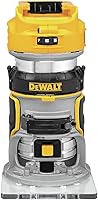
9 Best Trim Routers for Woodworking (November 2026)
The best trim routers for woodworking include the AVID POWER 6.5 Amp 1.25 HP Compact (best overall trim router), the WEN RT1460 6-Amp Handheld 1/4-Inch Variable Speed for clear line visibility, and the AKYPACH Router Tool for visible curve work.
On this page (5 sections)
The best trim router for woodworking is the AVID POWER 6.5 Amp 1.25 HP Compact because it combines variable speed, two collets, straight and curved guides, bits and dust collection. WEN is the better fit for a clear base and soft start, while TEENO gives you the largest included bit set.
A trim router earns its place for rounding edges, trimming laminate, cutting shallow grooves, or following a template without a full size router. It suits light, controlled cuts where visibility and hand control matter more than maximum plunge depth.
That small size lets you move around cabinet doors, shelf edges, or tabletops and make small corrections without moving the workpiece. Speed range, collet size, and guide options matter more than headline power alone.
A router that matches your bits and sets depth in small steps will give cleaner results than a more powerful model that is harder to control. Check what is in the box before you buy extra parts, as guides, collets, bits, and dust collection can cover straight cuts, curves, and template work from the first project.
If your work needs deeper cuts or a larger motor, a larger router or dedicated plunge model may suit better, and you can compare those options in our guide to wood routers for woodworking. Use this roundup to match the router to the cuts you make most often, including collet sizes for existing bits, guides for templates, and speed control for softwood, hardwood, and laminate.
Our picks at a glance
-
1

-
2
 Best for clear line visibility
WEN RT1460 6-Amp Handheld 1/4-Inch Variable Speed
9.4/10 our score
See it on Amazon -
3
- 4
 Best for a starter bit setCheck it
- 5
 Check it
AVID POWER Compact Wood Router Tool
Best for fast trimming - 6
 Check it
Dobetter 1.25HP Wood Router Tool
Best for speed adjustment - 7
 Check it
Anesty Compact Router with Trimmer/Fixed Base
Best for a broad accessory kit - 8
 Best for circle routingCheck it
- 9
 Check it
Ozmatip Pattern Flush Trim Bit 4 Pcs
Best for template trimming
The best trim routers for woodworking
The best trim router depends on your bit collection, material, guide needs and preferred speed control. We compared the stated power, speed ranges, collets, bases, guides and included accessories, then scored each pick for common edge-trimming and small woodworking jobs.
AVID POWER 6.5 Amp 1.25 HP Compact: Best overall trim router
- 6.5-amp, 1.25 HP motor
- 10,000–32,000 RPM
- 1/4 in and 3/8 in collets
- Edge guide, roller guide and dust hood
The AVID POWER combines broad speed control with two collets, guides, bits and dust collection. It suits woodworkers who want one corded kit for edges, grooves and curves.
Pros
- Wide speed range
- Two collet sizes
- Multiple guides and dust hood
Cons
- Corded design
- More kit pieces to store
The AVID POWER 6.5 Amp 1.25 HP Compact is the most complete choice for a mixed workshop. Its 10,000-32,000 RPM range lets you use lower settings for heat-sensitive work and higher settings for lighter trimming.
Lower speed can help with hard oak edges or larger bits, while higher speed can help a small bit leave a cleaner finish on soft pine or laminate. The rack-and-pinion depth system gives fine adjustments on the fixed base, so you can set a shallow pass, lock it, and return to the same depth for repeat cuts.
The kit includes 1/4-inch and 3/8-inch collets for more bit flexibility. An edge guide helps with straight cuts, the roller guide follows curves, and the dust hood connects to a standard shop vacuum.
Dual LED lights illuminate the cutting path in cabinets or under counters. The kit also has 5 router bits, spare carbon brushes, and wrenches, with aluminum and ABS construction.
Keep the base flat and clean and check carbon brushes as part of regular maintenance. Store extra collets and guides where you can find them quickly, so the kit stays ready for straight, curved, and edge work.
WEN RT1460 6-Amp Handheld 1/4-Inch Variable Speed: Best for clear line visibility
- 6-amp soft-start motor
- 12,000–30,000 RPM
- Transparent base plate
- 1-5/8 in base travel
The WEN RT1460 focuses on controlled routing with soft start, a transparent base and a marked adjustment scale. Its 1/4-inch collet suits the common small-bit format.
Pros
- Soft start
- Clear base
- Guide fence and trim guide
Cons
- Only a 1/4-inch collet
- Lower horsepower than several picks
The WEN RT1460 is a strong choice when you want to see the cut line clearly. Its transparent base plate gives you a direct view of the work area, and the soft-start motor begins gradually.
That visibility helps in daily use when you are following a pencil line, template, or guide. You can watch the bit meet the line instead of relying on the edge of an opaque base to guess where the cut will land.
The 6-amp motor runs from 12,000 to 30,000 RPM. A 1-inch scale with 1/16-inch markings and 1-5/8 inches of base travel help you set gradual passes instead of removing too much material at once.
The marked scale is useful for repeat work. You can note a setting for a dado, groove, or edge profile, then return to that setting on the next piece with more confidence.
Its 1/4-inch collet works with the majority of 1/4-inch-shank router bits. The guide fence supports straight cuts, while the trim guide helps maintain distance around curved or irregular workpieces.
Choose this model if visibility and controlled starts matter most. If you want two collet sizes or a broader accessory kit, the AVID POWER and Dobetter models are more flexible.
For setup, fit the guide you need before you set depth, tighten the collet properly, and test the cut on scrap. That order helps you keep the guide, bit, and workpiece aligned from the first pass.
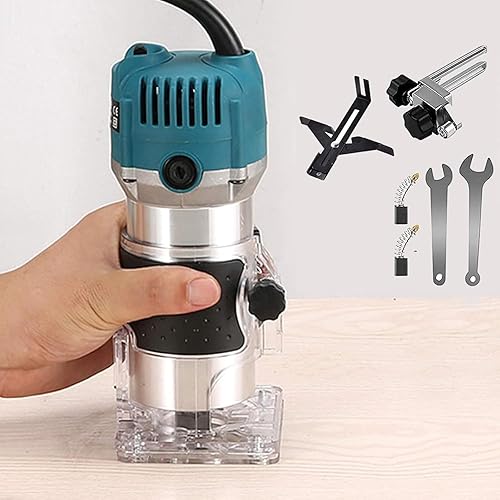
AKYPACH Router Tool: Best for visible curve work
- 800 W motor
- 30,000 RPM
- Aluminum and plastic construction
- Transparent base with straight and trimming guides
The AKYPACH has a transparent base and guides for straight and curved cuts. Its 800 W corded motor fits trimming, slotting and edge work in wood.
Pros
- Transparent base
- Straight and trimming guides
- 800 W motor
Cons
- Single 6.35 mm collet
- No variable speed stated
The AKYPACH Router Tool suits small jobs where a transparent base and basic guides are useful. Its 800 W corded motor reaches 30,000 RPM and uses a 6.35 mm collet.
The 6.35 mm size matches the common 1/4-inch bit format, which makes it easier to find bits for trimming, chamfering, grooving, and curve work. Check your bit shanks before ordering extras so they match this collet.
The aluminum and plastic body includes a soft handle. Its adjustable knob and scale support depth changes, while the transparent base makes it easier to follow the trimming area.
A straight guide supports linear work, and the trimming guide with rollers follows curves. The tool is aimed at wood processing, cabinet work, veneer, plastic board and similar edge or groove tasks.
Those guides change the character of the tool in practice. The straight guide helps with consistent grooves and edges, while the roller guide helps you keep an even distance around a curved workpiece.
There is no variable speed range stated for this model. Pick it when a fixed high-speed setup and visible base fit your work, and choose WEN or AVID POWER when speed adjustment is a priority.
For care, keep the transparent base clean so visibility stays clear, and check guide fit and bit tightness before each session. A short check at setup can prevent a wobbling guide or loose bit from spoiling a cut.
TEENO Wood Router: Best for a starter bit set
- 6.5-amp, 1.25 HP motor
- 31,000 RPM
- 15-piece 1/4-inch bit set
- Straight and trimming guides
TEENO is a practical starting kit because it pairs a 1.25 HP motor with 15 router bits and two guides. It fits buyers building a basic edge-routing setup.
Pros
- 15-piece bit set
- 1.25 HP motor
- Straight and trimming guides
Cons
- No variable speed stated
- Fixed-base design
The TEENO Wood Router is the best match for a new setup that needs many bits immediately. Its 6.5-amp, 1.25 HP motor reaches 31,000 RPM and comes with a 15-piece 1/4-inch shank router bit set.
A large included set helps if you are starting from scratch. You can try different profiles for chamfering, rounding, grooving, and edge work without buying separate bits for each first project.
The transparent base helps you see the work area, while the rubber-covered base supports grip and control. A depth adjustment knob lets you change the cut without tools.
Tool-free depth changes are handy when you need a quick correction. You can raise or lower the bit a small amount, test the result, and adjust again without stopping to find a wrench.
The straight guide supports linear routing, and the trimming guide helps with curves. The kit also includes 2 wrenches, an Allen wrench, 2 carbon brushes and a screw nut.
Keep the bit case organized and label the profiles you use most. That habit saves time when you need to switch from a straight bit for a groove to a round-over bit for an edge.
TEENO does not state a variable speed range for this model. It is a practical choice for common woodworking cuts when the included bit selection matters more than fine speed matching.
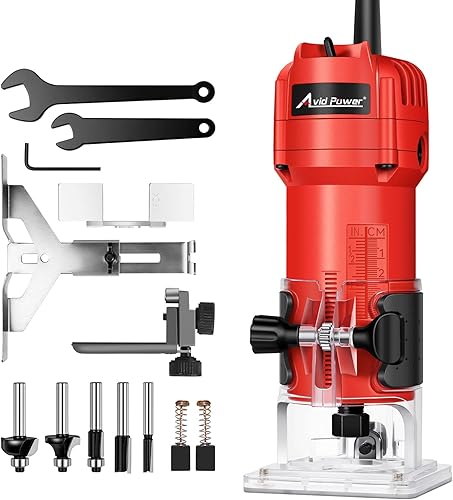
AVID POWER Compact Wood Router Tool: Best for fast trimming
- 5.3-amp, 630 W motor
- 35,000 RPM
- 1/4-inch collet
- Straight guide, roller guide and 5 bits
This AVID POWER model emphasizes a high stated speed and a compact fixed base. The included guides and five bits cover common trimming and grooving tasks.
Pros
- Highest stated speed here
- Straight and roller guides
- Five bits included
Cons
- Single collet size
- No variable speed stated
The AVID POWER Compact Wood Router Tool is built around quick trimming with a stated 35,000 RPM maximum. Its 5.3-amp, 630 W motor and fixed base suit edge work, slotting, grooving and hinge trimming.
A high stated speed suits light trimming where a small bit needs to cut cleanly without bogging down. It is less about removing heavy material and more about moving quickly through edge and detail work.
The 1/4-inch collet accepts the included 5 router trim bits. A straight guide helps with linear cuts, while the roller guide supports curved work.
That guide pair covers the two most common paths in trim routing. You can run a straight line for a groove or hinge mortise, then switch to the roller guide for a shaped edge or curved piece.
Its rubber handheld base is designed for grip, and the air vent is intended to help manage heat during longer use. Replacement carbon brushes are included for continued maintenance.
For longer sessions, keep the vents clear and let the motor cool if it feels hot. Dust on the base and around the bit can also affect control, so a quick clean between jobs helps.
This model has no variable speed range stated. Choose it for its high stated speed and compact accessory set, or move to AVID POWER's 6.5-amp model if you need speed adjustment and two collets.
Dobetter 1.25HP Wood Router Tool: Best for speed adjustment
- 6.5-amp, 1.25 HP motor
- 10,000–32,000 RPM
- 1/4 in and 3/8 in collets
- 12 bits, guides, dust hood and bag
Dobetter suits buyers who want adjustable speed and a large accessory bundle. Its 12 bits, two collets, guides, dust hood and portable bag support varied small jobs.
Pros
- Variable speed
- Two collet sizes
- 12 bits and portable bag
Cons
- Heavier 3.53 kg stated weight
- Plunge base
The Dobetter 1.25HP Wood Router Tool is a flexible choice for buyers who want variable speed and a larger accessory bundle. Its 6.5-amp motor runs from 10,000 to 32,000 RPM.
Both 1/4-inch and 3/8-inch collets give you more bit-size options. Rack-and-pinion depth adjustment and inch and millimeter scales help you set the base for repeatable passes.
The package includes 12 wood router bits, an edge guide, a roller guide, a dust hood, a wrench, carbon brushes and a portable bag. Its stated base type is plunge, which separates it from the fixed-base picks above.
For the distinction, see trim router vs plunge router.
A plunge style base changes how you start a cut. You can position the router over the work, lower it to depth, and control the cut from above, which some users find easier for grooves and detail work.
The stated weight is 3.53 kg, so it may feel less convenient for long freehand trimming than a lighter compact model. Choose it when depth control and accessory range matter more than minimum weight.
For storage, the portable bag helps keep bits and guides together, but plan bench space for the full kit. Keeping the bag packed by job type makes it easier to pick up the right guides and bits.
Anesty Compact Router with Trimmer/Fixed Base: Best for a broad accessory kit
- 710 W motor
- 10,000–30,000 RPM
- 15 router bits
- Trimmer and fixed bases
Anesty offers a variable-speed motor, trimmer and fixed bases, 15 bits and dust extraction. It fits buyers who want several setup options in one corded kit.
Pros
- Two base styles
- 15-bit set
- Variable speed
Cons
- Accessory-heavy kit
- Fixed corded power
The Anesty Compact Router is useful when you want both trimmer and fixed-base options in one kit. Its 710 W motor has 6 adjustable speeds from 10,000 to 30,000 RPM.
The rack-and-pinion depth system and clear scale support measured adjustments. Its supplied 1/4-inch and 3/8-inch collets cover common bit sizes, while the trimmer base adds stability for edge work.
The kit includes 15 router bits, a straight guide, a roller guide, a template guide, a dust-extracting attachment, a spanner and carbon brushes. A plastic case stores the bits.
That range of parts suits a workshop that moves between tasks. You can use the trimmer base for edge work, the fixed base for guided cuts, and the template guide when you need to copy a shape.
Anesty states a trimmer plunge capacity of 0–40 mm and a routing plunge capacity of 0–35 mm. Choose this model if you want several base and accessory options, but check your storage space before choosing a kit this full.
For setup, match the base to the job before you set depth. A stable base and the right guide will do more for accuracy than a small depth change after the cut has started.
Keep the bit case closed between jobs and store the dust attachment with the router. That keeps the kit intact and makes it easier to move from one project to the next.
Kreg Trim Router Base Plate: Best for circle routing
- Integrated handle
- Clear design
- Circle cutting from 3-1/2 to 15 in
- Fits most trim routers
The Kreg base plate is an accessory for improving grip, visibility and circle routing. It makes the most sense when you already own a compatible trim router.
Pros
- Integrated handle
- Circle-cutting range
- Clear visibility
Cons
- Not a motor or complete router
- Compatibility still needs checking
The Kreg Trim Router Base Plate is for adding control to a compatible trim router, not for replacing the motor. Its integrated handle improves grip and balance, while the clear design supports visibility.
The base plate supports circle cutting from 3-1/2 to 15 inches. That range makes it useful for round tabletops, openings and templates when your project needs a guided arc.
Kreg says it fits most trim routers, but you should confirm the fit for your exact router before ordering. It is a focused accessory for buyers who already have a trim router and want more control during circle or template work.
For general router selection, compare this accessory with our guide to the best cordless router for woodworking.
An integrated handle changes how you apply pressure during a cut. Instead of gripping the router body in an awkward position, you can guide the plate with a more natural hand placement.
Clear visibility helps when you start a circle or follow a template line. You can see where the bit is entering the work and correct your path before a small drift becomes a visible error.
For setup, check compatibility, fit the plate securely, and test the circle on scrap wood first. Confirm the diameter setting and make a shallow pass before cutting to full depth.
Ozmatip Pattern Flush Trim Bit 4 Pcs: Best for template trimming
- Four bits
- 1/4-inch shanks
- Top bearings
- 1/2, 3/4, 1 and 1-1/2 in cutting lengths
Ozmatip's top-bearing bits help copy a template with a handheld, table or CNC router. The four cutting lengths give you more choices for matching workpiece thickness.
Pros
- Four cutting lengths
- Top bearings
- 1/4-inch shanks
Cons
- Bits only
- For wood and composition materials, not metal
The Ozmatip Pattern Flush Trim Bit 4 Pcs set is the best add-on here for template work. Each bit has a 1/4-inch shank and a top bearing that follows the template edge.
The set includes cutting lengths of 1/2, 3/4, 1 and 1-1/2 inches. Those options help you match the bit to the thickness of the workpiece instead of using one length for every project.
The bits are designed for composition materials, plywood, hardwoods and softwoods. They are not for metal or other non-wood materials such as steel or iron.
Use these bits with a compatible handheld, table or CNC router. They work especially well when the template is below the workpiece, but make sure the shank and cutting length match your router and material.
A top bearing follows the template from above the workpiece, which changes how you set up the cut. Keep the bearing firmly against the template and keep the router base flat to avoid a step in the finished edge.
For care, clean pitch and dust from the flutes and bearing after use, and check the bearing for smooth movement before the next job. A clean bearing tracks more evenly and helps the bit copy the template shape.
Match the cutting length to the work thickness with a little margin for safe control. Too short a bit may not reach through the stock, while an unnecessarily long bit can be harder to control on thin work.
How we compared trim routers for woodworking
The scores weigh specs, features and buyer feedback against what you are shopping for. For trim routers, the main factors are speed control, motor output, collet size, depth adjustment, base visibility, guides and included items.
A variable-speed router gives more control over bit size, material and cutting speed. The AVID POWER, WEN, Dobetter and Anesty models state speed ranges, while AKYPACH, TEENO and the smaller AVID POWER state one maximum speed.
Collet size matters because the bit shank must match the router. The 1/4-inch format is common, while models with both 1/4-inch and 3/8-inch collets offer more choice.
Guides change how you use a trim router. A straight guide supports dados and grooves, a roller guide follows curves, and a transparent base helps you see the line.
The Kreg base plate adds a handle and circle-cutting support to a compatible router. Included bits, guides and dust collection can matter as much as the motor on day one.
Base style also affects control. A fixed base suits many edge jobs, while a plunge style base suits cuts that start from the surface.
Weight and corded power deserve a look. A lighter router may be easier to guide for long freehand work, while a corded model avoids a battery running out mid-project.
We also weighed how easy it is to set depth and repeat a cut. A clear scale and a locking adjustment help you return to the same setting on the next piece.
What should you check before buying a trim router?
Start with the work you do most often. Edge trimming needs a stable base and good visibility, while grooves and dados benefit from depth adjustment and a straight guide.
Check the collet before buying bits. A 1/4-inch router needs a 1/4-inch shank, and a dual-collet model can accept both 1/4-inch and 3/8-inch shanks when the matching collet is installed.
Speed control is useful with different materials or bit sizes. Lower speeds can help limit heat, while higher speeds can suit small bits, but always follow the bit and router instructions.
If you are deciding between compact styles, read our comparison of trim router vs compact router. For battery-based setups, our guide to cordless router kits with batteries covers a different buying path.
Look at guides if you plan to follow templates or cut curves. A roller guide, trim guide, or template guide can make a router far easier to control than freehand work alone.
Consider dust collection if you work indoors or trim laminate often. A dust hood or extractor keeps the cutting line visible and reduces clean-up time.
Think about storage and set-up time as well. A kit with many bits and guides is versatile, but you need space to store it and time to fit the right parts.
Match the router to your bench and projects, not just to headline specs. A model that fits your bits, guides, and most common cuts will be easier to use.
How do you use a trim router safely?
Secure the workpiece before routing and keep the base flat on the surface. Set the bit depth in shallow passes when the cut is deep, and keep both hands positioned for control.
Choose the correct collet and tighten the bit firmly. Keep the cord away from the cutting path on corded models, and connect the dust hood or extractor when the setup supports it.
Move the router steadily in the correct direction for the cut. Practice the feed direction on scrap wood first, especially with a guide or template.
Disconnect power before changing bits or making base adjustments. For a DeWalt-specific setup, see how to use a DeWalt cordless router, and check the best DeWalt router battery if you are comparing battery systems.
Check that the bit is secure and the collet matches the shank size before you start. A loose or mismatched bit can damage the work and make the router harder to control.
Keep your hands clear of the bit path and maintain a firm grip on the router body or base. Plan the cut so you do not need to reach across the workpiece or twist the cord into the cut.
Use the correct speed for the bit and material, and follow the instructions for both. Higher speed is not always better, and forcing a cut can cause burning, chatter, or a rough edge.
Clean the base, guides, and bit after use, and store the router where the bit will not be knocked or damaged. A short clean and check after each session helps the next set-up go faster.
Which trim router should you choose?
Choose the AVID POWER 6.5 Amp 1.25 HP Compact for the most complete corded kit, including variable speed, two collets, guides, bits and dust collection. Pick WEN if a transparent base, soft start and marked travel are your priorities.
Choose TEENO if you want 15 bits with a 1.25 HP router, or Dobetter if you want variable speed, two collets and a larger accessory bundle. Choose Kreg for circle routing with a compatible trim router, and Ozmatip when template trimming is the job.
For more technique help, read how to use a Ryobi trim router. The best trim routers for woodworking are the ones whose collet, guide system and speed range match the cuts you make most often.
If you already own bits, start with the collet size and work backward. A router that accepts your current shank size will save money and let you start cutting right away.
If you are building a kit from scratch, look at included bits and guides as part of the value. A router with a useful set in the box may cover more first projects than a bare tool with no accessories.
For template work, check bearings and cutting lengths before you buy. Match the base style to your habits, too, as fixed-base models suit many edge jobs, while a plunge style base may suit starts and grooves from the surface.
In the end, choose the router you will reach for most often. The right fit for your bits, guides, and materials will give you cleaner edges and more confidence on every project.
Our top 3 picks at a glance
-
1
-
2
Best for clear line visibility
WEN RT1460 6-Amp Handheld 1/4-Inch Variable Speed
9.4/10 our score
See it on Amazon -
3
Frequently asked questions
What is the best trim router for woodworking?
The AVID POWER 6.5 Amp 1.25 HP Compact is the strongest all-around choice here because it has 6 variable speeds, 1/4-inch and 3/8-inch collets, an edge guide, a roller guide and a dust hood. Choose WEN if a transparent base and soft start matter more.
What size trim router should I use?
A compact trim router with a 1/4-inch collet suits edge trimming, small grooves, laminate work and light decorative cuts. Higher-power models help with tougher stock, but match the bit size, cutting depth and speed to the material and cut.
Are corded or cordless trim routers better?
Corded trim routers provide continuous power, while cordless models remove the power cord from the work area. The products in this roundup are corded except for the Kreg base plate and Ozmatip bit set, so compare them with our guide to the best cordless compact router.
Can a trim router cut circles?
Yes, with the right base or guide. The Kreg Trim Router Base Plate supports circle cutting from 3-1/2 to 15 inches and has an integrated handle.
Check that your router fits the base before relying on it for a project.