9 Best Benchtop Band Saws for Woodworking (November 2026)
The best benchtop band saws for woodworking include the SKIL 2.8 Amp 9 In. 2-Speed Benchtop for balanced bench features, the WEN 9-Inch Band Saw for straight cuts and curves, and the Woodskil 9-Inch Band Saw for angled table cuts.
On this page (6 sections)
The best benchtop band saws for woodworking save bench space while handling curves, small stock and light resawing. The SKIL 9-inch model is our top pick for its two-speed drive, quick tension setting and dust port; WEN and Woodskil offer clear cutting capacities and useful guides.
A benchtop band saw is only compact relative to a floor model. Measure the saw, table, dust connection and room needed to feed long stock before settling on a spot.
If you need greater resaw capacity or wider work support, compare our best band saw for woodworking guide. For a larger floor saw, see best 14-inch band saws for woodworking.
Our picks at a glance
-
1
 Best for balanced bench features
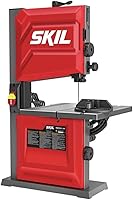
SKIL 2.8 Amp 9 In. 2-Speed Benchtop
9.7/10 our score
See it on Amazon -
2

-
3

- 4
 Check it
Woodskil 10-Inch Benchtop Bandsaw with Stand
Best for taller stock with a stand - 5
 Best for serious resaw capacityCheck it
- 6
 Best for a work light and two speedsCheck it
- 7
 Best for high resaw capacityCheck it
- 8
 Check it
SEESII Benchtop Band Saw for Woodworking
Best for a compact 8-inch throat - 9
 Best for a 10-inch throat and two speedsCheck it
How we chose benchtop band saws for woodworking
The strongest choices pair a useful cutting envelope with features that fit small-shop work. We compared stated cutting capacity, blade guidance, table adjustment, speed options, dust ports and included accessories.
We gave higher scores to models with clear capacity details and practical setup features for common woodworking tasks. Larger floor models remain in this roundup because their capacity may suit buyers who can give up the bench space, but they are not compact substitutes.
A band saw can handle curves, straight cuts with a fence, and some resawing when the stock fits its capacity. If those jobs are new to you, this guide to what a band saw is used for in woodworking explains the basic uses.
Our score weighs specs, features and buyer feedback against what you’re shopping for.
| Product | Best for | Blade length | Motor | Dust port | Our score |
|---|---|---|---|---|---|
| SKIL 2.8 Amp 9 In. 2-Speed Benchtop | balanced bench features | 9 in | 2.8 amp induction | 2 ½ in | 9.7 |
| WEN 9-Inch Band Saw | straight cuts and curves | 59 ½ in | 9.6 | ||
| Woodskil 9-Inch Band Saw | angled table cuts | 59 ½ in | 9.4 | ||
| Woodskil 10-Inch Benchtop Bandsaw with Stand | taller stock with a stand | 1 ⅞ in | 9.3 | ||
| JET 14" Woodworking Band Saw | serious resaw capacity | 9.2 | |||
| WEN Band Saw with Stand | a work light and two speeds | 72 in | 9.1 | ||
| QD-KYOHO Band Saw | high resaw capacity | 8.7 | |||
| SEESII Benchtop Band Saw for Woodworking | a compact 8-inch throat | 350 watts, 120 V | 8.4 | ||
| QD-KYOHO Band Saw | a 10-inch throat and two speeds | 2.5 in | 8.2 |
The best benchtop band saws for woodworking by use
The SKIL is the most balanced compact choice here, while WEN gives you stated cutting capacity and included guides. Pick by the cuts you make and the space you have.
SKIL 2.8 Amp 9 In. 2-Speed Benchtop: Best for balanced bench features
- 2.8 amp induction motor
- Two-speed drive system
- Quick blade tension setting
- 2 ½-inch dust port
SKIL combines a two-speed drive with quick blade tension setting, lower blade guides and a dust port. A miter gauge and rack-and-pinion table adjustment add support for crosscuts and angle changes.
Pros
- Tool-free belt tensioning
- Blade-tracking sight window
- Steel base
Cons
- Cutting capacity dimensions are not specified here
- No fence is included in the stated components
The SKIL combines a 2.8 amp induction motor with a two-speed drive system. Tool-free belt tensioning and a quick blade tension setting make tension adjustments part of its setup.
Its precision ball-bearing and lower blade guides support consistent tracking. A blade-tracking sight window helps you monitor blade position while cutting.
The rack-and-pinion table adjustment supports quick angle changes, and the miter gauge guides crosscuts. The dust port accepts a standard 2 ½-inch vacuum hose.
Choose it if you want a 9-inch saw with useful setup and dust features. Check whether its cutting capacity fits your work, since the dimensions are not specified here.
WEN 9-Inch Band Saw: Best for straight cuts and curves
- 2.8 amp motor
- Cuts up to 3 ½ in deep and 9 in wide
- Table bevels up to 45 degrees
- Fence and miter gauge included
WEN offers stated cutting dimensions for planning workpieces, plus a fence for straight cuts and a miter gauge for crosscuts. Its table bevels up to 45 degrees.
Pros
- Fence and miter gauge included
- Accepts blades from ⅛ to ⅜ in wide
- Two-year warranty
Cons
- The listed motor has one stated speed
- Check the bench footprint and clearance before setup
The WEN 9-inch saw lists a maximum cut of 3 ½ inches deep and 9 inches wide. Those dimensions help you rule out workpieces that will not fit before you set up.
Its 12 ¼ x 11 ⅞-inch table bevels up to 45 degrees. A rip fence supports straight cuts, while the miter gauge guides crosscuts.
The saw accepts 59 ½-inch blades from ⅛ to ⅜ inch wide. A 2 ½-inch dust port, adjustable blade guard with ball-bearing supports and two-year warranty round out its stated features.
Choose this model if the fence, miter gauge and clear capacity dimensions match your projects. For projects that call for a broader setup, our guide to best 14-inch band saws for woodworking covers larger machines.
Woodskil 9-Inch Band Saw: Best for angled table cuts
- 3 amp motor
- Table tilts from 0 to 45 degrees
- Fence and miter gauge included
- 2 ½-inch dust port
The cast aluminum table tilts from 0 to 45 degrees, and the included fence and miter gauge cover straight and angled guidance. Its stated 3 ½-inch depth and 9-inch width suit modest stock.
Pros
- Fence and miter gauge included
- Steel base
- Dust port and wheel brush
Cons
- The listed motor speed is 1720 rpm
- Confirm the work surface dimensions suit your projects
Woodskil's 9-inch model pairs a 3 amp motor with a table that tilts from 0 to 45 degrees. Its stated cutting capacity is 3 ½ inches deep and 9 inches wide.
The cast aluminum table measures 12 5/16 x 11 ⅞ inches. A fence guides straight cuts, and its miter gauge supports angled work; the saw also has a 2 ½-inch dust port and a brush for the saw wheel.
It accepts 59 ½-inch blades from ⅛ to ⅜ inch wide. The maker describes the saw as suitable for wood and soft metal, but woodworkers should choose blades and settings for the material at hand.
For metal-focused models, compare band saws for metal cutting and check each saw's stated use.
For another saw type, see whether a scroll saw can cut metal.
Choose it if table tilt, a fence and miter gauge matter in a compact 9-inch format. Measure your largest workpiece against the stated capacity.
Woodskil 10-Inch Benchtop Bandsaw with Stand: Best for taller stock with a stand
- 5 ⅛-inch cutting height
- 10-inch throat
- Two speeds
- Stand included
This 10-inch model pairs a stand with a stated 5 ⅛-inch cutting height and 10-inch throat. Its two speeds and six ball-bearing guides suit buyers who need more capacity than a compact 9-inch saw.
Pros
- Stand included
- Two-speed operation
- Quick tension system
Cons
- Larger setup than a compact benchtop saw
- Check its footprint and storage needs before choosing
This Woodskil steps up to a 10-inch throat and 5 ⅛-inch cutting height, with a stand included. That larger capacity may help with taller work, though the stand takes the setup beyond a small benchtop footprint.
The saw has two speed settings, a 0 to 45 degree tilting cast aluminum table, and six ball-bearing guides. A fence and miter gauge are included for straight and angled cuts.
Quick tension and tool-free doors are designed to make blade adjustment and access easier. The 1 ⅞-inch dust port connects to a shop vacuum.
Choose this model if you need more cutting height and can give it a dedicated stand. Its stated dimensions are 37 x 18.31 x 14.76 inches, so verify the setup space and orientation before buying.
JET 14" Woodworking Band Saw: Best for serious resaw capacity
- 13-inch resaw capacity
- 13 ½-inch throat
- 1.75 HP motor
- Steel stand included
JET is a large floor-standing saw, not a compact bench choice. Its 13-inch resaw capacity and 13 ½-inch throat make it relevant if larger stock matters more than saving space.
Pros
- Large resaw capacity
- Table tilts 0 to 45 degrees right
- Five-year warranty
Cons
- 272 lb weight and 75.5 in length need substantial space
- Saw blade sold separately
The JET is a 14-inch floor-standing band saw with 13 inches of resaw capacity and a 13 ½-inch throat. It is not a compact bench saw, but it belongs in the comparison for buyers weighing capacity against shop space.
For the terminology, see table saw versus bench saw.
Its 1.75 HP motor runs a 116-inch blade, and the saw accepts blade widths from ⅛ to ¾ inch. The 360-square-inch cast iron table tilts 0 to 45 degrees to the right.
JET includes a steel stand and resaw fence, while the blade is sold separately. The machine weighs 272 lb and measures 75.5 inches long, so plan its location and delivery before choosing it.
Choose JET when thick stock and resaw work matter more than a small footprint. For a limited bench, one of the 9-inch saws is a more practical format.
WEN Band Saw with Stand: Best for a work light and two speeds
- 3.5 amp motor
- Cuts up to 6 in deep and 9 ¾ in wide
- Two speeds
- Work light and stand included
This WEN adds a stand and work light, with two speeds and a larger cutting capacity than the 9-inch models. It needs more space than a small benchtop saw.
Pros
- Fence and miter gauge included
- Three-in-one dust port
- Table bevels up to 45 degrees
Cons
- Stand takes floor space
- Larger footprint than compact bench models
The WEN with stand adds a work light and two speeds to a 10-inch saw. Its stated maximum cut is 6 inches deep and 9 ¾ inches wide.
The cast aluminum table measures 14 ⅛ x 12 ½ inches and bevels up to 45 degrees. A fence and miter gauge are included, along with a three-in-one dust port that fits 1 ¾, 2 ¾ and 4-inch hoses.
It uses 72-inch blades from ⅛ to ½ inch wide and operates at 1520 or 2620 FPM. The stand raises it off the workbench, but it still needs floor space.
Choose it if you want a stand, work light and larger capacity than the 9-inch models. It is a poor match for a shop that needs to keep its saw on a small bench.
QD-KYOHO Band Saw: Best for high resaw capacity
- 13-inch cutting height
- 13 ⅝-inch throat
- Two speeds
- Cast iron table
QD-KYOHO describes a 14-inch floor-standing saw with a 13-inch cutting height and large cast iron table. Consider it when capacity is the priority and a compact bench footprint is not.
Pros
- Two speed settings
- Table tilts 45 degrees right and 5 degrees left
- Overload protection
Cons
- 34 x 25 x 74 in dimensions require floor space
- Not a small benchtop format
The QD-KYOHO 14-inch saw lists a 13-inch cutting height and a 13 ⅝-inch throat. Its dual speed settings and large cast iron table suit work beyond the reach of compact models.
The table measures 21 ½ x 15 ¾ inches and tilts 45 degrees right and 5 degrees left. The saw has a 2 HP motor, overload protection and a work light socket.
At 34 x 25 x 74 inches, this is a floor machine that requires a dedicated spot. It is best considered by buyers with larger stock and enough room to handle it safely.
Choose it for capacity and table size when a benchtop footprint is not a requirement. If you need a compact saw, focus on the SKIL, WEN or Woodskil 9-inch options instead.
SEESII Benchtop Band Saw for Woodworking: Best for a compact 8-inch throat
- 8-inch cutting width
- 3 ⅛-inch cutting height
- 0 to 45 degree tilting table
- 12 x 12-inch table
SEESII's 8-inch throat and 3 ⅛-inch cutting height are aimed at smaller stock and limited bench space. A fence, miter gauge and dust port are included.
Pros
- Compact stated dimensions of 17 x 12 x 27 in
- Table tilts up to 45 degrees
- Dust port and blade brush
Cons
- Narrower throat than the 9-inch picks
- Check the stated motor and blade speed units before comparing
SEESII gives small-shop buyers an 8-inch throat and 3 ⅛-inch cutting height in a 17 x 12 x 27-inch body. Its 12 x 12-inch steel table tilts from 0 to 45 degrees.
The saw includes a miter gauge, double-sided fence and dust port. Its stated 350-watt motor runs on 120 V, and the maker describes it as suited to curves and straight cuts.
The 8-inch throat is narrower than the 9-inch picks, so check your stock width before choosing it. The stated motor and blade speed use different units, so avoid comparing those speed numbers directly with other models without confirming their meaning.
Choose SEESII when the smaller stated footprint and cutting envelope fit your projects. It is not the pick for wide panels or taller stock.
QD-KYOHO Band Saw: Best for a 10-inch throat and two speeds
- 4 ¾-inch cutting height
- 9 ⅝-inch throat
- Two speed settings
- Double-sided fence assembly
This QD-KYOHO has greater stated height and throat capacity than the 9-inch saws, plus two speeds and a double-sided fence. Its table and body need more room than the smallest bench models.
Pros
- Two speed settings
- Quick-release blade tension
- Table tilts 45 degrees right and 5 degrees left
Cons
- 20.5 x 17.5 in table is larger than compact models
- Product name's 10-inch size differs from its stated 9 ⅝-inch throat
This QD-KYOHO has a 9 ⅝-inch throat and 4 ¾-inch cutting height, with two speed settings. Its capacity is larger than the 9-inch benchtop picks, though the 20.5 x 17.5-inch table needs more room.
It includes a double-sided fence assembly and a quick-release blade tension system. The table tilts 45 degrees right and 5 degrees left, and a 2.5-inch dust port connects to extraction.
The product name describes it as a 10-inch band saw, while its stated throat is 9 ⅝ inches. Compare that actual dimension with your widest stock and available table space.
Choose it if the added cutting height and dual speeds matter more than a compact table. For buyers focused on limited bench space, a smaller 9-inch model is easier to fit.
What should you check before choosing a benchtop band saw?
Check the cutting height, throat width, table dimensions and required space around the saw. Those measurements tell you whether the machine can handle your work and fit your shop.
Cutting height limits the stock thickness you can feed through the blade. Throat width limits the distance from blade to frame, which matters when cutting wider boards or curves.
Also check blade length and compatible widths before buying replacement blades. A fence helps guide straight cuts, while a miter gauge supports crosscuts; neither replaces steady workpiece control.
For curves, blade width affects how tightly you can turn. If your projects focus on precise curved shapes, a WEN scroll saw guide can help you decide whether a scroll saw fits the work better.
Is a 9-inch or 10-inch band saw better for a small shop?
A 9-inch band saw is usually easier to fit, while a 10-inch model can offer more cutting capacity and a larger table. Let your workpiece size decide, then confirm the saw's actual dimensions.
The WEN 9-inch model lists a 9-inch cutting width and 3 ½-inch depth. The Woodskil 10-inch model lists a 10-inch throat and 5 ⅛-inch cutting height, but it comes with a stand.
A larger nominal size does not guarantee that the entire machine will fit your bench. Include the table, dust hose, blade-door access and room for feeding stock in your measurements.
If your work is mainly small curves and modest stock, the 9-inch format may be enough. Choose a larger machine only when you have specific work that needs the added capacity.
Can a benchtop band saw handle resawing?
A benchtop band saw can resaw stock that fits its cutting height, but its capacity is limited compared with a larger floor saw. Match the work to the machine and use a blade suited to resawing.
The WEN 9-inch lists a maximum cut depth of 3 ½ inches. The JET lists 13 inches of resaw capacity, but its 272 lb weight and floor-standing size make it a different kind of shop commitment.
Resawing means cutting a board along its thickness to make thinner pieces. Learn the setup and terminology in our guide to what resawing means in woodworking.
Which benchtop band saw should you choose?
Choose the SKIL for a balanced set of setup features, WEN for stated 9-inch capacity with a fence and miter gauge, or SEESII for a smaller stated footprint and narrower throat. Move to a stand or floor model only when you need more capacity and have the room.
The SKIL's two-speed drive, tension setting and dust port make it the strongest all-around compact pick in this group. WEN offers a clear capacity and included guides, while Woodskil adds a tilting table and similar 9-inch cutting dimensions.
If resawing thicker stock is your main job, compare the larger WEN and JET options with the space they require. Choose the smallest saw that safely handles your regular workpieces.
For non-powered hand cuts, see our best Japanese pull saws guide. If you are comparing tools for demolition or pruning, our pages on how to use a Ryobi reciprocating saw and the best cordless reciprocating saw cover a different kind of cutting task.
Our top 3 picks at a glance
-
1
Best for balanced bench features
SKIL 2.8 Amp 9 In. 2-Speed Benchtop
9.7/10 our score
See it on Amazon -
2
-
3
Frequently asked questions
What size benchtop band saw is best for woodworking?
A 9-inch benchtop saw suits many small-shop jobs, including curves and stock within its cutting capacity. Check throat width, cutting height and table size against your largest workpiece, then leave room around the saw for safe handling and blade changes.
A larger throat helps with wider stock but usually needs a larger setup.
Can a benchtop band saw resaw lumber?
Yes, if the stock fits below the saw's cutting height and within its throat, and the blade is suited to the cut. The WEN 9-inch model lists a maximum cutting depth of 3 ½ inches.
For thicker stock, compare larger saws and learn what resawing means in woodworking.
Is a benchtop band saw good for curves?
Yes. A band saw blade follows curved cut lines when you guide the workpiece steadily, and a narrower compatible blade can make tighter turns.
For a broader look at common jobs, see what a band saw is used for in woodworking.
What should I check before buying a benchtop band saw?
Measure the available bench space and compare it with the saw's dimensions, table, dust port and required clearance. Then match cutting height and throat width to your stock, and confirm the blade length and width the saw accepts.
A stand model may take less bench space but still needs floor space.