Table Saw vs Band Saw: Which Should You Choose? (November 2026)
Choose a table saw for straight sheet cuts and repeatable rips; choose a band saw for curves and resawing. The better fit depends on the cuts you make most and the capacity each job requires.
On this page (7 sections)
- Table saw vs band saw: what is each saw best at?
- Which saw is better for sheet cutting and ripping?
- Which saw handles curves and resawing?
- How do cut quality and accuracy compare?
- Which saw fits a small workshop?
- What should you consider before buying either saw?
- Which table saw or band saw should you choose?
Choose a table saw for straight sheet cuts and repeatable ripping; choose a band saw for curves and resawing. This table saw vs band saw comparison comes down to the shape of your cuts, the size of your stock and the space you can give each tool.
A table saw guides stock along a fence into a circular blade. A band saw feeds stock into a narrow continuous blade, which can follow curves and cut through taller material within its capacity.
Neither tool is a universal substitute for the other. If your projects include both sheet breakdown and curved parts, you may eventually want both, but start with the saw that handles your most frequent difficult cut.


Table saw vs band saw: what is each saw best at?
A table saw is best for straight cuts; a band saw is best for curves and resawing. Their blade paths and work surfaces shape the jobs each handles well.
A table saw's fence guides a board parallel to the blade for ripping. With a suitable setup, the saw can also crosscut panels and boards, but the work still needs support and control.
A band saw's thin blade runs continuously through the work. You can steer stock along a curve, and a taller cutting capacity can let you split thicker boards into thinner pieces.
When is a table saw the better choice?
Choose a table saw when you need straight, repeatable cuts in boards or sheet goods. Its fence is useful for ripping a board to a consistent width or breaking a large panel into strips.
For example, the DEWALT compact portable table saw has a 24.5 in. rip capacity for ripping 4x8 plywood or OSB sheets. The SKIL jobsite model has a 25-1/2 in. rip capacity and an integrated folding stand.
Those capacities don't remove the need to support long or wide stock. Plan the infeed and outfeed area before cutting, and follow the saw's manual and safe operating instructions.
When is a band saw the better choice?
Choose a band saw when your cut curves, turns or passes through thicker stock that fits the saw's capacity. A narrow blade can follow a marked line more readily than a table saw's circular blade.
Band saws can also resaw boards, meaning you cut a board along its thickness to make thinner pieces. The usable stock size depends on the saw's cutting height and throat width, along with a suitable blade and setup.
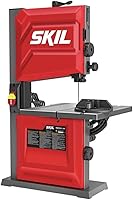
A compact band saw has limits. The WEN 9-Inch Band Saw, for example, cuts up to 3-1/2 in. deep and 9 in. wide, which sets a clear boundary for the stock you can feed through it.
Which saw is better for sheet cutting and ripping?
A table saw is generally the better fit for straight sheet cutting and ripping. Its fence and table give you a direct way to guide a panel or board along a straight path.
Full sheets can be awkward to handle on a small table, even when the saw's rip capacity is sufficient. Use infeed and outfeed support that keeps the panel level, and get help handling large or heavy sheets when needed.
A 24.5 in. rip capacity, such as the DEWALT's, describes the distance available for ripping alongside the blade. It doesn't mean the saw table alone supports an entire 4x8 sheet.
A band saw is not the usual first choice for sheet breakdown. Its table and cutting path are better suited to feeding manageable stock than controlling a large flexible panel.
If you don't have the space or support for a full sheet, a circular saw and guide can be a more manageable way to break it down first. Our guide to what separates a circular saw from a table saw compares those setups.
Which saw handles curves and resawing?
A band saw handles curves and resawing better because its blade can follow a curved line and cut through taller stock. Check capacity before planning either job.
Draw the curve clearly and feed the work at a steady pace without forcing a tight turn. For a very small radius, blade width matters: a narrower blade can turn more sharply, but the correct blade also depends on the cut and saw.
Resawing requires enough cutting height for the board and a blade suited to the job. The WEN's 3-1/2 in. depth gives you a specific limit, while its blade options range from 1/8 to 3/8 in. wide.
A table saw's circular blade can't follow a curve through the work. It can make straight cuts to remove waste around a shape, but that approach doesn't replace a band saw for curved stock.
If you want help choosing a woodworking model, see our guide to the best band saw for woodworking. For a smaller footprint, compare the best benchtop band saws for woodworking.
How do cut quality and accuracy compare?
A table saw is usually easier to set up for consistent straight rips; a band saw is more flexible for shaped cuts. Accuracy depends on setup, blade condition, stock support and how you feed the work.
A table saw's fence gives you a repeatable reference for parallel cuts. Check that the fence is aligned as the manufacturer directs, and use the right blade and feed rate for the material.
A band saw can leave a rougher edge after a curved or resaw cut, especially if the blade wanders or the feed is uneven. Plan to leave a little cleanup allowance when the final edge needs to be smooth or exact.
Neither tool guarantees a finished surface straight off the blade. Sanding or planing may be part of the process, depending on the cut and the project.
Which saw fits a small workshop?
A compact table saw favors straight-cut work, while a benchtop band saw can take less floor space and add curve-cutting ability. Measure storage and working clearance, not just the tool's footprint.
The DEWALT table saw is described as compact for transport and storage, with on-board storage for key accessories. The SKIL model has folding legs, which can help you store the saw between jobs.
A benchtop band saw still needs a stable bench and enough room to guide stock around the blade. Its smaller size does not make every board or curve manageable.
If you make mostly trim and angle cuts, a miter saw may fit better into your workflow. Read our comparison of miter saw vs band saw for the kinds of cuts each tool handles.
What should you consider before buying either saw?
Choose by your most common cut, the stock dimensions and the space required to support the work. A tool's headline capacity matters only if your materials fit and you can guide them safely.
For a table saw, check rip capacity, blade size, fence adjustment, stand or storage needs, and how you will support wide panels. A 10 in. blade is not by itself a measure of the width or length of stock the saw can handle.
For a band saw, check cutting height, throat width, blade length and supported blade widths. If resawing matters, use the stated cutting height as a firm planning limit rather than assuming the motor can handle any board that fits.
Power and portability also matter. The DEWALT and SKIL table saws are corded, while the Milwaukee band saw is cordless and intended for cutting stock such as pipe; it is a different tool format from a woodworking band saw.
If you need to crosscut boards at set angles, see how a miter saw differs from a table saw. If you are choosing between two portable curve-cutting tools, our jigsaw vs band saw comparison can help.
Which table saw or band saw should you choose?
Pick a table saw if sheet breakdown and straight ripping drive your projects; pick a band saw if you need curves or resawing within its capacity. Match the saw to the work you repeat most often.
The DEWALT compact portable table saw fits a buyer looking for a 24.5 in. rip capacity and a compact design. The SKIL adds an integrated folding stand and a 25-1/2 in. rip capacity.
The WEN benchtop band saw fits smaller curve and resawing jobs within its 3-1/2 in. depth and 9 in. width. The Milwaukee cordless band saw suits portable cuts in stock that fits its 3-1/4 in. capacity, rather than replacing a woodworking band saw.
A hand saw can also handle some straight cuts without a powered setup. Compare it with a circular saw in our guide to hand saw vs circular saw, then choose the tool that suits your material, workspace and cut list.
Frequently asked questions
Is a table saw a band saw?
No. A table saw uses a circular blade that rises through a flat table, while a band saw uses a continuous blade running around wheels.
A table saw is built for guided straight cuts; a band saw handles curves and can resaw stock within its capacity.
Can a band saw rip boards?
Yes, a band saw can make straight cuts with a fence, and some models can resaw boards. Its cut may need cleanup, and capacity depends on the saw's throat width and cutting height.
For repeated, accurate rips, a table saw is usually the more direct choice.
Can a table saw cut curves?
A table saw is designed for straight cuts, not curves. Don't steer a board sideways into the blade to make a curved cut.
Use a band saw for curves, or a jigsaw when the workpiece is too large or awkward for your band saw.
Which saw is better for plywood?
A table saw is generally better for ripping plywood into straight strips, if the sheet can be supported safely. A band saw is not designed to handle large sheet goods in the same way.
For crosscuts, consider a circular saw with a guide or another suitable setup.
Can a benchtop band saw resaw lumber?
A benchtop band saw can resaw lumber that fits its cutting height and throat capacity, but those limits may rule out wide or thick stock. Check the exact capacity and use a suitable blade and setup.
For example, the WEN 9-Inch Band Saw cuts up to 3-1/2 in. deep and 9 in. wide.