9 Best Flush Cut Saws for Woodworking (November 2026)
The best Japanese flush cut saws for woodworking include the SUIZAN Flush Cut Saw 5" for scratch-free surface trimming, the RUITOOL Japanese Hand Saw 6 Inch Double for double-edge versatility, and the GARTOL Hand Saw for Wood Cutting for a two-saw starter set.
On this page (9 sections)
- Best Japanese flush cut saws for woodworking
- What should a flush cut saw do?
- How do these Japanese pull saws compare?
- Which flush cut saw fits your woodworking job?
- How do you use a flush cut saw without scratching wood?
- Does wood grain direction change the cut?
- What if you need to cut metal or concrete flush?
- How should you finish the trimmed surface?
- Which is the best flush cut saw for woodworking?
The best flush cut saw for woodworking is the SUIZAN Flush Cut Saw 5" for trimming dowels, plugs and joinery beside a finished surface. Its no-set teeth and flexible blade are made to lie flat, while the double-edge RUITOOL is a useful alternative if you want two tooth patterns.
A flush cut is a close trim, not a rough cut. The goal is to remove the part that stands proud without marking the board around it.
These picks include dedicated Japanese flush cut saws and broader Japanese pull saws that can also handle finishing cuts. If you need a powered tool for larger jobs, compare our guide to the best flush cut power saw.
Best Japanese flush cut saws for woodworking
The best Japanese flush cut saw for most close trimming is the SUIZAN, while the other saws fit buyers who want multiple tooth patterns, replaceable blades or a set. We compared their stated blade features and how directly they suit dowels, plugs and joinery.
The score weighs specs, features and buyer feedback against what you're shopping for.
Our picks at a glance
-
1

-
2
 Best for double-edge versatility
RUITOOL Japanese Hand Saw 6 Inch Double
9.6/10 our score
See it on Amazon -
3

- 4
 Check it
Temple Tool Co. Japanese Flush Cut Saw
Best for pegs and tenons - 5
 Best for fine cuts in tight spacesCheck it
- 6
 Check it
SUIZAN Ryoba Double Edge Saw 7"
Best for flush cuts and joinery - 7
 Check it
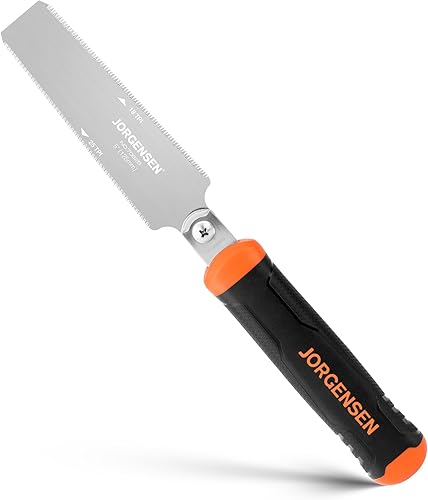
JORGENSEN 5 Inch Double Edge Japanese Flush
Best for replaceable-blade convenience - 8
 Best for longer reachCheck it
- 9
 Check it
Evertools Japanese Hand Saw Set
Best for a three-saw assortment
What should a flush cut saw do?
A flush cut saw should shave down a peg or dowel while its blade lies flat against the surrounding wood. No-set teeth are useful because they do not flare beyond the blade and are designed to cut the excess without scratching the surface.
Blade flexibility also matters. A flexible blade can bend to meet a broad surface, but use only enough pressure to guide it, since force can make a thin blade wander or buckle.
For a close fit, cut the projection in small strokes and stop when it is nearly level. Sand the last trace carefully if the cut leaves a ridge.
How do these Japanese pull saws compare?
The SUIZAN is the clearest match for flush trimming because its maker specifies no-set teeth. Double-edge saws offer more general cutting choices, though their stated features do not all confirm no-set teeth.
| Product | Best for | Blade length | Teeth | Blade | Our score |
|---|---|---|---|---|---|
| SUIZAN Flush Cut Saw 5" | scratch-free surface trimming | 4.72 in | 17 TPI hardwood, 25 TPI softwood | 0.012 in thick, flexible, no-set teeth | 9.7 |
| RUITOOL Japanese Hand Saw 6 Inch Double | double-edge versatility | 6 in | 14 TPI and 17 TPI | Flexible SK5 high-carbon steel | 9.6 |
| GARTOL Hand Saw for Wood Cutting | a two-saw starter set | 9.5 | |||
| Temple Tool Co. Japanese Flush Cut Saw | pegs and tenons | 6 in | 9.3 | ||
| Razorsaw GYOKUCHO SAW | fine cuts in tight spaces | 32 TPI hardwood, 21 TPI softwood | 9.1 | ||
| SUIZAN Ryoba Double Edge Saw 7" | flush cuts and joinery | 7.09 in | 7–11 TPI rip, 19 TPI crosscut | 9.0 | |
| JORGENSEN 5 Inch Double Edge Japanese Flush | replaceable-blade convenience | 5 in | 18 TPI hardwood, 25 TPI softwood | Flexible SK5 steel | 8.8 |
| RUITOOL Japanese Hand Saw | longer reach | 10 in | 6–10 TPI and 18 TPI | 8.3 | |
| Evertools Japanese Hand Saw Set | a three-saw assortment | 8.1 |
Which flush cut saw fits your woodworking job?
Choose by how close the cut must sit to the surface and whether you need the saw for other cuts too. A dedicated flush-cut blade favors careful trimming, while a Ryoba or set can cover more shop tasks.
SUIZAN Flush Cut Saw 5": Best for scratch-free surface trimming
- No-set teeth
- Flexible 0.012 in blade
- 17 TPI and 25 TPI edges
- Beech handle
No-set teeth and a thin, flexible blade suit trimming dowels, plugs and tenon ends flush with wood. Two edges cover hardwood and softwood.
Pros
- No-set teeth help avoid scratching the surface
- Thin blade flexes flat
- Two tooth patterns for different woods
Cons
- Blade is not replaceable
- Made for fine trimming rather than general sawing
The SUIZAN is the most focused option for trimming a dowel or plug without marking the face. Its no-set teeth and thin, flexible blade let it lie flat against the wood while removing the excess.
It has a double edge: 17 TPI for hardwood and 25 TPI for softwood. The 4.72 in blade is compact for tight spots, and the beech handle keeps the saw light at 1.76 oz.
The blade is fixed to the handle and is not replaceable, so this is a simple dedicated tool rather than a system you refresh with replacement blades. It is also intended for wood, not metal, concrete or masonry.
Choose it when scratch avoidance during close trimming is your main concern. For a broader hand-saw choice, see our best Japanese pull saw guide.
RUITOOL Japanese Hand Saw 6 Inch Double: Best for double-edge versatility
- 6 in flexible SK5 blade
- 14 TPI and 17 TPI edges
- Beechwood handle
- Three-sided ground teeth
A flexible, double-edge blade gives you two tooth patterns for different cuts. Its 6 in blade is a practical size for flush and finish cuts.
Pros
- Two edges for different cutting needs
- Flexible blade
- Beechwood handle
Cons
- The flush-cut feature is not described with no-set teeth
- Longer blade than the compact 5 in options
The RUITOOL has a 6 in flexible SK5 blade with two edges, one at 17 TPI and the other at 14 TPI. That gives you a flush-cut option alongside another tooth pattern for woodworking tasks.
Its beechwood handle and double-edge layout suit a buyer who wants one saw for finish cuts and general hand sawing. The maker describes the blade as hardened and three-sided ground, but does not specify no-set teeth.
Choose it if flexibility across cut types matters more than a stated no-set design. Use a light pull stroke and keep the blade level near a finished face.
GARTOL Hand Saw for Wood Cutting: Best for a two-saw starter set
- Includes a 6 in flush-cut saw
- Includes a double-edge Ryoba saw
- SK5 steel blades
- Wooden handles
This two-piece set pairs a flush-cut saw with a Ryoba saw for rip and crosscuts. It suits buyers who want a dedicated trimming saw plus a general woodworking saw.
Pros
- Includes separate flush-cut and Ryoba saws
- SK5 steel blades
- Wooden handles
Cons
- You need space for two saws
- The flush-cut saw's tooth count is not specified
The GARTOL set includes a 6 in flush-cut saw and a double-edge Ryoba, so you have a dedicated tool for trimming plus another for rip and crosscuts. Both saws have SK5 steel blades and wooden handles.
This pairing can make sense for a new woodworking setup or a toolbox that lacks a separate flush saw. The flush-cut blade is described as flat and suited to trimming dowels and tenons, though its tooth count and no-set status are not specified.
Choose it if you can use both saws. If you only need to trim pegs and joinery, a dedicated flush-cut saw takes up less space.
Temple Tool Co. Japanese Flush Cut Saw: Best for pegs and tenons
- 6 in double-edge pull saw
- For pegs, wedges and tenons
- Beechwood handle with brass components
- Japanese steel
This Japanese flush cut saw is designed for trimming pegs, wedges and tenons beside an adjacent surface. Its double-edge design gives you two cutting edges.
Pros
- Purpose-built for flush trimming joinery
- Double-edge blade
- Beechwood handle with brass components
Cons
- Tooth counts are not specified
- Blade replacement details are not specified
Temple Tool Co. describes this 6 in double-edge pull saw for trimming pegs, wedges, dowels and tenons beside a surface. Its beech handle has brass components, and the blade is made from Japanese steel.
The stated use is a close match for joinery work, from cutting a protruding peg to bringing a tenon end flush. The available details do not specify tooth counts or whether the blade can be replaced, so focus your choice on its stated trimming purpose and handle materials.
Choose it when a purpose-built Japanese flush cut saw and a wood-and-brass handle suit your shop. Keep the blade flat and take care around finished faces.
Razorsaw GYOKUCHO SAW: Best for fine cuts in tight spaces
- 5 in blade
- 32 TPI and 21 TPI edges
- Thin, flexible blade
- Beechwood handle
The compact, thin blade is designed for clean flush cuts and fine cuts in narrow material. Its two edges have different tooth counts for hardwood and softwood.
Pros
- Compact 5 in blade
- Two tooth patterns
- Thin, flexible blade
Cons
- The maker's thickness descriptions conflict
- Tooth edges are described as crosscut teeth
The Razorsaw GYOKUCHO is a compact 5 in double-edge saw with 32 TPI for hardwood and 21 TPI for softwood. Its thin, flexible blade is designed for flush cuts and fine cuts in narrow material.
This size can help when larger saws feel awkward around small joinery. The handle is beechwood, and the teeth are impulse hardened.
One detail needs care: the provided descriptions conflict on blade thickness, so this comparison leaves that measurement out. Choose this saw for its stated compact size and two tooth patterns instead.
SUIZAN Ryoba Double Edge Saw 7": Best for flush cuts and joinery
- 7.09 in blade
- Rip and crosscut edges
- 0.02 in blade thickness
- Replaceable blade
This Ryoba is a general woodworking saw with rip and crosscut edges, so it can handle more than flush trimming. Choose it when joinery and board cuts matter too.
Pros
- Separate rip and crosscut edges
- Replaceable blade
- Narrow kerf
Cons
- Not described as a no-set flush-cut saw
- Larger than compact flush-trimming models
The SUIZAN Ryoba is for buyers who need a general Japanese pull saw alongside fine woodworking cuts. One edge has rip teeth at 7–11 TPI, and the other has 19 TPI crosscut teeth.
Its 7.09 in blade and 0.03 in kerf suit joinery, trim and small board cuts. The blade is replaceable, which gives you a way to refresh the cutting edge when it becomes difficult to use.
This is not described as a no-set flush-cut saw, so it is less purpose-built for shaving a dowel beside a finished surface. Choose it when rip and crosscut work matters as much as detail cutting.
JORGENSEN 5 Inch Double Edge Japanese Flush: Best for replaceable-blade convenience
- 5 in flexible SK5 blade
- 18 TPI and 25 TPI edges
- Replaceable blade
- Non-slip handle
A short double-edge blade and replaceable design make this a compact option for finish cuts. It has separate tooth counts for hardwood and softwood.
Pros
- Replaceable flexible blade
- Two tooth patterns
- Non-slip handle
Cons
- No-set teeth are not specified
- Blade thickness is not specified
JORGENSEN pairs a 5 in flexible SK5 blade with 18 TPI and 25 TPI edges for hardwood and softwood. The blade is replaceable, and the handle has a non-slip surface.
The short blade suits precise finish cuts, including trimming raised tenons. The maker says it cuts smoothly without scratching the surrounding surface, but no-set teeth are not specified.
Choose it if you want a compact Japanese-style flush saw with a replaceable blade. If the surface is already finished, guide the blade carefully and avoid pressing it into the board.
RUITOOL Japanese Hand Saw: Best for longer reach
- 10 in blade
- Flexible SK5 steel
- 6–10 TPI and 18 TPI edges
- Replaceable blade
The longer blade can serve broader woodworking cuts as well as flush-cut tasks. Its two tooth patterns cover rougher and finer work.
Pros
- Longer blade for broader cuts
- Two tooth patterns
- Replaceable blade
Cons
- Less compact for small joinery
- No-set teeth are not specified
The RUITOOL 10 in saw offers more blade length for broader jobs than the compact flush-cut models. Its flexible SK5 blade has a coarse edge that changes from 6–10 TPI and a finer 18 TPI edge.
That range can cover rough, semi-fine and fine cuts, and the blade is described as replaceable. The longer blade may feel less convenient when trimming a small dowel close to a finished face.
Choose it if you want a longer Japanese pull saw that can also handle flush-cut tasks. For a dedicated flush trim, a short blade is easier to guide near the surface.
Evertools Japanese Hand Saw Set: Best for a three-saw assortment
- 6 in flush-cut saw
- 6 in double-edge Ryoba
- 8 in pruning saw
- SK5 high-carbon steel
This set combines a flush-cut saw and Ryoba with a pruning saw for light branch cutting. It suits buyers who can use all three tools.
Pros
- Three saws for different jobs
- Includes a dedicated flush-cut saw
- SK5 high-carbon steel blades
Cons
- Includes a pruning saw that may not suit a woodworking-only shop
- Flush-saw tooth details are not specified
The Evertools set combines a 6 in flush-cut saw, 6 in Ryoba and 8 in pruning saw. Its SK5 high-carbon steel blades cover woodworking, trim and light branch cutting.
This set fits a shop that has use for all three tools, including a pruning saw. For furniture joinery alone, the pruning blade may add a tool you do not need, and the flush-cut saw's tooth details are not specified.
Choose it for an assortment of Japanese pull saws rather than one specialized cutter. Check that the set’s three roles match the work you actually do.
How do you use a flush cut saw without scratching wood?
Keep the blade flat against the surface and use light strokes to remove only the projection. The SUIZAN’s no-set teeth are designed for this close trimming, but control still matters.
Start the cut with a few short pulls so the teeth establish a path. Let the saw do the work, then lengthen the stroke when it moves freely.
Japanese pull saws cut on the pull stroke, so pull gently and relax on the return. Our guide on how to use a Japanese pull saw covers grip and stroke control.
Does wood grain direction change the cut?
Yes, grain direction affects how wood fibers separate and how clean the cut looks. A crosscut passes across the grain, while a rip cut follows it, and each may respond differently to tooth shape and stroke.
For a dowel or peg, begin with a light cut and watch for tear-out at the edge. Read how wood grain direction affects a saw cut if the cut follows or crosses visible grain.
What if you need to cut metal or concrete flush?
Wood flush saws are meant for wood, so use a tool made for the material when trimming metal or concrete. A hand saw with wood-oriented teeth is not a substitute for a metal cutting blade or masonry tool.
For metal work, compare a flush cut saw for metal. For concrete surfaces, our guide to choosing a flush cut concrete saw covers the different tool needs.
How should you finish the trimmed surface?
A light sanding can remove a small ridge after sawing, but keep the abrasive flat so you do not round the surrounding face. A sanding block gives more control on a small joinery surface than pressing loose paper with a fingertip.
Match the abrasive to the wood and finish, and begin gently. Our guide to different types of sanders explains common sanding tools and uses.
Which is the best flush cut saw for woodworking?
Choose the SUIZAN Flush Cut Saw 5" if the priority is trimming dowels, plugs and joinery close to finished wood, since its no-set teeth and flexible blade are designed for that work. Pick the RUITOOL double-edge saw for more tooth-pattern options, or the GARTOL set if you need a separate Ryoba too.
For a longer blade and broader cuts, the 10 in RUITOOL is the more versatile shape. If you cut other materials, choose the matching metal or concrete tool rather than asking a woodworking saw to do that job.
Our top 3 picks at a glance
-
1
-
2
Best for double-edge versatility
RUITOOL Japanese Hand Saw 6 Inch Double
9.6/10 our score
See it on Amazon -
3
Frequently asked questions
What is a flush cut saw used for?
A flush cut saw trims material that sticks above a finished wood surface, such as dowels, plugs, pegs and tenon ends. A thin blade can lie flat against the work while the teeth remove the excess.
Choose a saw with no-set teeth when avoiding scratches matters, and keep the blade level as you cut.
Is a Japanese flush cut saw a pull saw?
Yes. Japanese flush cut saws generally cut on the pull stroke, which keeps the blade in tension as you draw it toward you.
Use light pressure on the pull and ease off as you return the blade.
See how a pull saw differs from a push saw for the basic cutting action.
Can a flush cut saw scratch wood?
It can if the teeth project beyond the blade or if the blade tilts into the surface. A no-set saw has teeth that do not flare sideways, which helps trim close without scratching the work.
Keep the blade flat and let the teeth cut with light strokes.
Should I sand after flush cutting a dowel?
Often, a light sanding removes a small remaining ridge or evens the cut surface. Start with a fine abrasive and use a flat sanding block so you don't round the surrounding wood.
Choose an abrasive suited to the finish and material; our guide to different types of sanders covers the options.
How do I choose a Japanese pull saw flush cut blade?
Match the saw to the wood and the job. A compact, flexible blade with no-set teeth suits close trimming beside a finished face, while a double-edge Ryoba adds tooth patterns for other woodworking cuts.
Check whether the blade is replaceable if you expect to use the saw often.


